G5, G6 - Triangle congruence and geometrical arguments
Two triangles can match exactly even when one is turned or reflected. You will decide when their information guarantees a match, then use congruence, angle facts and similarity to explain triangle and quadrilateral properties and prove Pythagoras' theorem.
Tests for congruent triangles
Could four identical right triangles explain why ? By the end, you will use their areas to prove a result for every right triangle.
You already know
Equal sides of an isosceles triangle face equal angles. Angles in a triangle total ; parallel sides give equal alternate angles.
Congruent figures have the same shape and size. One may need moving, turning or reflecting to fit the other. Writing matches to , to , to ; thus , , .
| Test | Information that guarantees congruence | Why it fixes a triangle |
|---|---|---|
| SSS | Three corresponding sides equal | Two fixed-radius arcs locate the third vertex, up to reflection. |
| SAS | Two corresponding sides and their included angle equal | The angle fixes two rays and the lengths fix their endpoints. |
| ASA | Two corresponding angles and a corresponding side equal | The third angle follows, and the side fixes the size. |
| RHS | Right angles, equal hypotenuses and one other corresponding side equal | The right angle and two matched lengths fix the triangle. |
For ASA, the side can be between the angles or opposite matching angles: the third angle follows from . For RHS, identify the side opposite the right angle as the hypotenuse in each triangle. These congruence tests are not on the formula sheet: learn them.
Worked example 1: the included angle
Question. , , and . Explain why triangles are congruent and name the side equal to .
Plan. List the matching information, checking that the angle lies between the known sides.
Why SAS? The angle is where the two specified sides meet in each triangle.
Answer. The triangles are congruent by SAS, so , corresponding sides.
Check. The vertex match , gives the same side pair.
Change only the included angle from to in both triangles. The test should still apply.
Worked example 2: a different included angle
Question. , , and . Prove .
Plan. Establish congruence before claiming the unknown sides equal.
Why prove congruence first? The unknown sides are a consequence, not part of the given evidence.
Answer. , as required.
Check. Changing the shared angle changes the triangles, but both still have the same two lengths and included angle as each other.
ASA offers a different route. If , angles at are and at are , then the third angles are . ASA gives , hence , .
AAA establishes similarity, with equal angles and proportional sides, but not necessarily equal size: equilateral triangles of sides 3 and 6 both have three angles. SSA is not a general congruence test. Fix , , and : a radius-4 circle about crosses the ray from twice, giving two possible triangles. RHS handles the special right-angle case.
Watch out
Wrong: “Two sides and an angle are equal, so SAS.” The angle must be included between those two sides. With a non-included angle, two different triangles may fit. Name the sides and their meeting vertex before choosing SAS.
This time the supplied angle has moved away from the meeting point of the known sides.
Why isosceles base angles are equal
A proof explains why equal base angles follow from equal sides, without relying on a perfectly symmetrical sketch.
Let . Bisect the apex angle at , meeting at . The two smaller triangles have equal outer sides, common , and equal included half-apex angles. They are congruent by SAS. Their corresponding base angles are equal; corresponding base halves are equal too. Their equal adjacent angles at total , so each is .
[DIAGRAM: asset_name: Congruence derivation in an isosceles triangle; asset_slug: 1ma1_m48_isosceles; caption: Bisecting the apex creates two SAS-congruent triangles and proves the base-angle and midpoint properties.; description: Isosceles triangle ABC has AB and AC marked equal and apex bisector AD. Equal half-apex angles are marked, and D lies on BC. Two lightly filled matching halves identify triangles ABD and ACD; a right-angle square and equal base-half ticks show the derived results.]
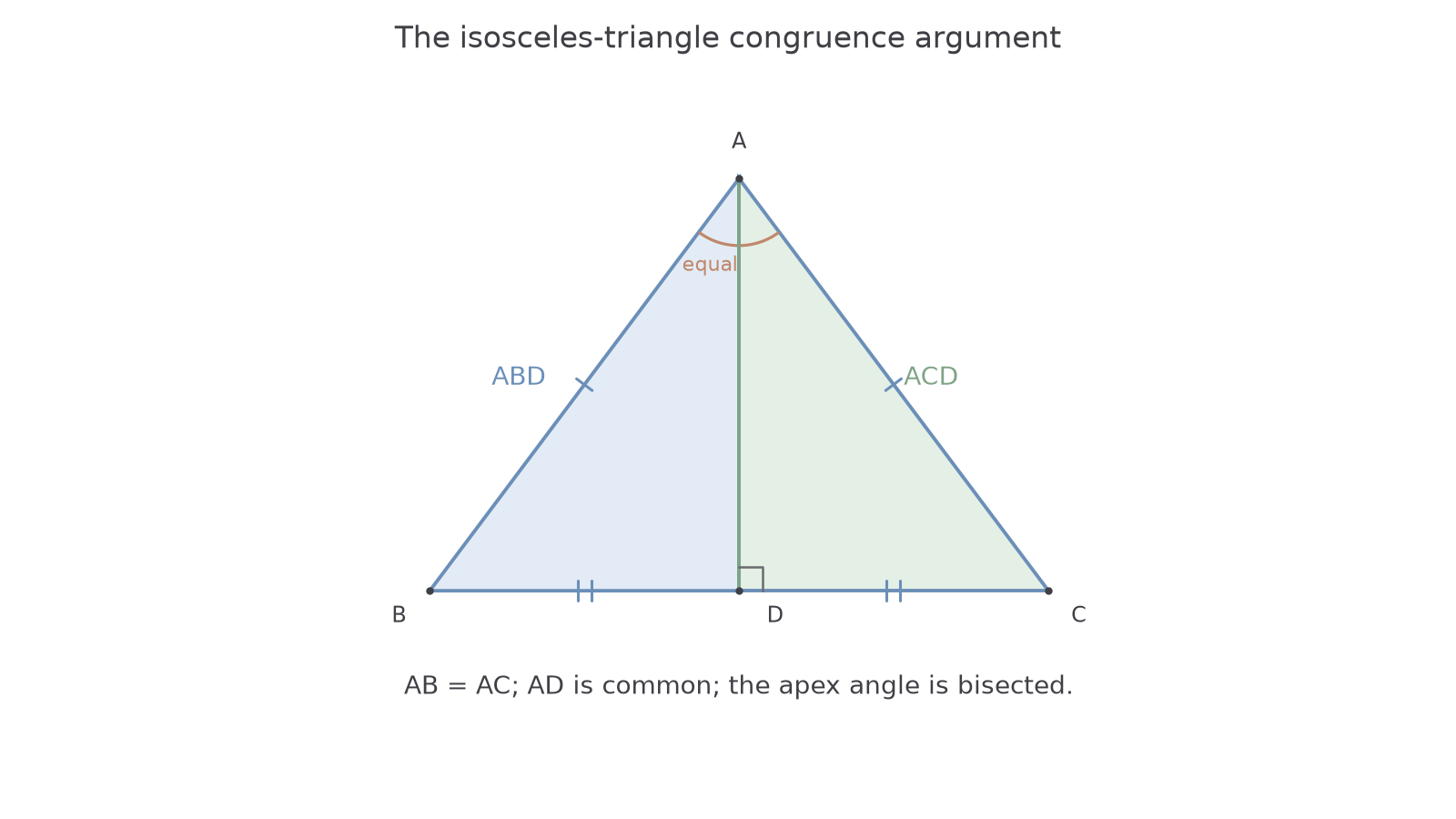
The diagram records the conclusions as well as the starting information. In a proof, state which facts you were given and which you deduced. The isosceles base-angle result is not on the formula sheet: derive it from SAS congruence when a proof is requested.
Worked example 3: starting with an angle bisector
Question. , and bisects , with on . Prove .
Plan. Compare with using the included half-apex angles.
Why not assume is the midpoint? That is exactly what the proof must establish.
Answer. , so is the midpoint of .
Check. The matching order sends to , giving the intended base halves.
Change only the condition defining : it is now given as the midpoint instead of the point where the apex bisector meets the base. The congruence test changes.
Worked example 4: starting with a midpoint
Question. , and is the midpoint of . Prove that bisects .
Plan. Use three side pairs to prove congruence, then match apex angles.
Why SSS rather than SAS? We now know the base halves, but have not yet established equal apex angles.
Answer. bisects the apex angle.
Check. The conclusion uses an angle pair at , the required vertex.
The converse base-angle result also holds: two equal triangle angles imply equal opposite sides. Compare the triangle with its reversed vertex order; the equal angles and shared intervening side give ASA. Thus base angles imply equal opposite sides and apex angle . Given equal sides and apex angle , each base angle is .
Watch out
Wrong: “, and looks central, so .” An unmarked line need not bisect anything. Give a construction or midpoint condition, then use congruence to derive the remaining properties.
Use the midpoint information again, with new labels, to prove another consequence of the same congruence.
Continue this lesson.
You’re previewing NovaLearn without an account. Create a free account to read the rest.
Create free account