G7, G8 - Negative enlargements and combined transformations
A negative enlargement reverses the direction from its centre. You will construct these images, follow transformations in order, and use unchanged properties to describe a combination as one transformation when that is possible.
Enlargements with negative scale factors (Higher)
Can an enlargement make a triangle smaller and put it on the other side of its centre? Try the scale factor : the fraction controls size and the minus sign controls direction.
You already know
An enlargement needs a centre and a scale factor. Corresponding vertices lie on lines through the centre. A positive factor keeps each image vertex on the same ray from the centre.
Take and . From to , move 4 right and 2 up. Multiplying this movement by gives 2 left and 1 down. Starting that new movement at reaches .
Negative enlargement
An enlargement with scale factor places each image point on the opposite ray from the centre, at times its original distance. Corresponding side lengths multiply by ; physical lengths do not become negative.
For a centre away from the origin, work with the movement from the centre, rather than multiplying the point's coordinates directly.
Centre-relative enlargement
For centre , point and non-zero scale factor ,
Subtract the centre coordinates, multiply both movements by , then add the centre coordinates back.
Not on the formula sheet: learn it.
The first example makes the three stages visible.
Worked example 1: a negative fractional factor
Question. Enlarge by scale factor about .
Plan. Find the movement from , reverse and halve it, then start that movement at .
Why this step? The scale factor multiplies a movement from , so the final addition must return to that same centre.
Answer. .
Check. The movements and have opposite directions, and the second has half the length.
The next example changes only the scale factor, from to . The original point and centre stay fixed.
Worked example 2: a negative integer factor
Question. Enlarge by scale factor about .
Plan. Use the same centre-relative movement, this time reversing and tripling it.
Why this step? A negative integer changes direction just as a negative fraction does; its magnitude now makes the image larger.
Answer. .
Check. , so lies between the original and image, with the required distance ratio.
To construct a whole polygon on paper, draw a line through the centre and each vertex. Extend each line through the centre. Mark the new distance on the opposite ray, then join the corresponding image vertices in order. Use a ruler and check every vertex, rather than moving a triangle of the right size into an estimated position.
[DIAGRAM: asset_name: Negative integer and fractional enlargements; asset_slug: 1ma1_m50_negative_enlargements; caption: Negative factors use the opposite ray; the magnitude sets the side-length multiplier.; description: Two coordinate panels use centre O(1,1) and triangle A(2,2), B(4,2), C(2,4). Factor minus 1 gives A'(0,0), B'(-2,0), C'(0,-2); factor minus one half gives A'(0.5,0.5), B'(-0.5,0.5), C'(0.5,-0.5). The centre lies between corresponding vertices.]
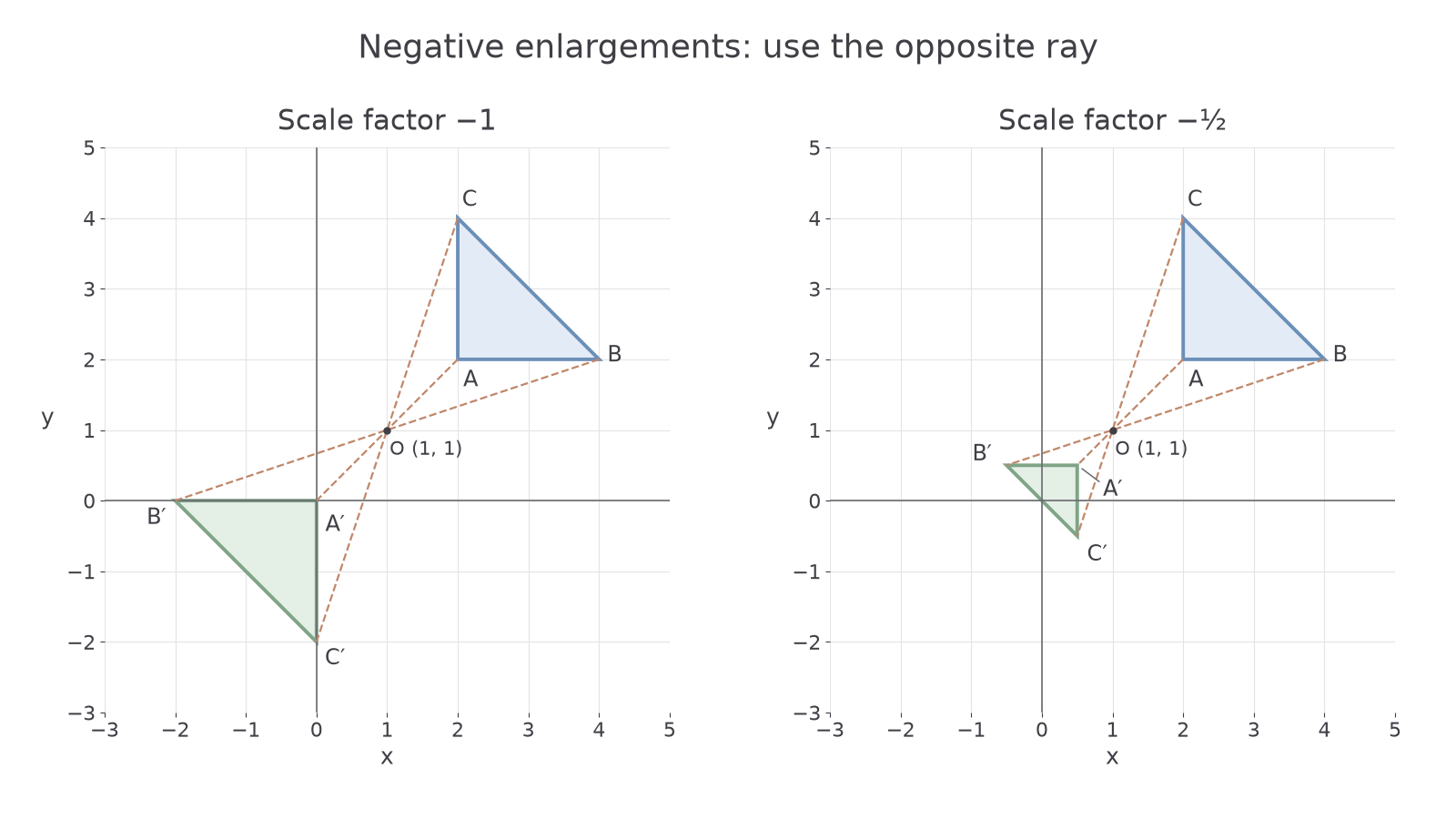
To describe an unknown negative enlargement, join corresponding vertices to locate the centre. Divide an image side length by its original length to find , then use the opposite-ray positions to choose the negative sign. Give both the signed factor and the centre.
Watch out
Wrong: for centre . That multiplies positions measured from the origin. Right: subtract , multiply the resulting movement, then add , giving .
A negative enlargement has the same effect as a positive enlargement of factor followed by a half-turn about the same centre. In particular, factor is exactly a rotation: it changes position but keeps size. Angles and vertex order around the polygon are preserved. Factor zero would collapse the polygon to a point, so it would not produce a similar polygon.
For your turn, change only the factor once more.
Following transformations in order (Higher)
The second transformation acts on the image made by the first, so record an intermediate point before making the next move.
Write . Keep a stated mirror line or rotation centre in its original coordinate position unless told otherwise. The moving shape does not carry the next centre with it.
You already know
Reflection in the -axis sends to . Translation by then adds horizontally and vertically.
These coordinate rules are not on the formula sheet: learn them. Test the order on one point before constructing every vertex.
Worked example 3: reflection and translation
Question. Reflect in the -axis, then translate by . Compare with the reverse order.
Plan. Write a separate two-stage chain for each order.
Why this step? Reflecting after translating reverses the new horizontal position, including the translation.
Answer. The final points are and , so the order matters.
Check. Both final points have vertical coordinate 2: neither move changes height.
The next example changes only the translation's horizontal component, from 3 to 4.
Worked example 4: changing the translation
Question. Reflect in the -axis, then translate by . Compare with the reverse order.
Plan. Apply each second move to its own intermediate image.
Why this step? The reflection is still in the fixed line , not in a line moved along with the point.
Answer. The final points are and .
Check. Increasing the translation by 1 moves the first answer 1 right and the reversed-order answer 1 left.
The picture tracks the same idea for all three vertices of a triangle.
Continue this lesson.
You’re previewing NovaLearn without an account. Create a free account to read the rest.
Create free account