G20 - Pythagoras and trigonometry in three dimensions
A solid can hide a familiar triangle. You will learn to choose a flat section through a cuboid or pyramid, calculate spatial lengths in stages, and identify the angle between a line and a plane or between two lines. The triangle methods stay the same; choosing the correct triangle is the new skill.
Finding the correct triangle inside a solid (Higher)
Will a straight rod fit completely inside a cuboid measuring by by ? No edge is long enough, so look for a triangle containing the longest corner-to-corner diagonal.
You already know
Pythagoras applies only to a right triangle. The sine and cosine rules work in general triangles. Any three points that are not on one line determine a flat triangle, even if the points belong to a solid.
Let be opposite base corners of the cuboid, and the upper corner directly above . The base triangle gives . Triangle contains the base diagonal, the vertical height and the body diagonal. Since is perpendicular to the base plane, it is perpendicular to , which passes through its foot . The right angle is at .
[DIAGRAM: asset_name: A right triangle inside a cuboid; asset_slug: 1ma1_m61_cuboid; caption: The body diagonal is the hypotenuse of a triangle with base diagonal ten and vertical height five.; description: Cuboid with base dimensions 6 cm by 8 cm and height 5 cm. Base corners A and C are opposite, G lies directly above C, and the highlighted section ACG has AC 10 cm, CG 5 cm and body diagonal AG.]
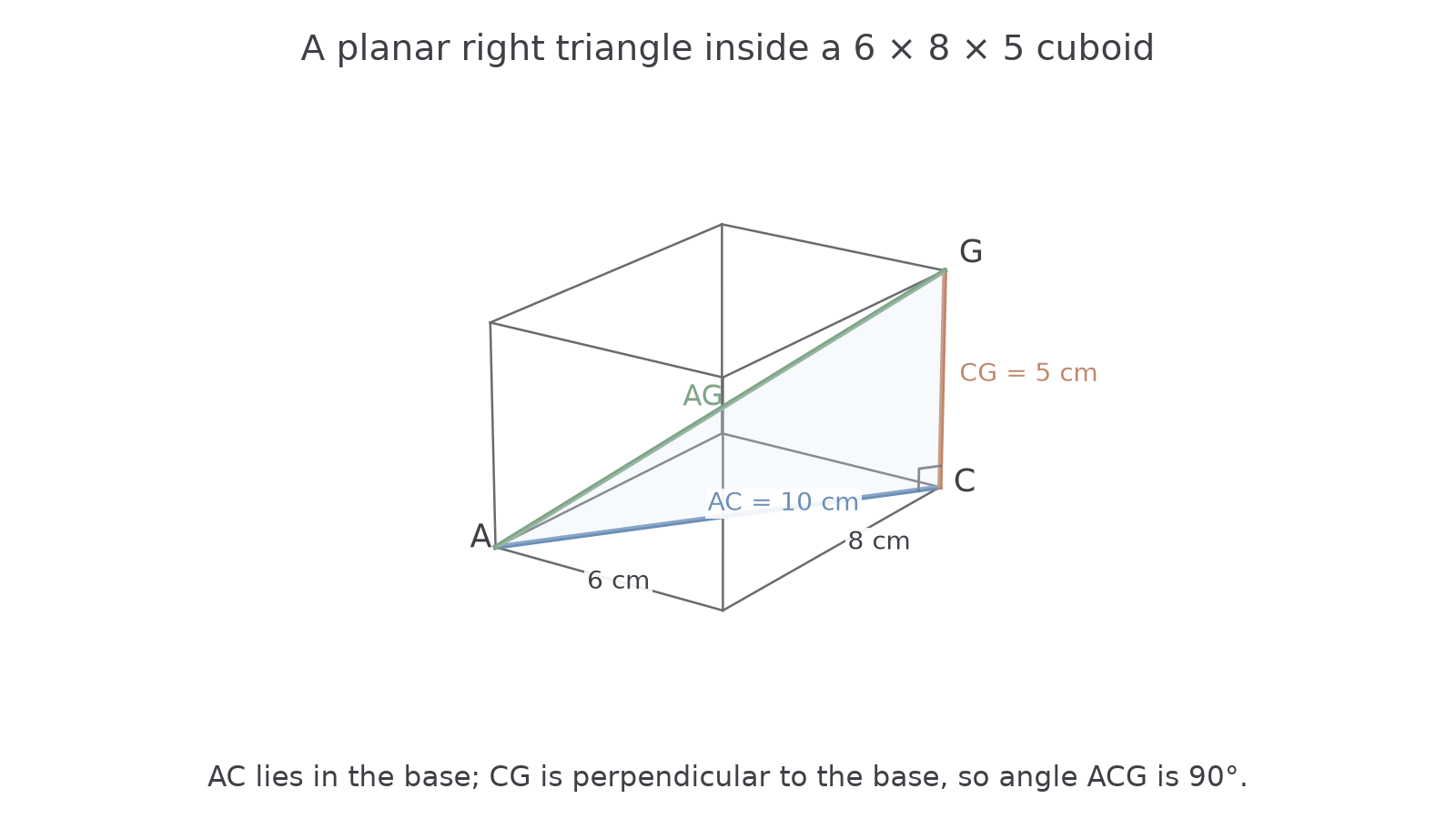
A perspective drawing can make right angles look slanted, and unrelated lines look perpendicular. Use stated geometry, not a measurement from the picture. It often helps to redraw your chosen triangle on its own.
A right square-based pyramid has its apex directly above the base centre . A face slant height ends at a base-side midpoint ; a sloping edge ends at a corner . These use different horizontal distances.
[DIAGRAM: asset_name: Two pyramid sections; asset_slug: 1ma1_m61_pyramid_sections; caption: The face slant height ends at M, but the sloping edge ends at V; both sections use the vertical height TO.; description: Oblique projection of a right square-based pyramid with base side 6 cm and perpendicular height TO 4 cm. M is the midpoint of a base side and V is its corner. Distinct highlighted segments show face slant height TM, sloping edge TV, perpendicular height TO and the different horizontal distances OM and OV. A projected right-angle mark at O identifies triangle TOM as right angled.]
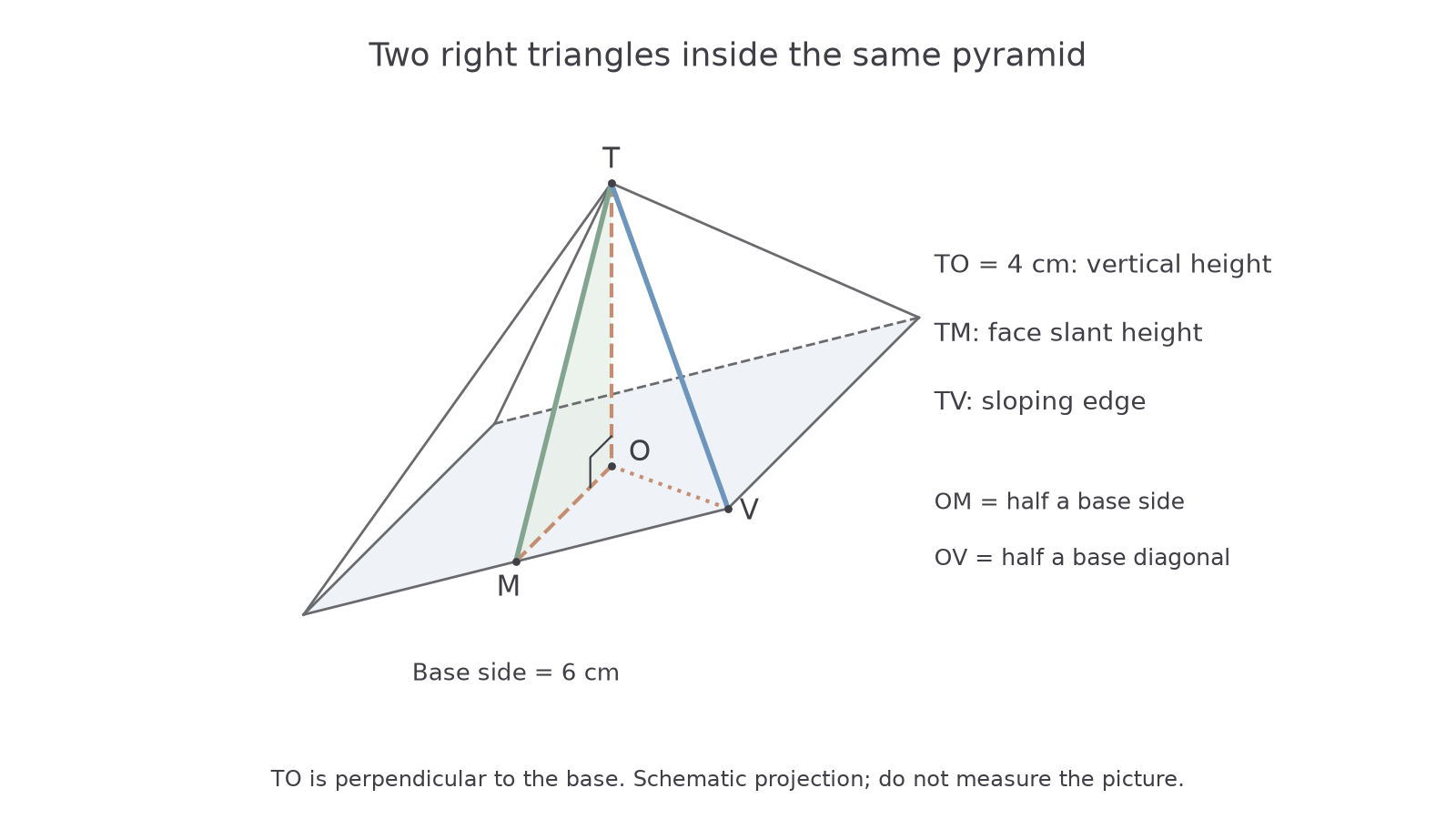
Worked example 1: selecting the face-height section
Question. A right square-based pyramid has base side and perpendicular height . Which triangle gives its face slant height ? Find its two perpendicular sides.
Plan. Join the apex to the base centre and the midpoint of a base side.
Why end at ? The perpendicular height of the triangular face meets the midpoint of its base edge, because that face is isosceles.
Answer. Use right triangle , with legs and , and hypotenuse .
Check. The vertical height ends at ; the face height ends at . They are different segments.
Change only the requested segment: find the sloping edge to a corner instead of the face height. The solid and its dimensions stay fixed.
Worked example 2: selecting the corner-edge section
Question. For the same -base pyramid with height , which triangle gives the sloping edge ? Find its two perpendicular sides.
Plan. Use the apex, base centre and corner; calculate the centre-to-corner distance in the square base.
Why use two half-sides? The route from the square's centre to a corner changes both base coordinates.
Answer. Use right triangle , with legs and , and hypotenuse .
Check. , so the corner is farther from the centre than the side midpoint is.
Choosing the endpoint correctly prevents a calculation that is accurate but answers the wrong question.
Watch out
Wrong: use for the corner-edge section. This is the centre-to-side distance, so it gives the face height instead. Correct: , then use triangle .
Try the corner section with only the base-side length changed.
Calculating spatial lengths in stages (Higher)
A length missing from one triangle can be found first in another triangle. Start in the base, then move into the vertical section.
Pythagoras' theorem
In a right triangle with perpendicular sides and hypotenuse ,
On the formula sheet (2026 version; the 2027 sheet will have the same content).
This is a two-dimensional rule. Using it twice explains why three squared edge lengths appear in a cuboid calculation.
Worked example 3: the longest cuboid diagonal
Question. Find the body diagonal of the opening by by cuboid. Give an exact answer and decide whether the rod fits.
Plan. Find the base diagonal , then use right triangle .
Why use , rather than or ? The body diagonal projects onto the whole base diagonal.
Answer. . The straight rod fits along it.
Check. , so the unrounded comparison confirms the fit.
Change only the cuboid height to . The base diagonal is still .
Continue this lesson.
You’re previewing NovaLearn without an account. Create a free account to read the rest.
Create free account