G20, G21 - Right-angle trigonometry and exact values
Trigonometry connects an angle in a right-angled triangle to ratios of side lengths. You will choose sine, cosine or tangent to find sides and angles, derive exact special-angle values, and calculate heights and distances from observations.
Opposite, adjacent and hypotenuse
You stand from a vertical tower, with your eyes above level ground. Looking above the horizontal, you see its top. How can you find the tower's height without climbing it?
You already know
The hypotenuse lies opposite a right angle. Right triangles with the same acute angle are similar, so corresponding side ratios stay equal even when the triangles have different sizes.
Choose an acute angle . The opposite side does not touch that angle. The adjacent side touches it but is not the hypotenuse. Both the adjacent side and hypotenuse touch , so “next to the angle” does not identify a side by itself.
[DIAGRAM: asset_name: Relative side names in a right triangle; asset_slug: 1ma1_m59_relative_sides; caption: Changing the chosen acute angle exchanges opposite and adjacent; description: A right triangle has angle theta at the lower-left vertex, opposite side on the vertical right edge, adjacent side on the horizontal bottom edge and hypotenuse on the sloping edge. The other acute angle phi is at the upper-right vertex, with a note that the two leg names exchange for phi.]
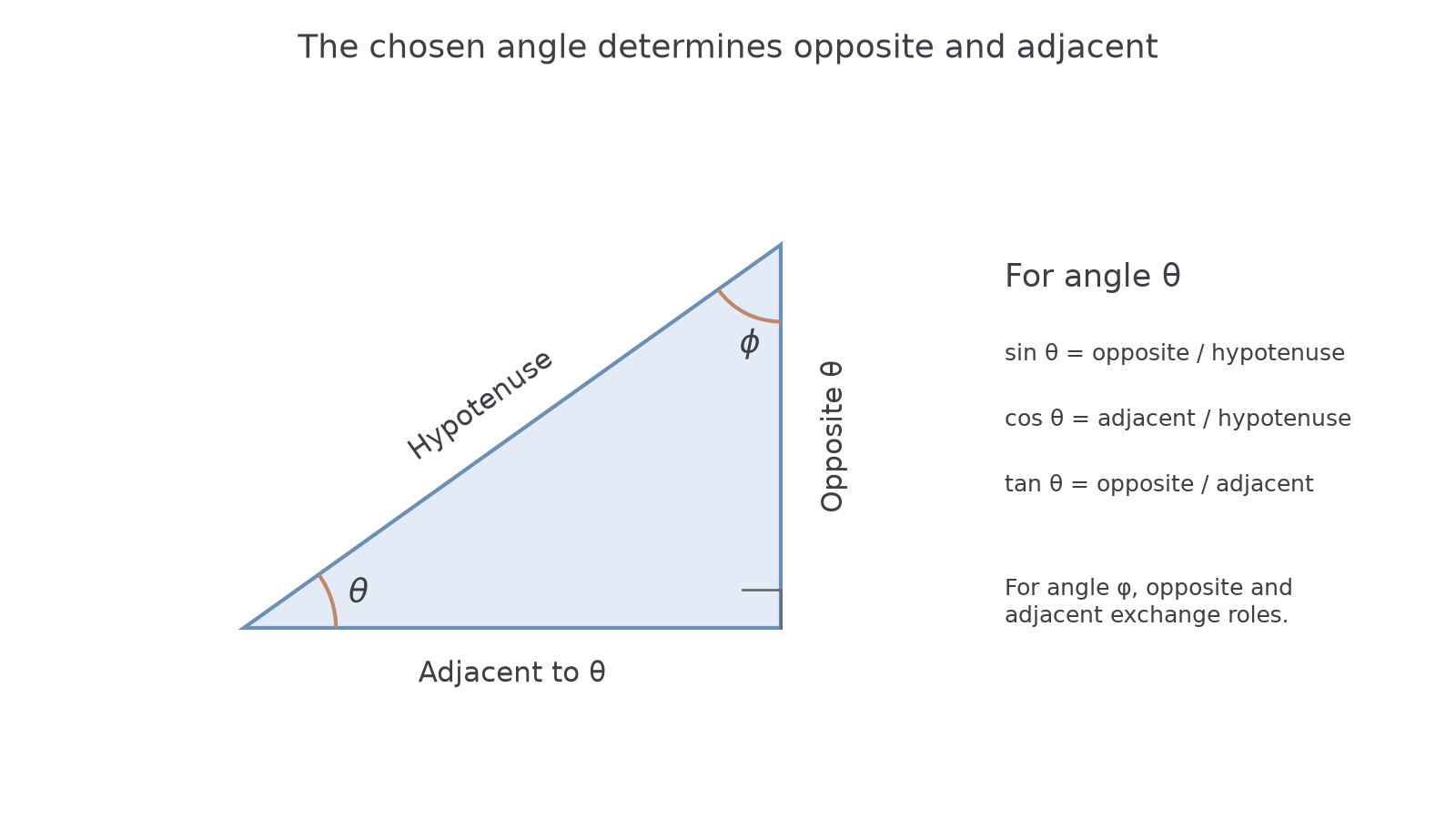
The hypotenuse keeps its name when you switch acute angles; the other two side names swap.
Right-angle trigonometric ratios
Use a right-angled triangle and the same chosen angle throughout. The memory aid SOH CAH TOA records these three ratios.
On the formula sheet (2026 version; the 2027 sheet will have the same content).
Ratios have no unit when numerator and denominator use the same length unit. The common similarity factor cancels, which is why the angle determines the ratio rather than the triangle's size.
Worked example 1: three ratios for one angle
Question. A right triangle has legs , units and hypotenuse units. Angle is opposite the -unit side. Write its three trigonometric ratios.
Plan. Label the sides relative to , then select each pair.
Why this step? Labelling before calculating prevents a correct ratio for the wrong angle.
Answer. , , .
Check. Both sine and cosine are less than , since each leg is shorter than the hypotenuse.
Change only the chosen angle: use the other acute angle in that same triangle.
Worked example 2: the side names exchange
Question. Angle is opposite the -unit side of the same triangle. Write its three ratios.
Plan. Exchange opposite and adjacent, leaving the hypotenuse fixed.
Why this step? Opposite and adjacent describe a side's relationship to the chosen angle, not permanent names for the two legs.
Answer. , , .
Check. Tangent may exceed , because the opposite leg may be longer than the adjacent leg.
For another example, the angle opposite the -unit side in a triangle has sine , cosine and tangent . Sine and cosine of an acute angle lie between and ; tangent has no such upper limit.
Watch out
Wrong: in example 2. That reverses the ratio and makes cosine exceed . Cosine is adjacent divided by hypotenuse, so .
These ratios apply directly to right triangles. For another shape, first identify or draw a suitable perpendicular to create one.
Choosing a ratio to find a side
Choose the ratio containing the known side and the side you need; a ratio involving another unknown side will not help yet.
Label opposite, adjacent and hypotenuse, write an equation, and rearrange before calculating. Use degree mode for angles given in degrees. A quick mode check is .
Worked example 3: finding an opposite side
Question. A right triangle has angle , adjacent side , and opposite side . Calculate to three significant figures.
Plan. Use tangent because the two relevant sides are opposite and adjacent.
Why this step? Sine would introduce the unknown hypotenuse, whereas tangent connects the required side directly to .
Answer. to three significant figures.
Check. , so the opposite leg should be shorter than the adjacent leg.
Change only the required side: with the same angle and adjacent length, find the hypotenuse instead. The unknown is now underneath the fraction bar.
Worked example 4: finding a hypotenuse
Question. A right triangle has angle , adjacent side , and hypotenuse . Calculate to three significant figures.
Plan. Use cosine, then isolate the denominator .
Why this step? Multiplying by cosine would shrink it, but the hypotenuse must be longer than .
Answer. to three significant figures.
Check. Using the unrounded value gives , and .
The same choice applies across all three ratios. An adjacent side of at gives hypotenuse . If an opposite side is at , the adjacent side is . With hypotenuse at , the legs are and , both shorter than .
Watch out
Wrong: in example 4. That cannot be the hypotenuse because it is shorter than the given leg. Rearranging gives division: .
Enter a whole expression using brackets where needed, keep the unrounded value, then round the final answer to the requested accuracy.
Inverse trigonometric functions and degree mode
To find an angle from a side ratio, reverse the trigonometric function with its inverse key.
The calculator's , , keys are usually reached using SHIFT or a second-function key. Here the superscript means an inverse function, not a reciprocal. For example, asks “which angle has tangent ?” The inverse steps are not separately on the formula sheet: derive them by reversing the taught trigonometric ratio.
Worked example 5: inverse tangent
Question. Relative to acute angle , a right triangle has opposite side and adjacent side . Find to one decimal place.
Plan. Form the tangent ratio and apply inverse tangent in degrees.
Why this step? Ordinary tangent starts with an angle; inverse tangent starts with its ratio.
Answer. .
Check. The opposite leg is shorter, so , as found.
Keep the triangle and chosen angle, but replace the supplied adjacent length with the hypotenuse . This changes the ratio you can use.
Worked example 6: inverse sine for the same angle
Question. A right triangle has opposite side and hypotenuse relative to . Find to one decimal place.
Plan. Use inverse sine because opposite and hypotenuse are known.
Why this step? There is no need to calculate the missing adjacent side before using a ratio that already has two known lengths.
Answer. .
Check. Pythagoras gives the missing leg , agreeing with example 5.
Inverse cosine works the same way: adjacent and hypotenuse give . A sine or cosine ratio above signals reversed sides or impossible data. A tangent ratio above is possible and gives an acute angle above .
Watch out
Wrong: . Inverse tangent is not reciprocal tangent. Enter using the inverse key, giving .
Continue this lesson.
You’re previewing NovaLearn without an account. Create a free account to read the rest.
Create free account