P6, P7 - Sample spaces, sets and Venn diagrams
P6 uses lists, tables, grids, Venn diagrams and trees to organise possibilities without omissions or repeats. P7 turns equally likely outcomes into theoretical probabilities. You will also complete two-way tables and separate overlapping groups before counting them.
Complete possibility spaces
Are the totals to equally likely when you roll two dice? There are eleven named totals, but listing their names hides how they happen.
You already know
For equally likely outcomes, probability is successful outcomes divided by all outcomes. An event can contain several individual outcomes.
For two coins, the ordered list is . Exactly one head has probability : the categories zero, one and two heads are not equally likely. Keep the first and second object distinguishable.
Possibility space
A complete collection of all individual outcomes, each included once. A list suits a single die; a labelled grid suits two dice. Outcomes such as and differ when the first and second die are distinguished.
Label one grid axis with every first-die score and the other with every second-die score. Fill each cell with the requested total, product or difference. A repeated total in different cells represents different underlying pairs.
[DIAGRAM: asset_name: Two-dice possibility space; asset_slug: 1ma1_m65_sample_space; caption: Every cell is an equally likely ordered pair; four cells give total five and six give total seven.; description: Six-by-six grid with first-die scores one to six down the rows and second-die scores one to six across columns. Each cell contains the sum. The four total-five cells are blue; the six total-seven cells are sage.]
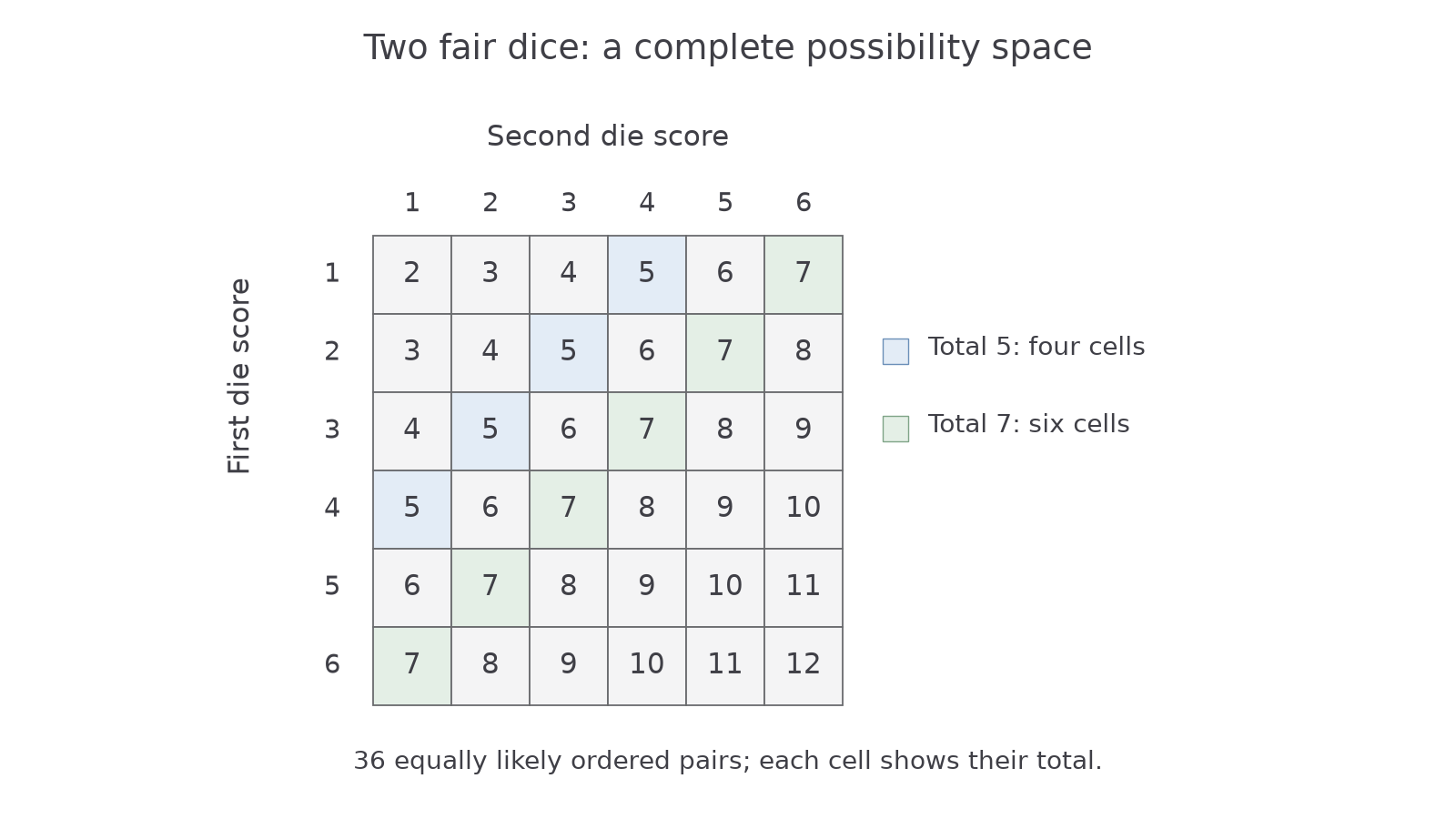
Use the grid to see every successful pair.
Worked example 1: a total of five
Question. Two independent fair dice are rolled. Find the probability of total .
Plan. Count the ordered pairs giving five in the complete grid.
Why this step? Each cell corresponds to one outcome of the two separate fair dice.
Answer. .
Check. The four highlighted five-cells match the four listed pairs.
Change only the target total to seven. The sample space stays the same size.
Worked example 2: a total of seven
Question. Find the probability of total with the same two dice.
Plan. Count its complete diagonal of successful pairs.
Why this step? Different totals occupy different numbers of cells, so their chances differ.
Answer. .
Check. Total seven has three times the chance of total three, which has only and .
That gives a useful surprise: the middle total is more likely than either extreme, even though each die is fair.
Watch out
Wrong: because totals run from to . Those totals are not equally likely. Count successful ordered pairs out of , giving .
Change the target total again, and make the successful outcomes visible.
Completing and using two-way tables
A two-way table classifies the same population by two attributes, so each person occupies one internal cell.
For example, a row may say how a pupil travels and a column whether they bring lunch. The outside row and column totals are marginal totals. Add cells to get a total; subtract known cells from a total to fill a gap. Every row and column must agree with the grand total.
Two-way table
A table with categories for one attribute in rows and another attribute in columns. Each internal cell meets both its row and column descriptions. Its totals count whole rows, whole columns and the complete population.
If one person is chosen uniformly from the complete population, every probability here uses the grand total as its denominator. A table cell describes “both”; several disjoint cells can describe “either” or “neither”.
Worked example 3: completing cells and totals
Question. Complete this table of pupils and find the probability that a randomly chosen pupil cycles and brings lunch.
| Travel | Brings lunch | Does not bring lunch | Total |
|---|---|---|---|
| Cycles | ? | ||
| Other | ? | ? | |
| Total | ? | ? |
Plan. Complete the rows by subtraction, then add down the columns.
Why this step? Both attributes must hold, so only their crossing cell is successful.
Answer. Missing cells/totals are ; the probability is .
Check. Row totals and column totals both give .
Keep every count unchanged and change only the event to “cycles or brings lunch”. This includes people meeting both descriptions.
Worked example 4: a union and its complement
Question. For the same table, find the probability of cycling or bringing lunch, and the probability of neither.
Plan. Add the three successful cells once, then use the remaining cell for neither.
Why this step? The pupils meeting both conditions belong in the union once.
Answer. for either or both; for neither.
Check. .
A row total counts all pupils in that row, including both lunch categories. A grand total remains necessary when selecting from everyone.
Watch out
Wrong: . This chooses a denominator containing cyclists only. The selection is from all , so the correct probability is . Also, counts the crossing cell twice; the union is .
Keep the same population and change only the other travellers not bringing lunch from to .
Sets, intersections and complements
Sets give short names to groups, and the universal set tells you which objects are available to be grouped.
Set notation
The universal set contains all objects under consideration. The intersection contains members of both sets; the union contains members of either or both. The complement contains members of outside . The empty set has no members.
A complement depends on . If changes, the objects outside may change too. Write each member once; order within a set does not matter.
Worked example 5: numerical sets
Question. Let , be the even numbers and the numbers greater than five. Find , and .
Plan. List each set, then select shared, combined and outside members.
Why this step? Union includes the overlap; “or” does not exclude members belonging to both.
Answer. The three sets are as listed.
Check. and together contain all eight members, without repetition.
Change only the complement requested: take the complement of the union rather than of alone.
Worked example 6: outside a union
Question. With the same , find .
Plan. Remove every union member from the universal set.
Why this step? The brackets make the entire union the group being complemented.
Answer. .
Check. None of is even or greater than five.
The same notation works with letters: for , , , the intersection is and the complement of the union is .
Watch out
Wrong: , excluding shared members. Union means either or both, so and must also be included. Only “exactly one set” excludes the intersection.
Change only B's boundary from greater than five to greater than four, keeping example 6's operation.
Venn regions and probabilities
A Venn diagram puts every member in exactly one region, making overlaps visible before you calculate probabilities.
Continue this lesson.
You’re previewing NovaLearn without an account. Create a free account to read the rest.
Create free account