G16, G17 - Perimeters, areas and composite shapes
Perimeter measures the distance around a shape; area measures the space inside it. You will find missing boundary lengths, use perpendicular heights in area formulae, and split or subtract regions to solve composite-shape problems.
Perimeter and missing boundary lengths
If you cut a rectangular corner out of an by sheet, does its perimeter get smaller? Its area certainly does, but the boundary has a surprise in store.
You already know
Opposite sides of a rectangle are equal. Convert lengths to the same unit before adding them: .
Imagine walking your pencil once around a shape. Count every outside edge, including an inward step, but leave out internal dividing lines.
Perimeter
The perimeter is the total length of a shape's boundary. It uses length units, such as centimetres. Area measures the region inside the boundary and uses square units.
For a regular polygon, all sides have length , so adding them gives . This rule is not on the formula sheet: learn it. A rectangle gives , derived by adding its two equal pairs of sides.
Worked example 1: tracing a rectangle
Question. Find the perimeter of an by rectangle.
Plan. Add the four boundary lengths.
Why this step? Multiplying by counts square centimetres inside the sheet, rather than centimetres around it.
Answer. The perimeter is .
Check. , using the equal pairs.
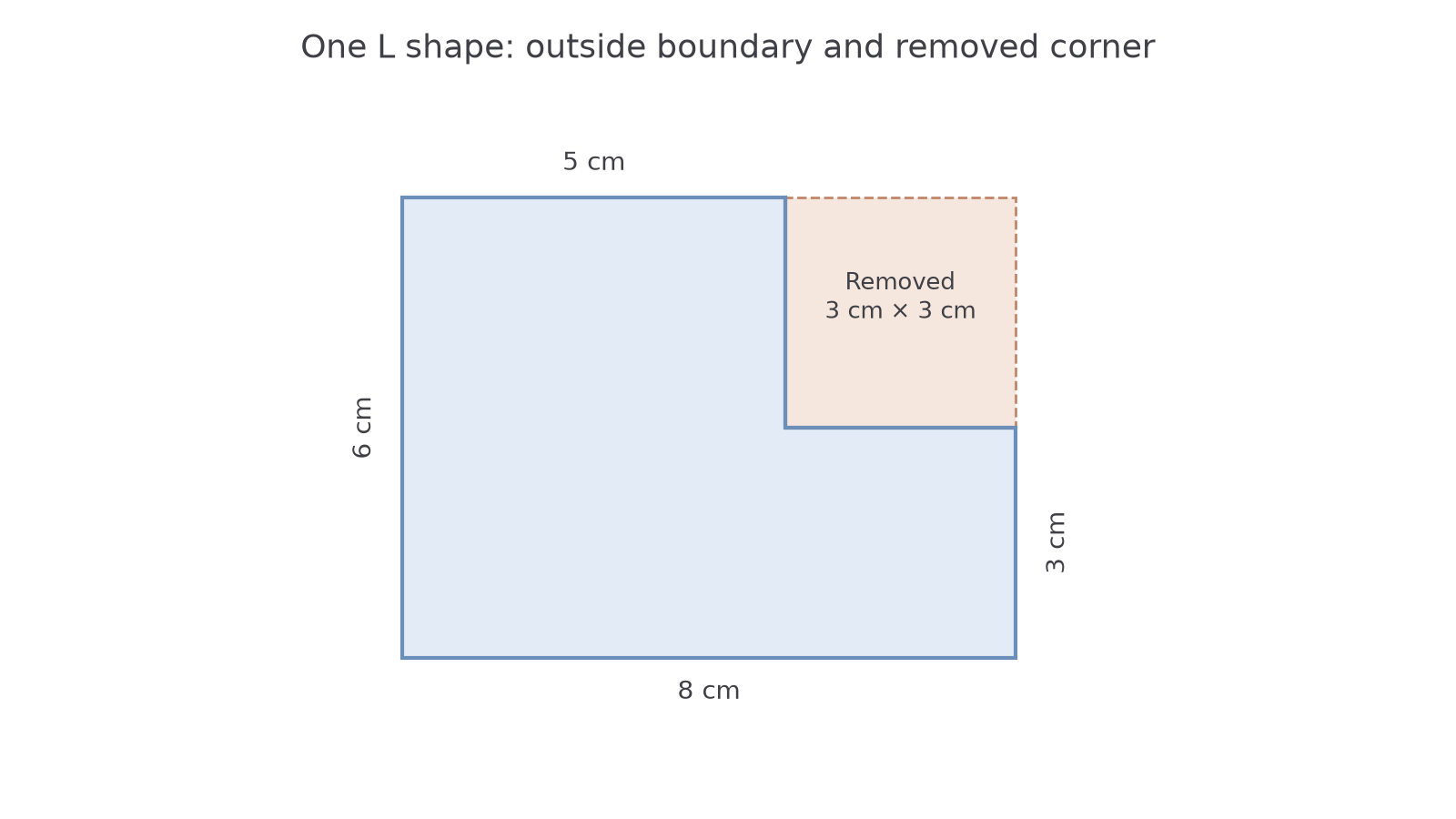
Now change just the boundary: remove a by corner from that rectangle. The overall width and height stay the same.
[DIAGRAM: asset_name: Boundary and removed corner of an L shape; asset_slug: 1ma1_m55_l_shape; caption: The same L shape can be traced for perimeter or subtracted from a rectangle for area; description: An L shape has overall width 8 cm and height 6 cm. A 3 cm by 3 cm upper-right corner is absent, leaving a right edge 3 cm high and a top edge 5 cm long. The absent corner is shown with a pale clay dashed outline, distinct from the blue actual boundary.]
Worked example 2: tracing the inward step
Question. Find the perimeter of the L shape shown.
Plan. Find the two step lengths, then trace the actual boundary once.
Why this step? The two new inward edges replace two equally long removed outer edges. Cutting out this corner changes area but leaves perimeter unchanged.
Answer. The L shape also has perimeter .
Check. The horizontal edges total , and the vertical edges total .
That unchanged perimeter is not a rule for every cut. A notch in the middle of an edge can introduce extra boundary. Trace the actual outline each time.
Watch out
Wrong: for this L shape. That removes two edges but forgets the two new step edges. Add all six actual edges to get .
For comparison, an uncut by rectangle has perimeter and area . A by rectangle has perimeter . If a curved boundary contains a semicircle, its arc length is , derived by halving the circle circumference. Add the diameter only if it too lies on the outside.
Base and perpendicular height
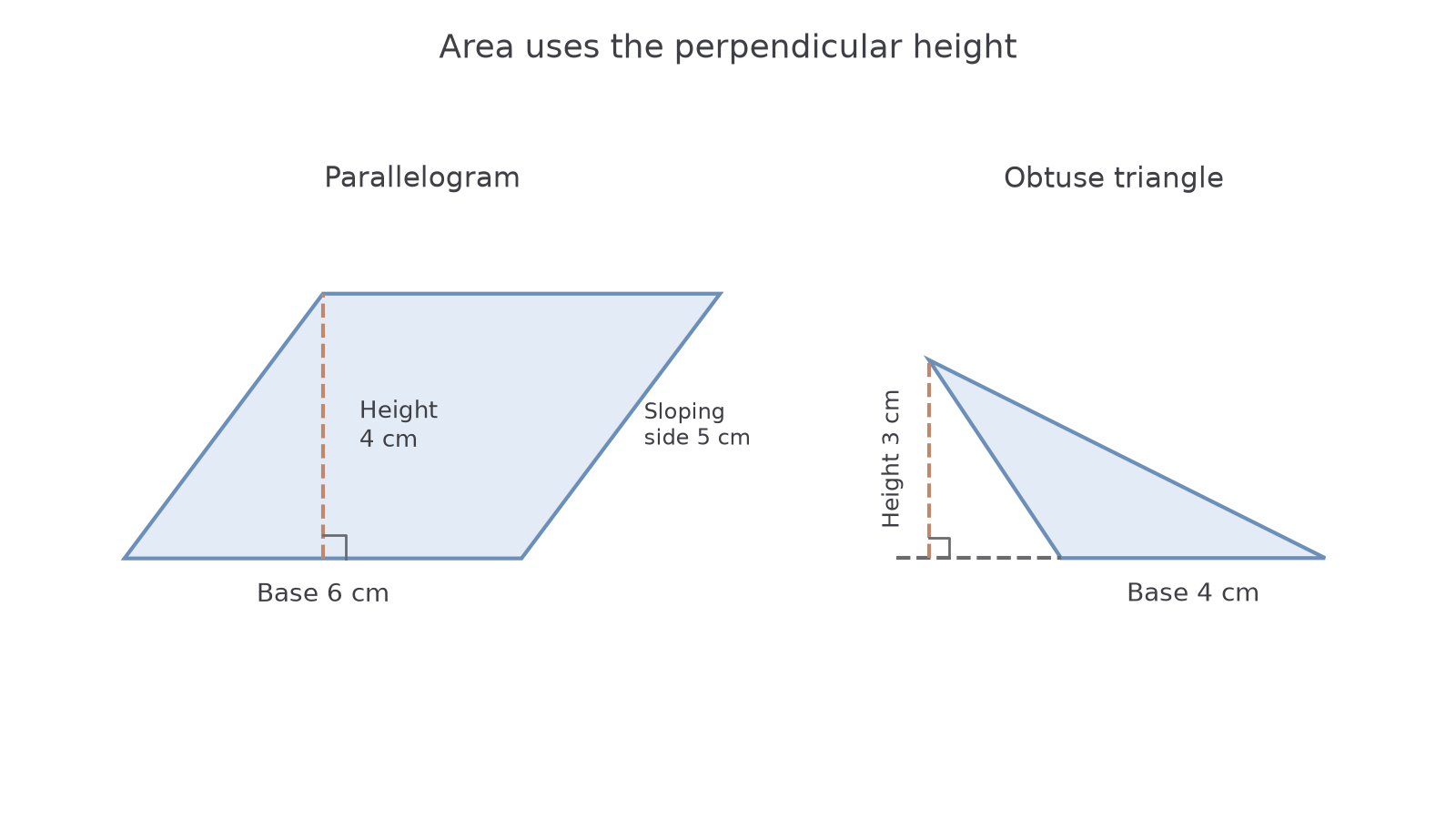
An area calculation needs the distance straight across from the base, rather than a sloping boundary side.
Cutting an end triangle from a parallelogram and moving it to the other end makes a rectangle without changing the area. The base and perpendicular height become the rectangle's dimensions. Two congruent copies of a triangle make a parallelogram with the same base and height, so one triangle occupies half its area.
Triangle and parallelogram areas
The base and height must be perpendicular and in the same length unit.
Not on the formula sheet: learn it.
For an obtuse triangle, the perpendicular may land outside the triangle. Extend the base line: height is distance to that line, not distance to a base endpoint.
[DIAGRAM: asset_name: Perpendicular heights for a parallelogram and an obtuse triangle; asset_slug: 1ma1_m55_heights; caption: A sloping side is not the perpendicular height; description: Left panel shows a parallelogram of base 6 cm and perpendicular height 4 cm, with the height dashed and a right-angle marker. Right panel shows an obtuse triangle with base 4 cm and height 3 cm falling to the extended base line outside the triangle.]
Worked example 3: the same base and height
Question. A parallelogram and a triangle each have base and perpendicular height . Find their areas.
Plan. Calculate base times height, then halve it for the triangle.
Why this step? The triangle needs the factor ; its base and height do not describe a whole rectangle.
Answer. The areas are and .
Check. Two copies of the triangle have area .
Keep that triangle but hide its height instead of its area. Reversing a formula uses the same relationship.
Worked example 4: recovering the perpendicular height
Question. A triangle has area and base . Find its perpendicular height.
Plan. Substitute the known area and base, then undo the multiplication.
Why this step? The area is six times the height, so dividing by six recovers the height.
Answer. The perpendicular height is .
Check. .
Continue this lesson.
You’re previewing NovaLearn without an account. Create a free account to read the rest.
Create free account