N14, N15, N16 - Estimation, rounding and simple error intervals
N14 uses estimates to check answers, including calculator displays. N15 develops decimal places, significant figures and intervals from rounding or truncation. N16 uses these limits of accuracy to judge what a reported measurement really tells you.
Estimating and checking calculations
A rod is labelled , rounded to the nearest tenth. Could its actual length be ? Before deciding what rounded measurements mean, practise using approximations deliberately.
You already know
A digit's value depends on its place. Multiplying or dividing by ten changes a number's scale; dividing a positive quantity by a number below one increases it.
An estimate replaces awkward numbers with nearby convenient numbers. It checks the size of an answer without claiming to find its exact value. One significant figure is often useful, but use the accuracy specified in the question.
Worked example 1: checking a calculator's scale
Question. Estimate , rounding each input to one significant figure. Is a displayed answer near ten plausible?
Plan. Round all three inputs, then work out the simpler quotient.
Why? Dividing by one fifth is multiplying by five, so the answer must exceed two hundred.
Answer. About ; a display near ten is not plausible.
Check. The original calculation is about , close to the estimated scale.
Change only the denominator to . Dividing by a quantity ten times smaller should make the answer ten times larger.
Worked example 2: a decimal-place change
Question. Estimate by rounding each input to one significant figure.
Plan. Keep the numerator estimate and adjust the denominator's scale.
Why? , so division multiplies two hundred by fifty.
Answer. About .
Check. The exact calculation is ten times Example 1, about .
Addition needs useful scales too: . Rounding every term to zero would be easy but unhelpful. Check signs, units and brackets as well as magnitude when using technology. If an accurate answer is required afterwards, return to the original inputs.
Watch out
An estimate is not the final accurate calculation. Wrong: replacing the original inputs by rounded ones and then reporting many decimal places. Keep the two purposes separate.
The matched question changes only the denominator once more.
Choosing and applying a degree of accuracy
Decimal places count from the decimal point; significant figures count from the first non-zero digit. For , two decimal places gives , while two significant figures gives .
Rounding
Choose the last retained place and inspect the next digit. If it is below five, leave the retained digit; if it is five or above, increase it, carrying where needed. This is the usual rule for positive numbers.
Leading zeros locate the value without counting as significant figures. Thus to three significant figures is . Zeros between significant digits count, and trailing zeros can show requested accuracy: to three significant figures is ; also shows three significant figures.
Worked example 3: decimal places and significant figures
Question. Round to (a) two decimal places and (b) three significant figures.
Plan. Locate the retained place separately for each request.
Why? Both requests happen to retain hundredths here, though they do not always name the same place.
Answer. (a) ; (b) .
Check. The next digit is below five, so neither result increases.
Change only the final digit from four to six. This forces a carry through the nines.
Worked example 4: carrying changes the leading digits
Question. Round to (a) two decimal places and (b) three significant figures.
Plan. Increase the retained place, then show the requested precision after carrying.
Why? After carrying, has four significant figures, so the two requested forms differ.
Answer. (a) ; (b) .
Check. Both equal ten numerically; the zeros communicate different accuracy.
Rounding twice can change an answer: rounds directly to at one decimal place, but going through gives . Keep unrounded intermediate values.
Context can require rounding upwards rather than to the nearest value. For passengers and buses holding , , but three buses are needed: two hold only a hundred. Likewise needs three. Monetary payments normally use pence; counts and capacity must fit the task.
Watch out
Wrong: to three significant figures is . That has four significant figures. Right: . For a bus problem, check capacity rather than automatically rounding a quotient to its nearest whole number.
Change only the last digit of Example 4 again.
Intervals behind rounded measurements
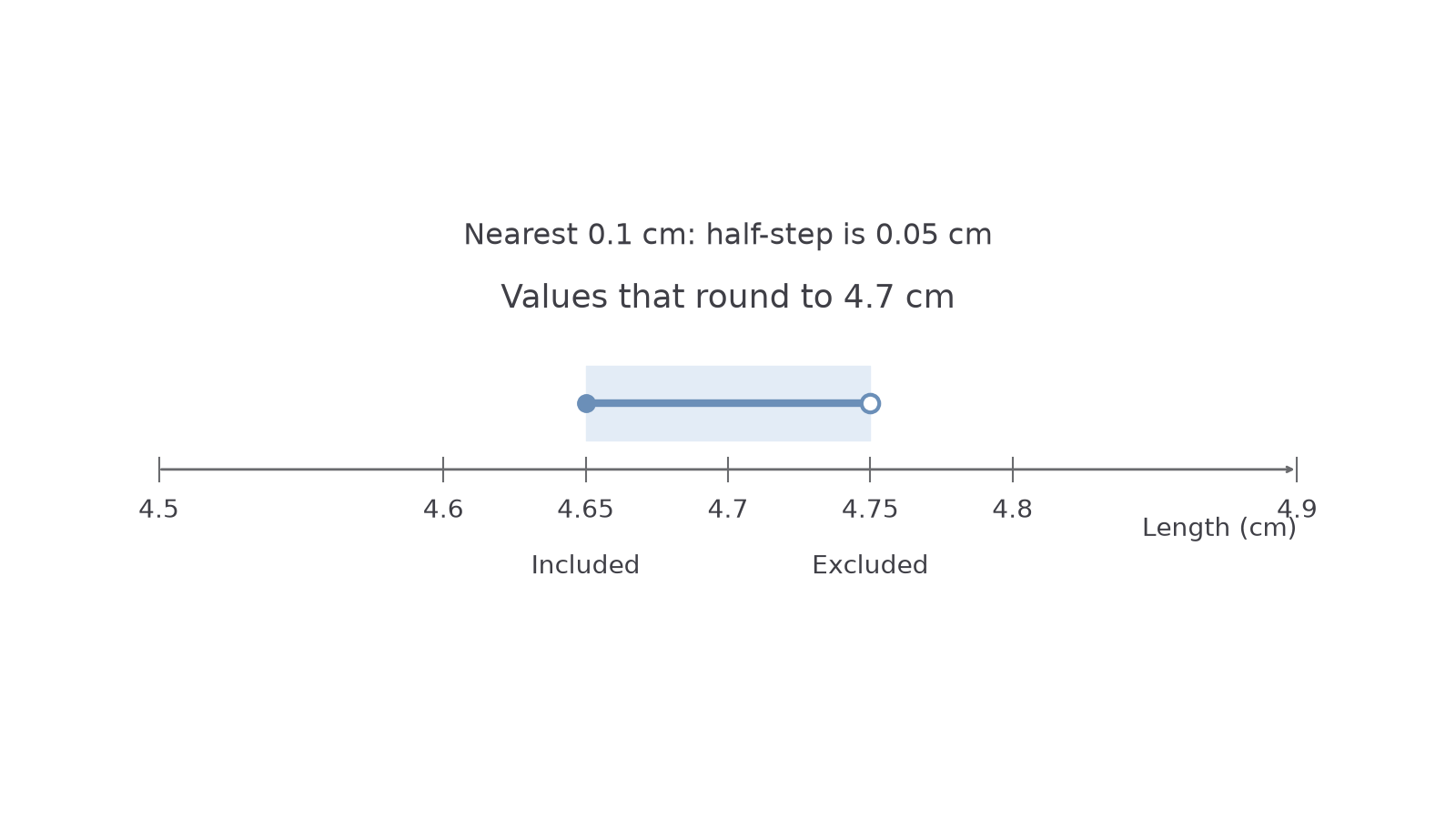
A rounded reading represents a range of possible original values. Its boundaries are half a rounding step below and above the reported value.
For to the nearest , the half-step is . The opening length falls within the possible range.
[DIAGRAM: asset_name: Values that round to 4.7; asset_slug: 1ma1_m10_rounding_interval; caption: The values from 4.65 inclusive to 4.75 exclusive round to 4.7 to the nearest tenth.; description: Number line in centimetres from 4.5 to 4.9, with a shaded blue interval from 4.65 to 4.75, a filled lower endpoint, an open upper endpoint, and 4.7 marked at the centre.]
Error interval
An inequality stating all values consistent with the reported accuracy. includes an endpoint; excludes it. Endpoint inclusion at an exact midpoint depends on the stated rounding convention.
For positive values, use the usual midpoint rule: an exact halfway value rounds upwards.
Worked example 5: a positive rounding interval
Question. A positive reading rounds to to one decimal place. Write its interval using the usual midpoint rule.
Plan. Take half of and test the two endpoints.
Why? rounds to , but rounds to .
Answer. .
Check. belongs to the interval and rounds to .
Change only the sign of the reading. For this example, exact negative midpoints round away from zero; that convention must be stated.
Worked example 6: a negative rounding interval
Question. A reading rounds to to one decimal place. Exact midpoints round away from zero. Write its interval.
Plan. Keep the same half-step, but test the negative endpoints with the given rule.
Why? rounds to , so exclude it; rounds to , so include it.
Answer. .
Check. lies inside and rounds to .
The step, not the number of written digits, determines the boundaries. A positive mass to the nearest gives , with in grams. An error interval describes rounding uncertainty; an inaccurate instrument could introduce additional error.
Watch out
Do not reverse numerical order for negative values. is less than . Check midpoint inclusion using the stated rule.
Change only the negative reported value in the second example.
Truncation and justified precision
Truncation cuts off digits without increasing the last retained digit. It moves a negative number towards zero, so its interval has a different orientation from a positive truncation interval.
Truncation
Remove all digits after the requested place. For example, truncated to one decimal place is , and becomes . The next digit is not used to round.
A reliable rounded report must work for every value in the possible interval. Looking only at the displayed value is not enough.
Worked example 7: positive truncation and reliable rounding
Question. A positive number is truncated to at one decimal place. Write its interval and decide its unique value to the nearest whole number.
Plan. Start at the reported value and add one full step, then compare the whole interval with a rounding interval.
Why? Every possible value is below the halfway point , so all round to four.
Answer. ; the unique whole-number report is .
Check. Both and truncate to and round to four.
Change only the sign. The interval now extends below the displayed value.
Worked example 8: negative truncation and reliable rounding
Question. A negative number is truncated towards zero to at one decimal place. Write its interval and its unique value to the nearest whole number.
Plan. Subtract a full step for the lower boundary and include the reported endpoint.
Why? would stay , so it is excluded; itself is allowed.
Answer. ; the whole-number report is .
Check. truncates to and rounds to .
Writing more digits cannot improve the measurement. A rod reported as to the nearest centimetre becomes , with in metres. Writing adds no information. Likewise, every value in rounds to a hundred to the nearest ten, but those values need not agree to the nearest tenth.
Watch out
Rounding uses a half-step on either side. Positive truncation starts at the reported value and uses a full step. Do not use the rounding interval for a value truncated to .
Change only the displayed negative value in the matched question.
Quick Recap
- Estimates check size; an accurate calculation uses the original inputs.
- Decimal places and significant figures can retain different positions; avoid rounding twice.
- Rounding boundaries are half a step away, with endpoints governed by the midpoint rule.
- Truncation removes digits; use the whole interval to judge reliable accuracy.
Yes, the opening rod could be : is consistent with the rounded label .