5.9B - Fish farming
Fish farming is the rearing of large numbers of fish to provide food, especially protein-rich food. A fish farm is more controlled than a natural lake or sea, but that control has to be managed carefully: crowded fish can run out of oxygen, spread disease, produce waste and eat each other. This lesson is about the methods used to keep fish alive, growing and harvestable.
Why fish farms need control
A fish farm may use ponds, tanks, cages or net pens. The exact equipment can vary, but the biological problem is the same: many fish are kept in a limited space so that farmers can produce a reliable food supply.
Fish farming
Fish farming is the controlled rearing of fish in large numbers to provide food, especially as a source of protein.
Keeping many fish together can increase yield, but it also creates risks.
| High-density farming risk | Why it matters biologically |
|---|---|
| Oxygen may become low | Fish need dissolved oxygen for aerobic respiration. |
| Waste products build up | Faeces, uneaten food and excreted ammonia can reduce water quality. |
| Predation may increase | Larger fish or other animals may eat farmed fish. |
| Disease spreads more easily | Fish are close together, so pathogens and parasites can pass between them. |
| Feeding must be controlled | Too little feed slows growth; too much feed is wasted and pollutes the water. |
[DIAGRAM: asset_name: Fish farming - diagram 01; asset_slug: b64_fish_farming__diagram_01; recommended_method: deterministic_drawing; description: Monochrome overview of a fish farm tank or cage with labelled controls for aeration and water flow, waste removal and filtration, controlled feeding, separating fish by size, predator exclusion, disease quarantine, and monitoring pH, temperature, salinity and dissolved oxygen.]
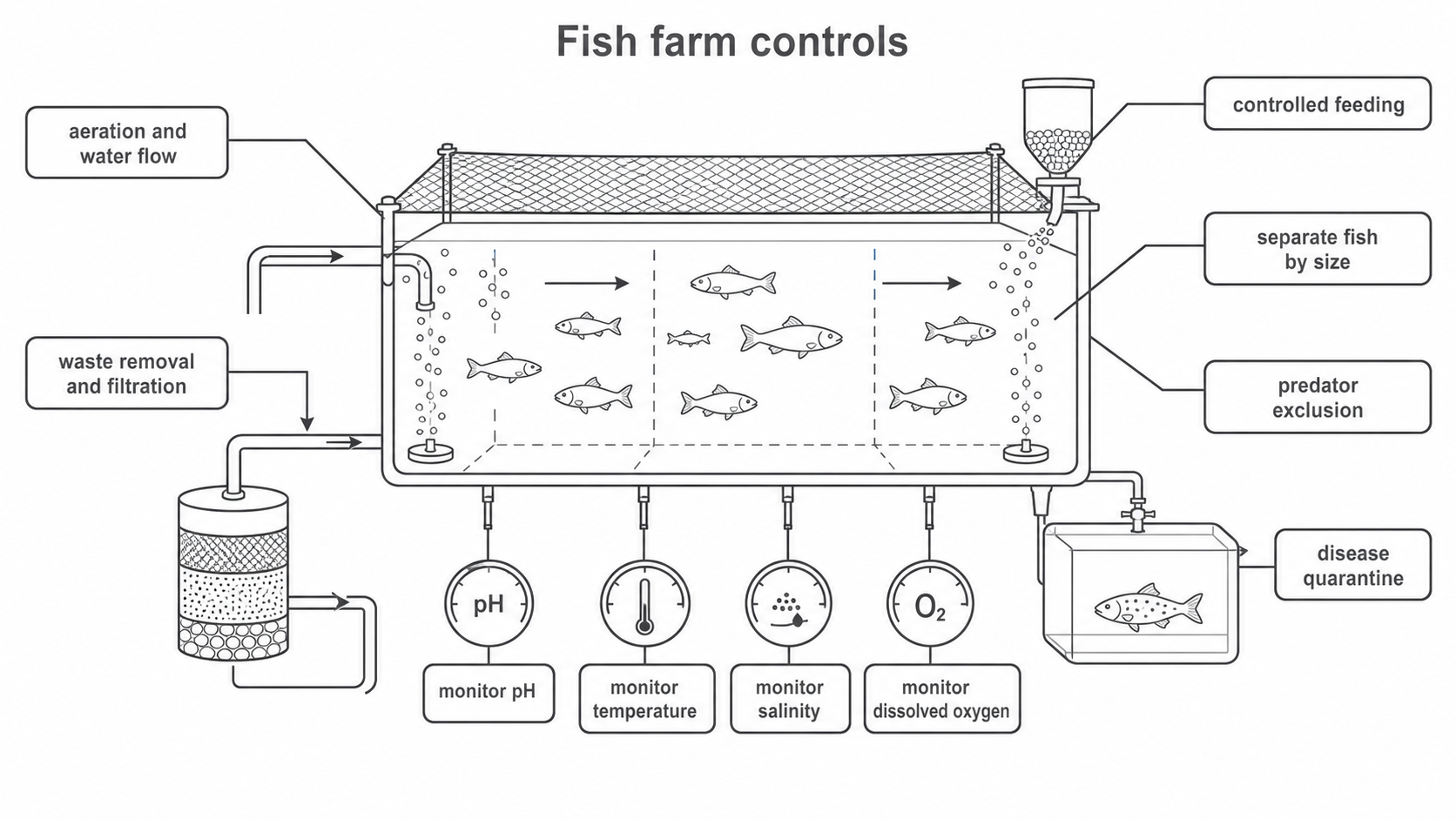
The exam point is not that one design is always best. It is that fish farming works by controlling the conditions that limit survival and growth. When a question asks about "water quality", name specific factors such as dissolved oxygen, pH, temperature, salinity or ammonia rather than writing only the vague phrase "good water quality".
Water quality and waste
Fish live in water, so the water is their immediate environment. A fish farm must maintain water quality by monitoring and controlling abiotic factors that affect respiration, enzyme activity, osmosis and general health.
Useful examples include:
| Water-quality factor | Why it is controlled | Possible method |
|---|---|---|
| Dissolved oxygen | Fish need oxygen for aerobic respiration. | Aerate the water, pump water through, avoid overcrowding. |
| Temperature | Enzyme-controlled reactions and metabolic rate depend on temperature. | Use heaters, chillers, shade or water flow. |
| pH | Extreme pH can damage cells and affect enzymes. | Monitor pH and adjust water conditions. |
| Salinity | The correct salt concentration helps fish maintain water balance. | Use suitable freshwater or seawater and monitor salts. |
| Ammonia and other waste | Ammonia can be toxic; waste encourages bacteria and lowers oxygen. | Remove waste, filter water, change water, avoid overfeeding. |
Waste products come from three main sources: faeces, uneaten food and excretory products such as ammonia. If these materials stay in the water, bacteria decompose them and respire. This uses dissolved oxygen, leaving less oxygen available for the fish.
In some fish-farm systems, biological filters contain nitrifying bacteria. These bacteria convert ammonia or ammonium compounds first to nitrite and then to nitrate. This can reduce toxic ammonia, but nitrate and other mineral ions still need managing because excess nutrients can encourage algal growth and reduce water quality.
Removing waste products therefore protects fish in several linked ways: it reduces toxic substances, reduces bacterial growth, helps keep oxygen levels higher and lowers the chance of disease.
Predation and disease
Fish farms must control both intraspecific and interspecific predation.
Intraspecific predation is predation within the same species. In fish farming, this can happen when larger or older fish eat smaller or younger fish of the same species. Farmers can reduce it by separating fish by size or age, grading fish into different tanks, providing enough feed, and avoiding stocking densities that increase stress.
Interspecific predation is predation between different species. Farmed fish may be eaten by birds, mammals, larger wild fish or other aquatic predators. Farmers can reduce this by using nets, cages, covers, screens, secure tank walls and barriers that keep predators away from the farmed fish.
Disease is also a major risk because crowded fish have frequent contact with each other. Pathogens or parasites can spread quickly through water or by direct contact. Diseased fish may also be stressed, eat less and grow more slowly.
Methods used to control disease include:
- using healthy fish stock
- quarantining new or sick fish
- removing dead or infected fish quickly
- cleaning equipment and tanks
- keeping stocking density low enough to reduce stress and contact
- maintaining good water quality and good nutrition
- using appropriate vaccines or medicines where needed
Continue this lesson.
You’re previewing NovaLearn without an account. Create a free account to read the rest.
Create free account