3.28-3.29 - Mitosis
Mitosis is cell division that keeps the chromosome set the same. When a diploid cell divides by mitosis, it produces two cells with identical sets of chromosomes. This makes mitosis useful whenever an organism needs more genetically identical cells, such as during growth, repair, cloning and asexual reproduction.
The diploid starting point
Chromosomes are found in the nucleus and carry genetic information. Before you can explain mitosis, you need to know what kind of cell is starting the division.
Diploid Cell
A diploid cell has two sets of chromosomes, arranged as pairs.
In a diploid body cell, the chromosomes are present in matching pairs. A simple diagram might show a diploid cell as 2n = 4, meaning there are two pairs of chromosomes. The exact number depends on the species, but the mitosis rule is always the same: the daughter cells keep the same chromosome number as the diploid parent cell.
Mitosis is not a reduction division. It does not halve the chromosome number and it does not make gametes. A diploid cell dividing by mitosis produces two diploid daughter cells. Each daughter cell has an identical set of chromosomes to the original cell.
Copying and separating chromosomes
For the two daughter cells to receive identical chromosome sets, the cell must prepare before it divides. Each chromosome is copied so that there are two identical copies available. During mitosis, these copied chromosomes are separated so that one copy of each chromosome goes to each side of the cell.
After the chromosomes have been separated, the nucleus and cytoplasm divide to form two daughter cells. Each daughter cell receives one copy of every chromosome from the original diploid set, so both daughter cells are diploid and genetically identical.
[DIAGRAM: asset_name: Mitosis - diagram 01; asset_slug: b50_mitosis__diagram_01; recommended_method: deterministic_drawing; description: Minimal labelled four-stage process diagram using a simplified diploid cell with two chromosome pairs, showing chromosomes copied before mitosis, one copy of every chromosome moving to each side, and two diploid daughter cells with identical chromosome sets.]
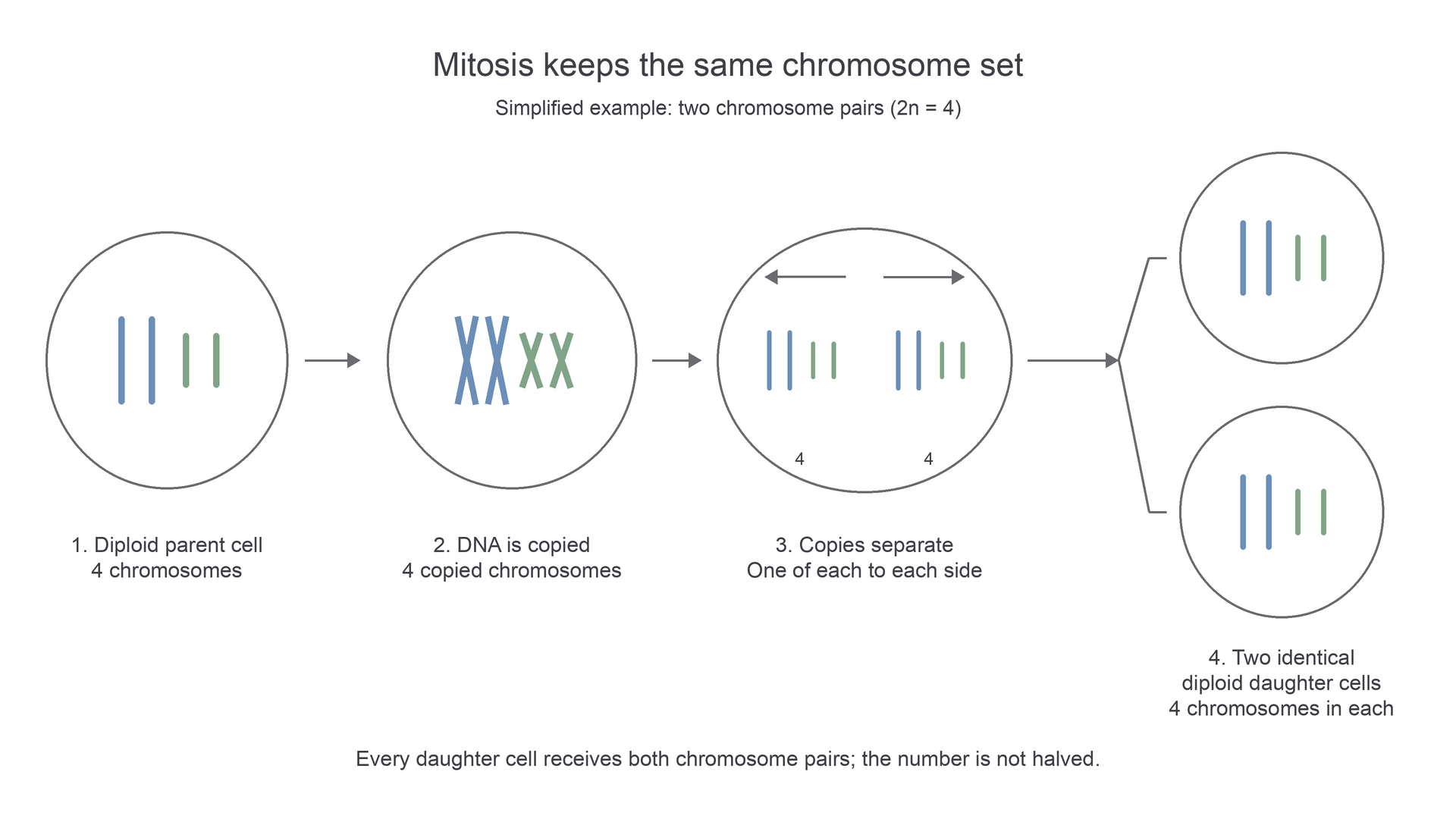
The stage names of mitosis are less important here than the chromosome logic: copy the chromosomes, separate the copies equally, then form two cells. If one daughter cell did not receive a copy of every chromosome, the chromosome sets would not be identical.
Uses of mitosis
Mitosis is used when the new cells need the same genetic information as the original cell. Edexcel names four required contexts: growth, repair, cloning and asexual reproduction.
Continue this lesson.
You’re previewing NovaLearn without an account. Create a free account to read the rest.
Create free account