3.33 - Variation and its causes
Variation means that individuals of the same species are not all identical. Pearson Edexcel asks for one precise idea here: variation within a species can be caused by genetic factors, environmental factors, or a combination of both. The skill is to identify the cause and explain it without drifting into genetic crosses, mutation or natural selection.
What variation means
A species is a group of organisms that can reproduce to produce fertile offspring. Variation is the difference in characteristics between individuals of the same species.
Variation
Variation is the differences in characteristics between individuals of the same species.
Examples of variation in humans include height, body mass, natural eye colour and blood group. Examples in plants include height, leaf size, flower colour and yield. The individuals are still members of the same species; they just do not have exactly the same characteristics.
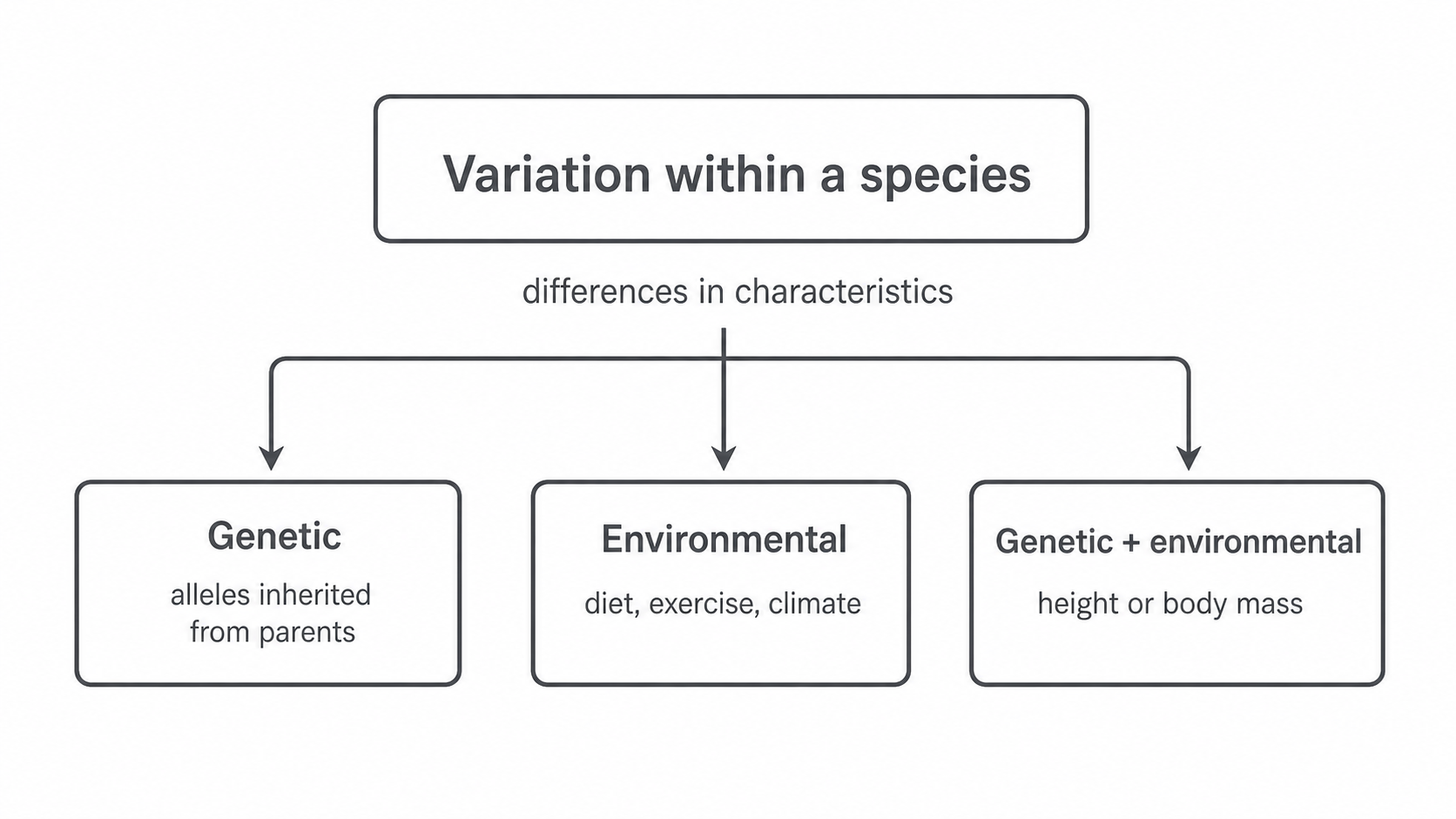
Variation can be described by looking at a characteristic and asking why individuals differ. For this lesson, there are three possible answers:
| Cause of variation | Meaning |
|---|---|
| Genetic | caused by inherited genetic information |
| Environmental | caused by surroundings or experiences during life |
| Combination | caused by both inherited genetic information and environmental factors |
[DIAGRAM: asset_name: Variation and its causes - diagram 01; asset_slug: b52_variation_and_its_causes__diagram_01; recommended_method: deterministic_drawing; description: Monochrome classification diagram showing variation within a species as differences in characteristics, then three cause routes: genetic, environmental, and combination of both, with short examples for each route.]
Genetic causes
Genetic variation is caused by differences in the genetic information inherited by individuals. This genetic information is carried in DNA, including genes and alleles. If a characteristic is genetic, individuals differ because they inherited different versions or combinations of genetic information.
Genetic variation
Variation caused by differences in inherited genetic information.
Some characteristics are strongly controlled by genes. Human blood group is a good example for this lesson: the blood group an individual has depends on inherited alleles, not on diet, exercise or sunlight. Natural eye colour is also mainly genetic, although the full inheritance is more complex than a single simple gene.
The important exam word is inherited. Genetic causes can be passed from parents to offspring because the information is in DNA. You do not need to explain meiosis, random fertilisation or mutation in this lesson; those belong to neighbouring specification points.
Environmental causes
Environmental variation is caused by the conditions an organism experiences during its life. In biology, environment does not only mean weather or habitat. It can include diet, water supply, light intensity, temperature, disease, exercise, training, accidents and chemicals.
Environmental variation
Variation caused by differences in the surroundings or experiences of individuals.
A scar is environmental variation because it is caused by an injury after birth, not by the genetic information inherited from parents. A suntan is environmental because it is caused by exposure to sunlight. In plants, two genetically similar seedlings may grow to different heights if one receives more light, water or mineral ions than the other.
Environmental variation is often not inherited. If a person builds muscle through training, their children do not inherit those larger muscles through DNA. The children may inherit genetic information that affects potential muscle development, but the training itself is an environmental factor.
Continue this lesson.
You’re previewing NovaLearn without an account. Create a free account to read the rest.
Create free account