3.17B-3.18B - Protein synthesis and the genetic code
Every cell needs proteins: enzymes, membrane proteins, structural proteins and many others. A gene is useful because its base sequence can be used as instructions for building a particular protein. In this lesson, you follow those instructions from DNA to mRNA, then from mRNA to a chain of amino acids at a ribosome.
RNA as a working copy
DNA stays in the nucleus of a eukaryotic cell. Protein synthesis happens at ribosomes in the cytoplasm. The cell therefore uses RNA as a working copy of the information in a gene.
RNA
RNA is a nucleic acid that is usually single stranded and contains the base uracil (U) instead of thymine (T).
The base letters for DNA are A, T, C and G. The base letters for RNA are A, U, C and G. That small letter change matters in exams: if you are writing an RNA sequence, use U where a DNA sequence would use T.
| Feature | DNA | RNA in this lesson |
|---|---|---|
| Strands | Two strands in a double helix | Single stranded |
| Bases used | A, T, C, G | A, U, C, G |
| Main role here | Stores the gene | Carries or uses the gene message in protein synthesis |
Two RNA types are especially important here. mRNA, or messenger RNA, carries a copy of the code from a gene to a ribosome. tRNA, or transfer RNA, helps put amino acids into the correct order during translation.
Transcription makes mRNA
Protein synthesis begins with transcription. During transcription, the base sequence of a gene is copied into an mRNA molecule.
Transcription
Transcription is the stage of protein synthesis in which a gene in DNA is copied into mRNA.
In a simple Edexcel-style description, the DNA in the gene unwinds or unzips so one strand can act as a template. Complementary RNA bases line up against the exposed DNA bases. The RNA bases join to form a single-stranded mRNA molecule.
[DIAGRAM: asset_name: Protein synthesis and the genetic code - diagram 01; asset_slug: b46_protein_synthesis_and_the_genetic_code__diagram_01; recommended_method: deterministic_drawing; description: Monochrome transcription diagram showing a gene in the nucleus, one DNA template strand with bases T A C G G A T T T, complementary mRNA bases A U G C C U A A A forming by base pairing, and the completed mRNA leaving the nucleus for a ribosome.]
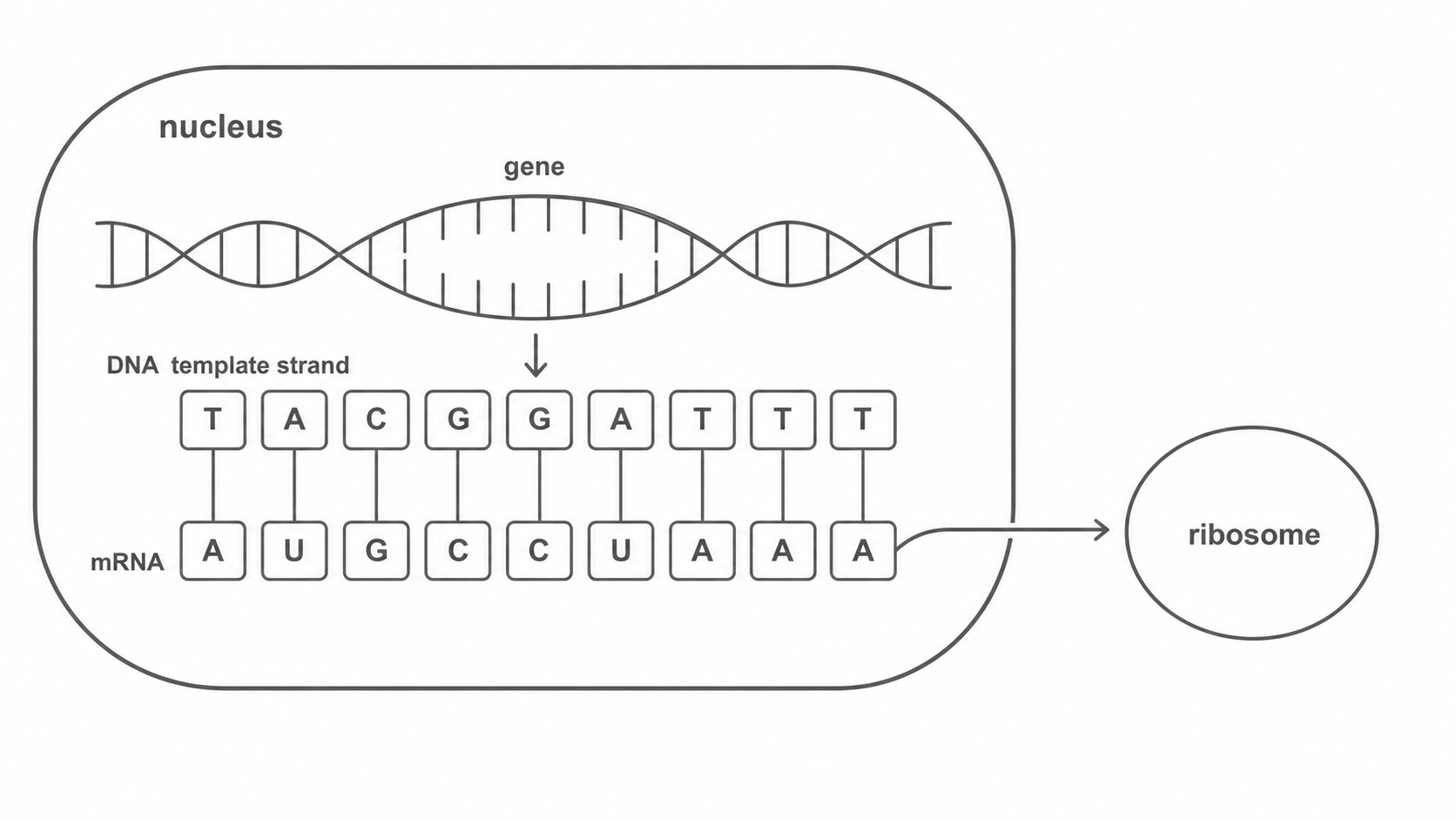
The base-pairing rule is similar to DNA base pairing, but RNA uses U instead of T:
| DNA template base | RNA base added |
|---|---|
| A | U |
| T | A |
| C | G |
| G | C |
For example, if the DNA template sequence is TAC GGA TTT, the mRNA sequence formed is AUG CCU AAA. The mRNA then leaves the nucleus and travels to a ribosome.
Codons and anticodons
The genetic code is read in groups of three bases. A group of three bases on mRNA is called a codon. Each codon can specify an amino acid.
Codon
A codon is a sequence of three bases on mRNA that codes for an amino acid or a protein-synthesis instruction.
Triplets are useful because there are four different RNA bases: A, U, C and G. If bases were read one at a time, there would be only four possible codes. If they were read in pairs, there would be possible codes, which is not enough for 20 different amino acids. Reading bases in threes gives possible codons, enough to code for the amino acids used in proteins.
tRNA molecules carry amino acids to the ribosome. Each tRNA has an anticodon, a three-base sequence that is complementary to an mRNA codon.
Continue this lesson.
You’re previewing NovaLearn without an account. Create a free account to read the rest.
Create free account