2.94-2.95B - Hormones and endocrine control
Hormones are chemical messages that help coordinate body processes. This lesson focuses on the source, role and effect of the named hormones in the specification: adrenaline, insulin, testosterone, progesterone, oestrogen, and the Biology-only hormones ADH, FSH and LH. The key skill is to link the gland that releases a hormone to the change it causes in its target organs.
Endocrine messages
An endocrine gland releases hormones directly into the blood. The blood carries each hormone around the body, but only target organs or target cells respond strongly because they have the right receptors for that hormone.
Hormone
A hormone is a chemical substance released by an endocrine gland and carried in the blood, where it alters the activity of one or more target organs.
For this lesson, learn each hormone as a three-part chain:
- source: the gland or organ that releases the hormone
- role: the job the hormone helps control
- effect: the actual change caused in the target organ or body system
For example, the pancreas is the source of insulin. Insulin's role is to reduce blood glucose concentration when it is too high. Its effect is that liver and muscle cells take in glucose and convert some of it to glycogen for storage.
Do not swap source and target. The kidney is a target organ for ADH, but it is not the source of ADH. The ovaries are target organs for FSH and LH, but the pituitary gland is the source of FSH and LH.
Adrenaline and insulin
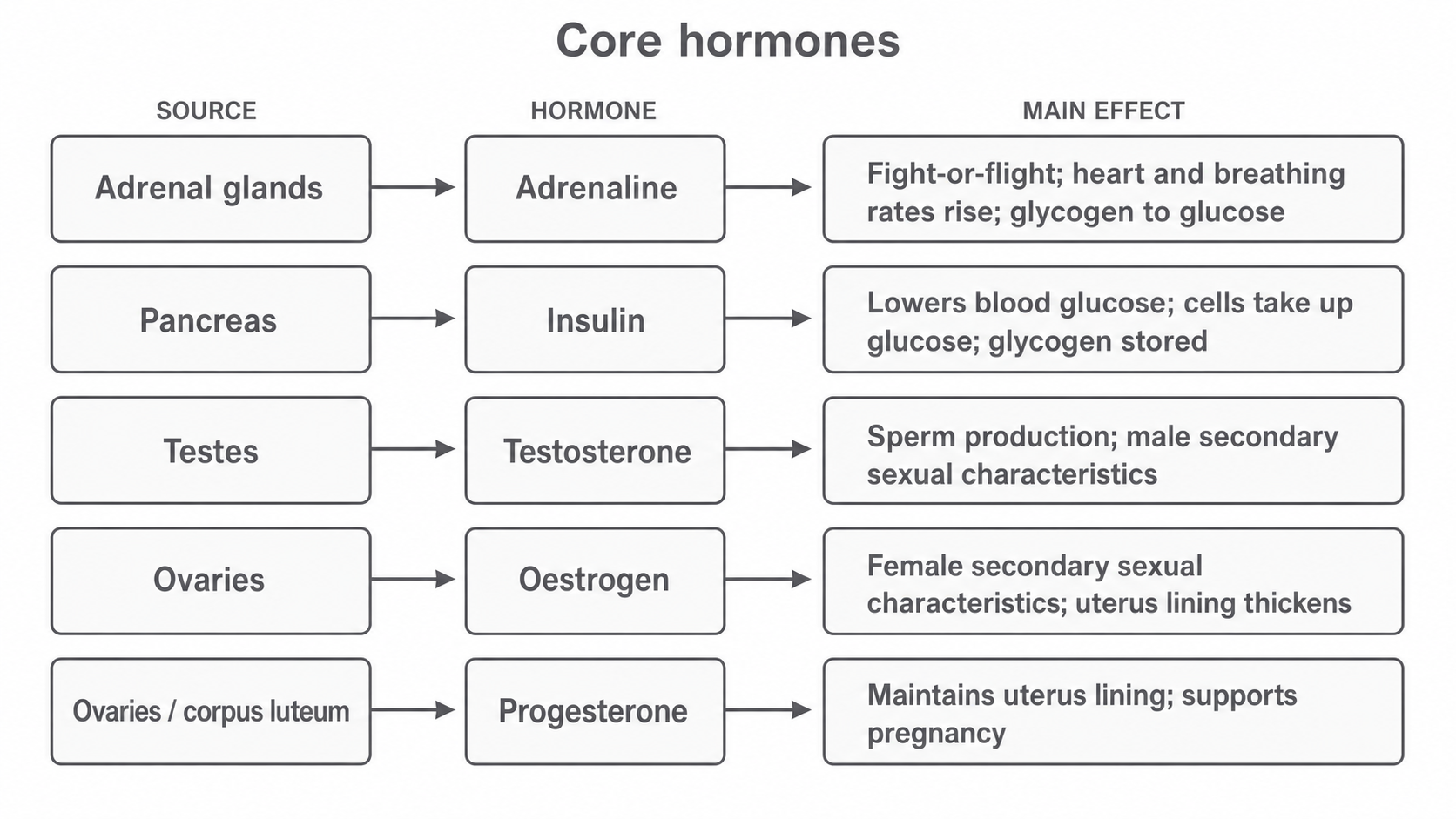
Adrenaline is released by the adrenal glands, which are found above the kidneys. Its role is to prepare the body for sudden action, often called a fight-or-flight response.
Adrenaline has several linked effects:
- heart rate increases, so blood transports substances faster
- breathing rate increases, so more oxygen enters the blood and more carbon dioxide is removed
- stored glycogen is broken down to glucose, especially in the liver
- more glucose and oxygen are available to muscle cells for aerobic respiration
The important exam link is not just "adrenaline increases heart rate". The biological reason is that active muscles need a faster supply of oxygen and glucose for respiration.
Insulin is released by the pancreas. Its role is to lower blood glucose concentration when blood glucose is too high, such as after a meal.
Insulin causes liver and muscle cells to take glucose out of the blood. In the liver and muscles, glucose can be converted to glycogen for storage. This reduces blood glucose concentration back towards normal.
This cluster only requires insulin from the blood-glucose control system. Do not bring in other hormones unless a later lesson has taught them.
Sex hormones
Testosterone, oestrogen and progesterone are sex hormones. In this cluster, focus on their sources, broad roles and effects. Detailed menstrual-cycle control is taught later in the reproduction topic.
Testosterone is released by the testes. It is the main male sex hormone. Its effects include stimulating sperm production and causing male secondary sexual characteristics such as a deeper voice, facial and body hair, and increased muscle development.
Oestrogen is released by the ovaries. It is one of the main female sex hormones. Its effects include causing female secondary sexual characteristics and helping repair or thicken the uterus lining during the menstrual cycle.
Progesterone is released by the ovaries, especially by the corpus luteum within the ovary after ovulation. Its role is to maintain the uterus lining, preparing it for implantation and helping maintain early pregnancy if fertilisation occurs.
[DIAGRAM: asset_name: Hormones and endocrine control - diagram 01; asset_slug: b39_hormones_and_endocrine_control__diagram_01; recommended_method: deterministic_drawing; description: Monochrome flow map of the five core hormones showing source gland, hormone name, role and main effect for adrenaline, insulin, testosterone, oestrogen and progesterone.]
Be precise with source words. "Testosterone comes from the male reproductive system" is too vague. "Testosterone is released by the testes" is the mark-scheme answer.
Continue this lesson.
You’re previewing NovaLearn without an account. Create a free account to read the rest.
Create free account