3.23, 3.25 - Monohybrid inheritance and genetic diagrams
A monohybrid cross follows the inheritance of one characteristic controlled by one gene. Genetic diagrams are a tidy way to show how parental alleles can combine in offspring, then use those combinations to predict probabilities. In this lesson, the focus is not memorising one cross, but learning the method that works for any simple monohybrid question.
What genetic diagrams show
A monohybrid cross follows one gene at a time. For example, a cross about fur length is monohybrid if it only follows the alleles for fur length, even if the organisms also have many other inherited characteristics.
Genetic diagram
A genetic diagram shows the parental genotypes, the gametes they can make, and the possible offspring genotypes from a cross.
In a simple dominant-recessive example, each parent has two alleles for the gene. Each gamete receives one allele from that pair. At fertilisation, one allele from each parent combines to make the offspring genotype.
The usual allele notation is:
- a capital letter for the dominant allele, such as H
- the lower-case version of the same letter for the recessive allele, such as h
- two letters together for a genotype, such as HH, Hh or hh
If a question gives you allele letters, use them. If it does not, choose one clear letter and keep the capital/lower-case pair consistent.
Build the cross
A clear genetic diagram has four stages. Pearson mark schemes often reward these stages separately, so do not skip straight to a final percentage.
First, write the parent genotypes. For example, if H is the dominant allele for short fur and h is the recessive allele for long fur, then a heterozygous short-furred parent is Hh and a long-furred parent is hh.
Second, write the gametes each parent can produce. The Hh parent can pass on H or h. The hh parent can only pass on h.
Third, combine the gametes in a Punnett square or equivalent grid. Each box shows one possible offspring genotype.
Fourth, convert genotypes into phenotypes and ratios. In this example, Hh offspring have short fur because H is dominant, while hh offspring have long fur.
[DIAGRAM: asset_name: Monohybrid inheritance and genetic diagrams - diagram 01; asset_slug: b48_monohybrid_inheritance_and_genetic_diagrams__diagram_01; recommended_method: deterministic_drawing; description: Monochrome genetic diagram for Hh x hh showing allele key, parent genotypes, gametes, four offspring boxes, a 1:1 genotype ratio and a 1:1 phenotype ratio.]
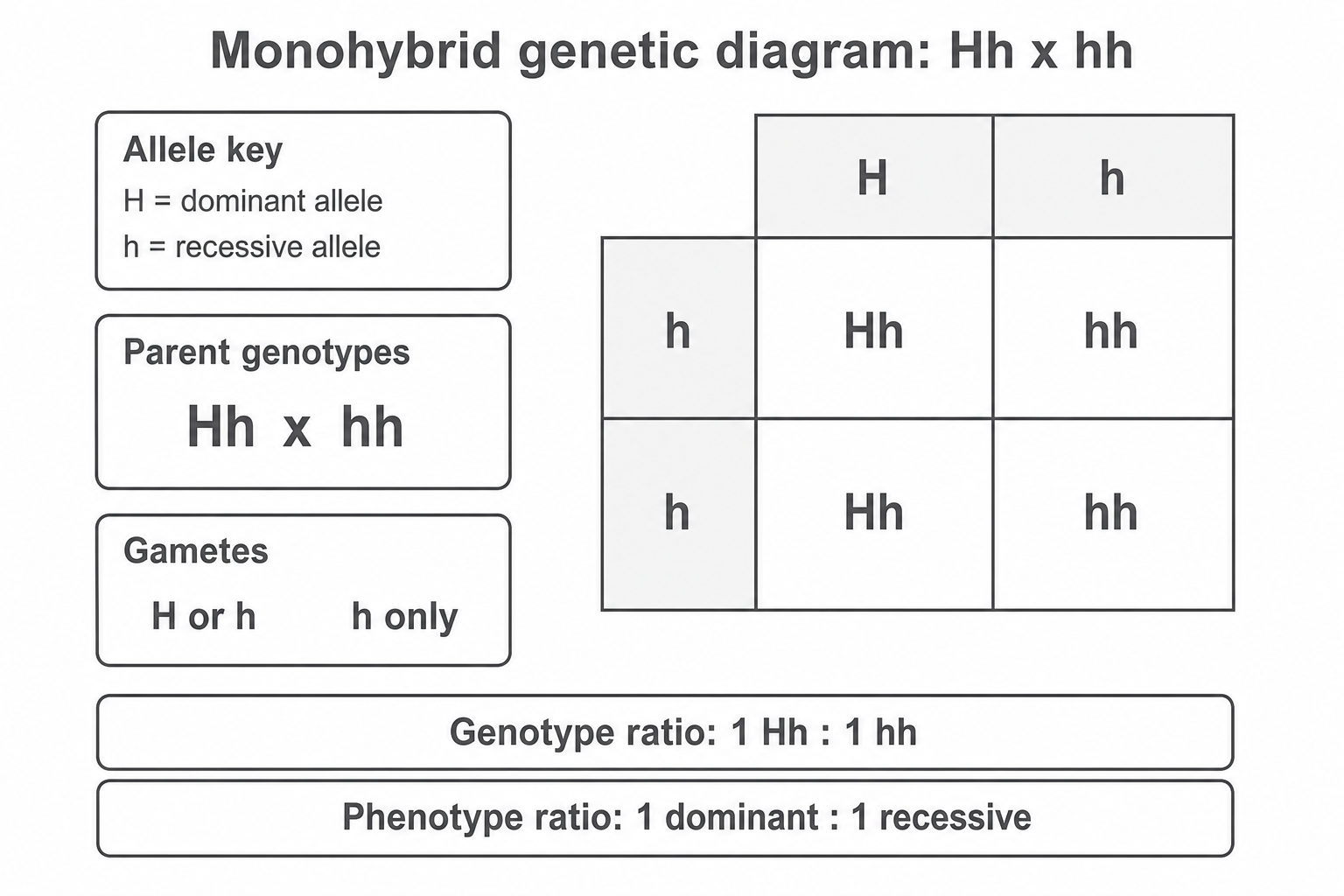
The completed cross predicts:
- genotype ratio: 1 Hh : 1 hh
- phenotype ratio: 1 short fur : 1 long fur
- probability of long-furred offspring: 1/2 or 50%
Heterozygous crosses
A very common monohybrid pattern is a cross between two heterozygous parents, such as Aa x Aa. Each parent can produce two types of gamete, A or a, so the genetic diagram has four equally likely boxes.
Continue this lesson.
You’re previewing NovaLearn without an account. Create a free account to read the rest.
Create free account