2.43B-2.45B - Stomata, day - night gas exchange and leaf gas-exchange practical
A leaf is not a sealed sheet. It has tiny adjustable pores called stomata, and those pores let gases diffuse between the air and the living cells inside the leaf. In this lesson you will track how stomata support gas exchange, why a leaf's net exchange changes between darkness, dim light and bright light, and how hydrogen-carbonate indicator shows those changes in the required practical.
Stomata as gas-exchange pores
Stoma
A stoma is a tiny pore in the epidermis of a leaf. The plural is stomata.
Stomata are openings between pairs of guard cells. When the pore is open, gases can diffuse between the outside air and the air spaces inside the leaf. Carbon dioxide can diffuse in for photosynthesis, and oxygen can diffuse out when photosynthesis is faster than respiration. Oxygen can also diffuse into the leaf when cells need it for respiration.
[DIAGRAM: asset_name: Stomata, day/night gas exchange and leaf gas-exchange practical - diagram 01; asset_slug: b19_stomata_day_night_gas_exchange_and_leaf_gas_exchange_practical__diagram_01; recommended_method: deterministic_drawing; description: Monochrome labelled diagram of an open stoma between guard cells, showing CO2 diffusion into the leaf and O2 diffusion out through the pore.]
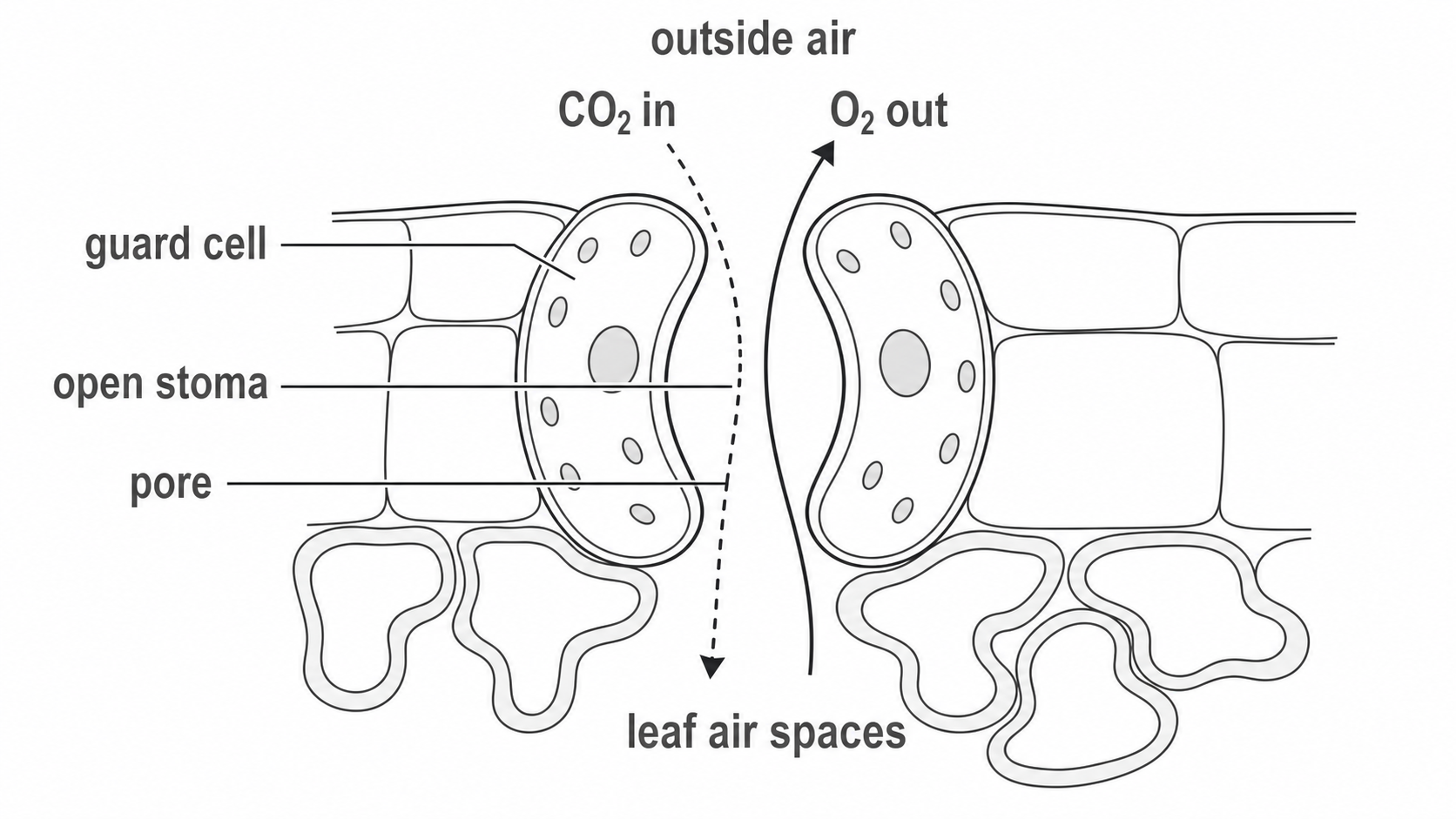
The important word is diffusion: gases move from a region where their concentration is higher to a region where their concentration is lower. Stomata do not pump gases. They provide a short, adjustable pathway for diffusion, so opening a stoma increases gas exchange and closing it reduces gas exchange.
Guard cells matter because they change the size of the pore. This helps a plant balance the need for gas exchange with the risk of losing water vapour, although this lesson focuses on carbon dioxide and oxygen exchange rather than transpiration.
Net exchange in light and dark
Respiration continues in plant cells during the day and during the night. It uses oxygen and releases carbon dioxide. Photosynthesis needs light, so it happens only when light intensity is high enough; it uses carbon dioxide and releases oxygen.
Net gas exchange means the overall movement of gases after both processes have been considered together. You can think of it as the visible result of two processes happening at once.
[DIAGRAM: asset_name: Stomata, day/night gas exchange and leaf gas-exchange practical - diagram 02; asset_slug: b19_stomata_day_night_gas_exchange_and_leaf_gas_exchange_practical__diagram_02; recommended_method: deterministic_drawing; description: Monochrome three-panel model comparing dark, dim light and bright light: respiration only/net CO2 out; photosynthesis equals respiration/no net CO2 change; photosynthesis greater than respiration/net CO2 in and O2 out.]
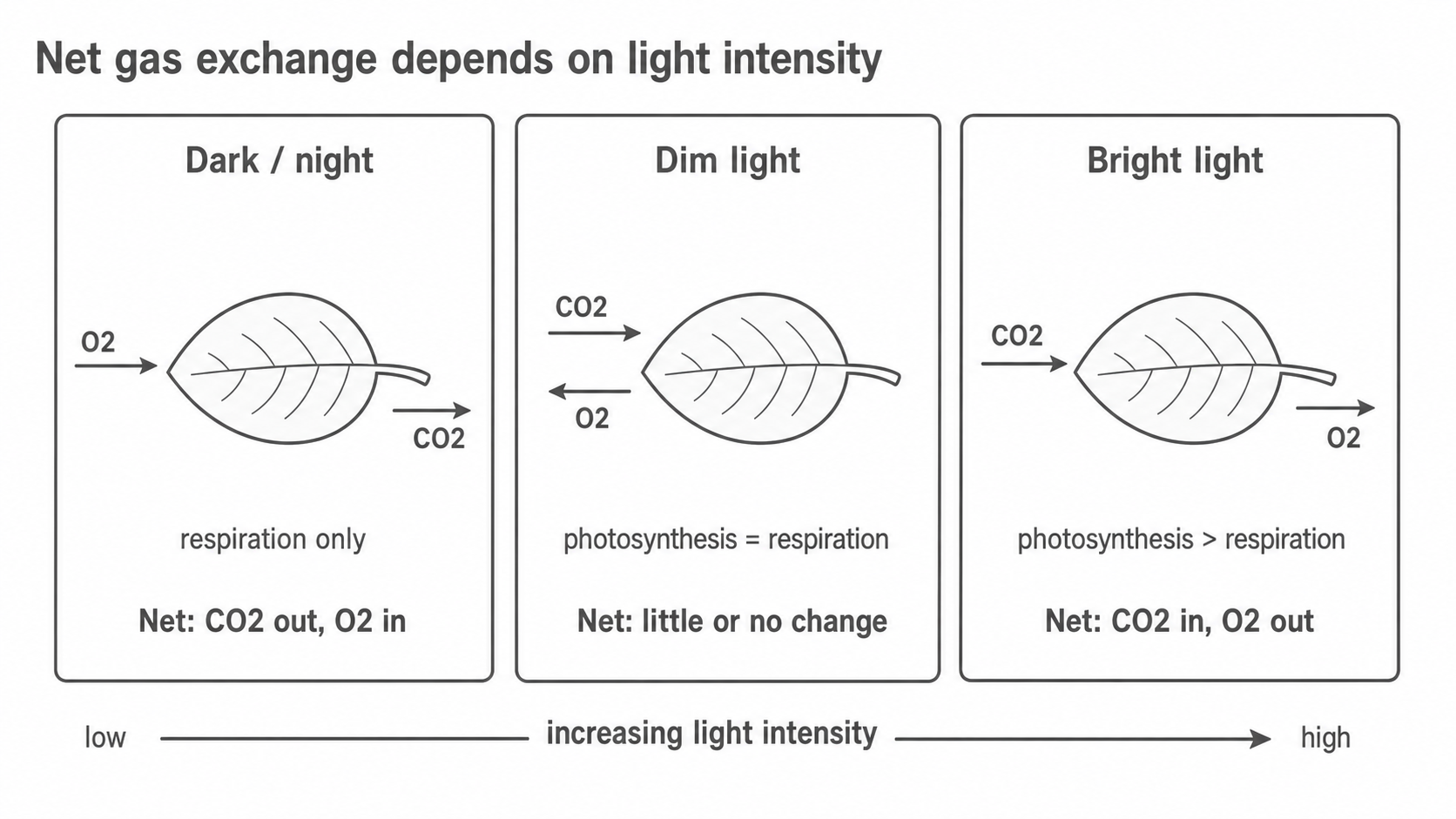
In darkness, photosynthesis stops but respiration continues. The leaf has a net uptake of oxygen and a net release of carbon dioxide.
In dim light, photosynthesis may occur at about the same rate as respiration. Carbon dioxide released by respiration is used in photosynthesis, and oxygen released by photosynthesis is used in respiration. There may be little or no net exchange with the air.
In bright light, photosynthesis is usually faster than respiration. The leaf has a net uptake of carbon dioxide and a net release of oxygen.
What hydrogen-carbonate indicator shows
Hydrogen-carbonate indicator shows changes in carbon dioxide concentration. It is not an oxygen test. This distinction is a common exam trap: the colour change lets you infer whether photosynthesis or respiration is causing a net change in carbon dioxide.
| Carbon dioxide around the leaf | Indicator colour | Interpretation |
|---|---|---|
| Higher than atmospheric | Yellow | Respiration is adding more CO2 than photosynthesis removes |
| About atmospheric | Red/orange | Little or no net change in CO2 |
| Lower than atmospheric | Purple | Photosynthesis is removing more CO2 than respiration adds |
At the start of the practical, the indicator should be red/orange because it has been allowed to reach equilibrium with normal air. If it starts yellow or purple, the results are already biased.
Purple means carbon dioxide has decreased; yellow means carbon dioxide has increased; red/orange means little or no net carbon dioxide change.
Clean apparatus is also important. Traces of acid or alkali on the glassware or bung could change the indicator colour for a chemical reason instead of because of leaf gas exchange.
Continue this lesson.
You’re previewing NovaLearn without an account. Create a free account to read the rest.
Create free account