2.88-2.90 - Synapses and reflex arcs
Some nervous responses need to happen fast enough to protect the body before conscious thought has caught up. In this lesson, you will follow an electrical impulse from a stimulated receptor, across synapses, through the central nervous system and out to an effector. The required example is the withdrawal of a finger from a hot object.
Impulses link receptors to responses
A stimulus is a change in the environment, such as heat from a hot object. A receptor detects the stimulus. When a receptor in a sense organ is stimulated strongly enough, it starts an electrical impulse.
Electrical impulse
An electrical impulse is a fast signal that travels along a neurone or nerve.
For a rapid nervous response, impulses travel:
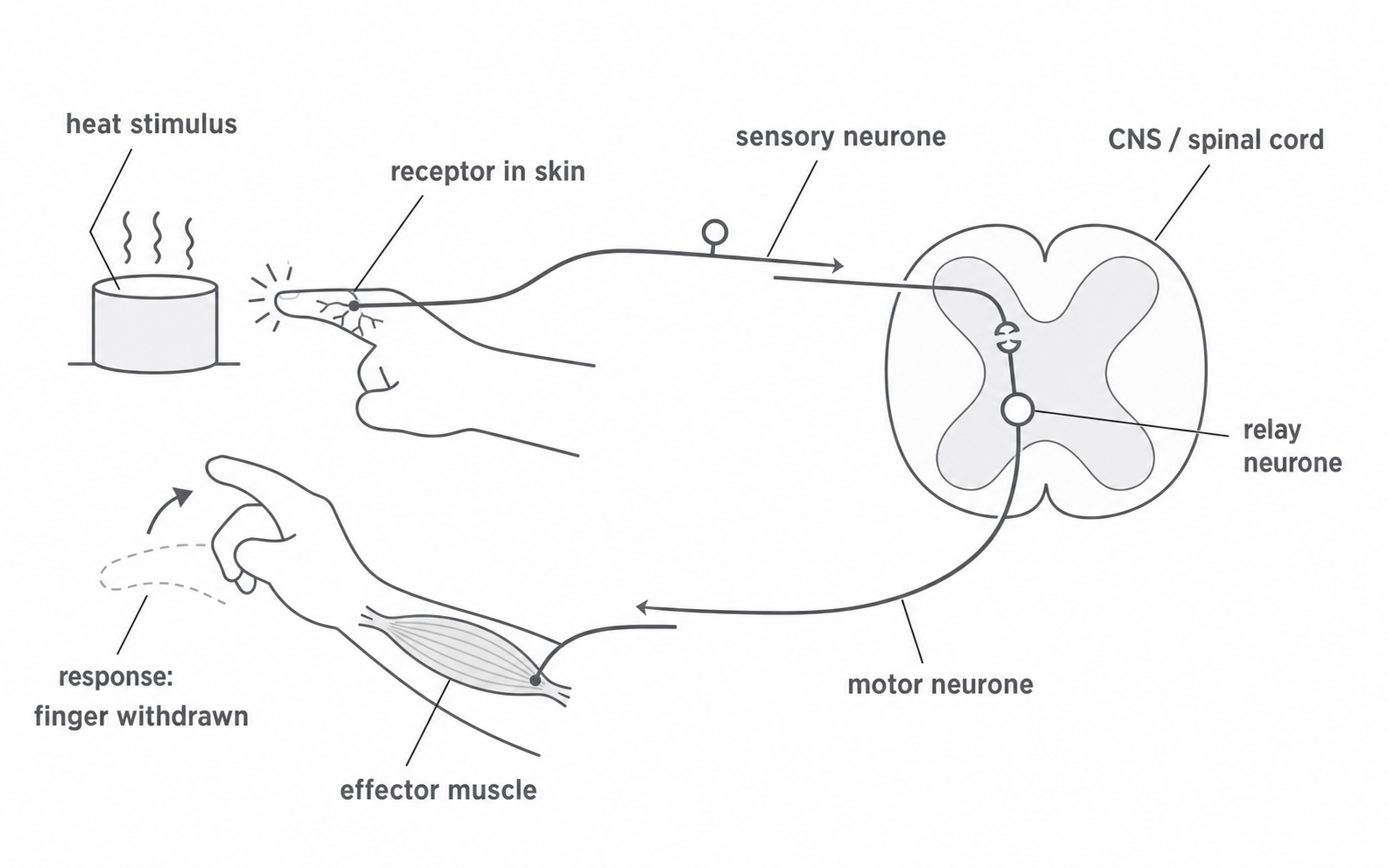
receptor -> sensory neurone -> central nervous system -> motor neurone -> effector -> response
The central nervous system, or CNS, is the brain and spinal cord. Impulses travel into the CNS from receptors and out of the CNS to effectors. An effector is a muscle or gland that produces the response; in the hot-object example, a muscle contracts so the finger moves away.
This is a nervous response, not a hormonal response. The key exam wording is that stimulation of receptors sends electrical impulses along nerves into and out of the CNS, resulting in a rapid response.
Synapses use neurotransmitters
Neurones do not join end-to-end as one continuous wire. There is a tiny gap between one neurone and the next. This junction is called a synapse.
Synapse
A synapse is a junction between neurones where information is transferred from one neurone to the next.
An electrical impulse cannot simply cross the gap. Instead, the impulse is passed across the synapse using chemicals called neurotransmitters.
Neurotransmitter
A neurotransmitter is a chemical messenger released at a synapse that passes information to the next neurone.
The sequence at a synapse is:
- An electrical impulse reaches the end of the first neurone.
- Neurotransmitter is released into the synapse.
- The neurotransmitter diffuses across the gap.
- The neurotransmitter binds to receptors on the next neurone.
- A new electrical impulse is started in the next neurone.
[DIAGRAM: asset_name: Synapses and reflex arcs - diagram 01; asset_slug: b36_synapses_and_reflex_arcs__diagram_01; recommended_method: deterministic_drawing; description: Monochrome labelled synapse diagram showing an electrical impulse reaching the axon terminal of the first neurone, neurotransmitter molecules diffusing across the synaptic gap, receptors on the next neurone, and a new electrical impulse continuing in the second neurone.]
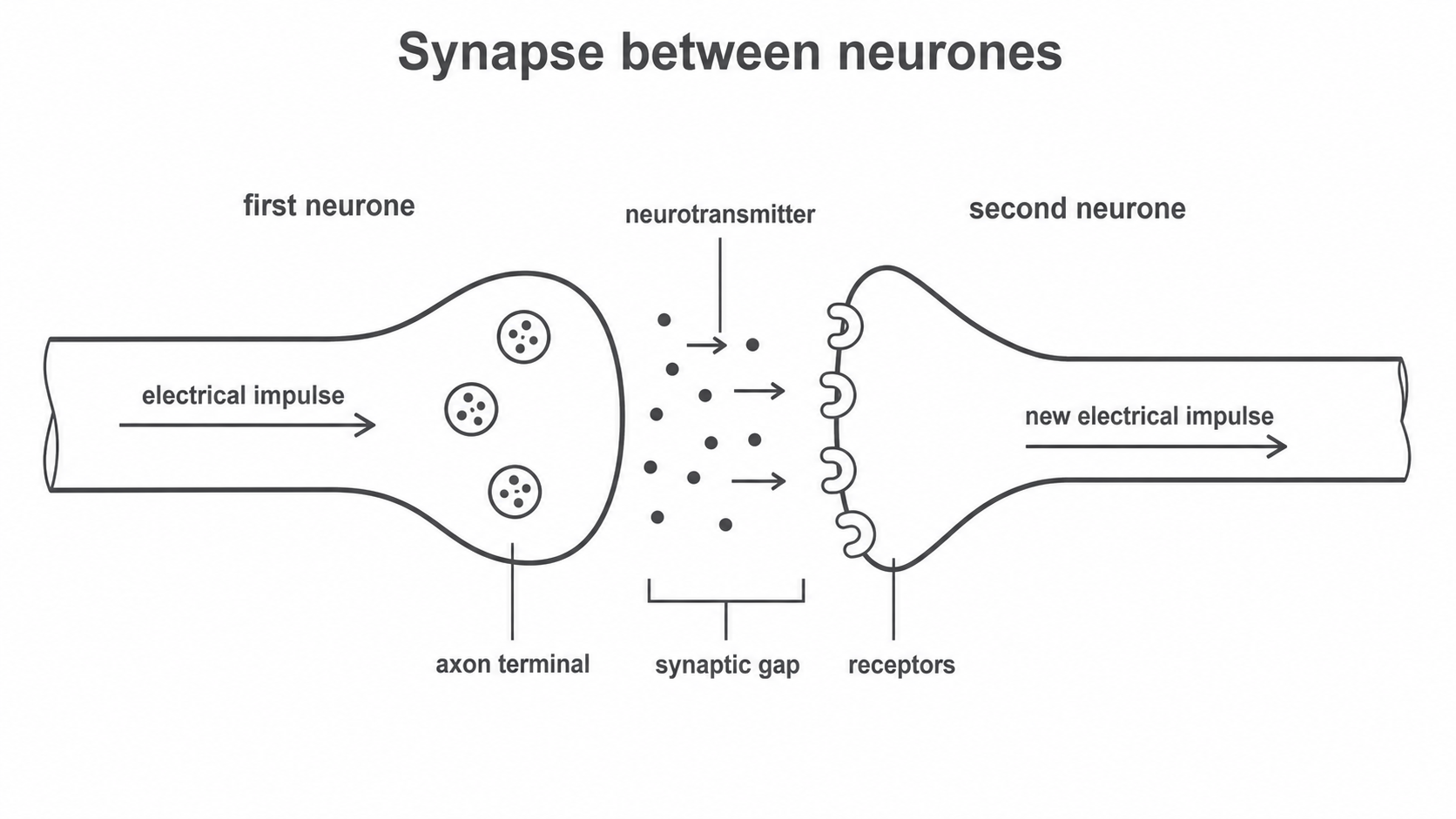
This means the signal is electrical along neurones, chemical across synapses, then electrical again along the next neurone.
The withdrawal reflex arc
A reflex arc is the pathway followed by impulses in a reflex response. Edexcel's required example is withdrawing a finger from a hot object.
[DIAGRAM: asset_name: Synapses and reflex arcs - diagram 02; asset_slug: b36_synapses_and_reflex_arcs__diagram_02; recommended_method: deterministic_drawing; description: Monochrome labelled reflex arc for withdrawal of a finger from a hot object, showing heat stimulus, receptor in finger skin, sensory neurone carrying impulse to CNS/spinal cord, relay neurone in the CNS, motor neurone carrying impulse to arm muscle effector, and muscle contraction withdrawing the finger.]
Continue this lesson.
You’re previewing NovaLearn without an account. Create a free account to read the rest.
Create free account