4.18B - Deforestation and environmental consequences
Deforestation changes more than the number of trees in an area. Removing forest cover exposes soil, changes how water returns to the atmosphere, and alters the movement of carbon between living biomass, soil and air. Edexcel questions usually reward linked cause-and-effect chains, so the aim is to explain what has been removed and what changes because of it.
What deforestation removes
Deforestation is the removal of trees from a forested area, often so the land can be used for farming, grazing, roads or buildings. In this specification point, you do not need case-study details about a named forest. You need to understand the environmental effects of removing the forest system.
Deforestation
Deforestation is the removal of forest trees from an area, especially when forest land is changed to another use.
A forest is not just a set of tree trunks. The trees, roots, leaf litter and soil organisms help keep the local environment stable.
| Forest feature | What it does before deforestation |
|---|---|
| Leaves and canopy | Intercept rain, shade the soil, photosynthesise and transpire water vapour. |
| Roots | Bind soil particles together, take up water and mineral ions, and leave channels for infiltration. |
| Leaf litter and dead wood | Protect the soil surface and recycle mineral ions as decomposers break them down. |
| Living biomass | Stores carbon in wood, leaves, roots and other organic molecules. |
When forest is removed, these functions are reduced or lost. That is why deforestation can affect soil, water cycling and atmospheric gases at the same time.
Leaching and soil erosion
Two soil effects named in the specification are leaching and soil erosion. They are linked, but they are not the same process.
Leaching
Leaching is the movement of soluble mineral ions out of soil when water drains through it.
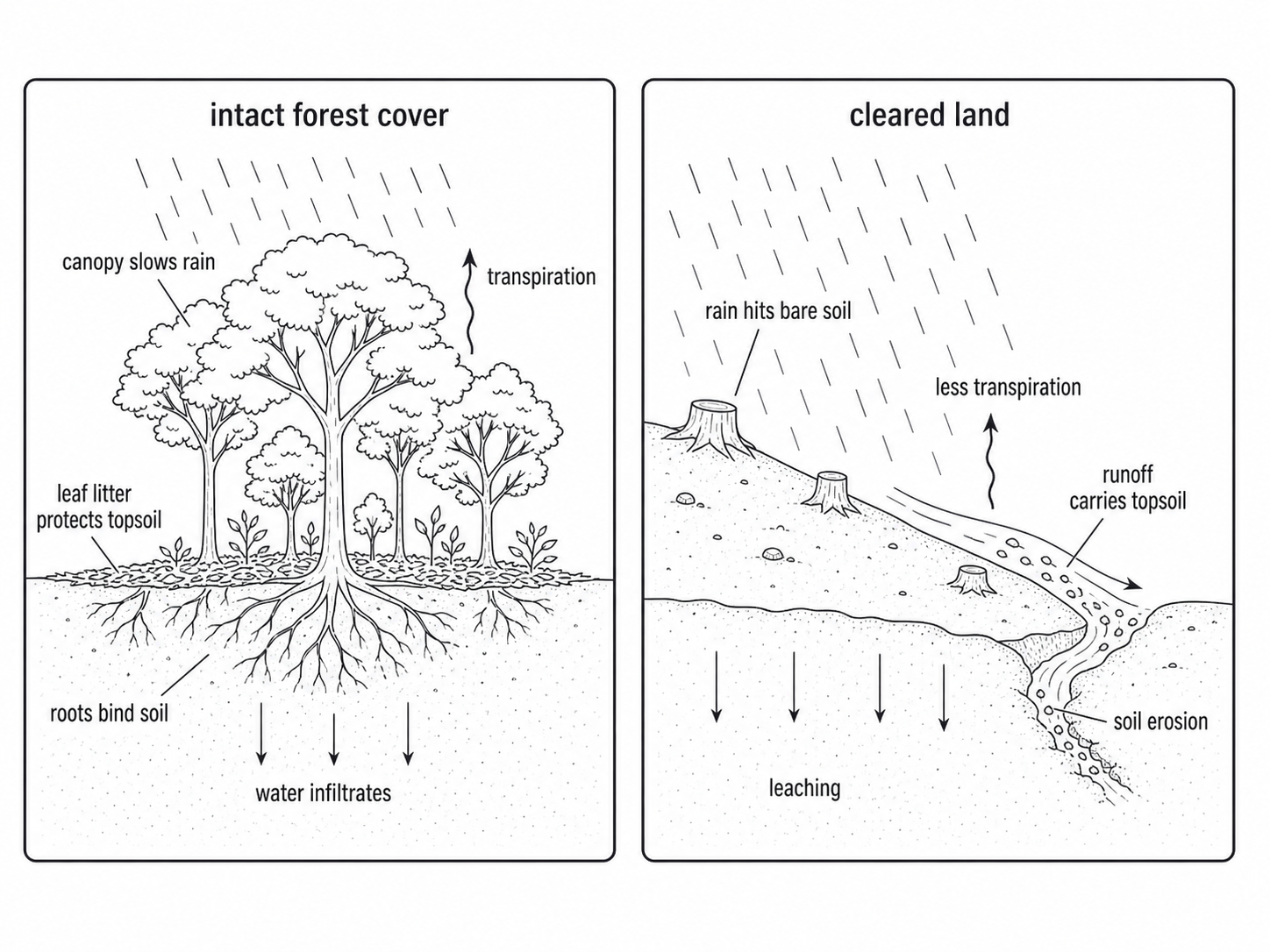
In a forest, mineral ions are recycled quickly. Leaves and branches fall, decomposers break them down, and roots take up the released mineral ions. After deforestation, there is less leaf litter and fewer roots, so this recycling is disrupted. Heavy rain can wash soluble mineral ions down through the soil or away in runoff. The soil becomes less fertile because mineral ions needed for plant growth are lost.
Soil erosion
Soil erosion is the removal of soil, especially fertile topsoil, by water, wind or gravity.
Forest roots help hold soil particles together. The canopy and leaf litter also reduce the impact of heavy rain on the soil surface. When trees are removed, rain can hit bare soil directly, surface runoff increases, and topsoil can be washed into streams or rivers. This removes fertile soil from the land and can add sediment to water habitats.
[DIAGRAM: asset_name: Deforestation and environmental consequences - diagram 01; asset_slug: b61_deforestation_and_environmental_consequences__diagram_01; recommended_method: deterministic_drawing; description: Monochrome two-panel schematic comparing intact forest cover with cleared land, showing canopy, leaf litter, roots, infiltration and evapotranspiration in the intact forest, and rain-driven leaching, surface runoff and soil erosion on cleared land.]
A strong exam answer names the process and its consequence. "Soil gets bad" is too vague. Write "mineral ions are leached from the soil, so the soil is less fertile" or "topsoil is eroded, so fewer plants can grow".
Disturbing evapotranspiration
Evapotranspiration is the movement of water from land to the atmosphere by evaporation and transpiration together. Evaporation can occur from soil and water surfaces. Transpiration occurs when water is taken up by plant roots, moves through the plant, and leaves as water vapour from the leaves.
Evapotranspiration
Evapotranspiration is the combined movement of water vapour from land to the atmosphere by evaporation and transpiration.
Forests can return large amounts of water vapour to the atmosphere because they have many leaves and deep or widespread root systems. Removing trees means less water is taken up by roots and less water vapour is released from leaves. This can disturb local water cycling by reducing humidity, cloud formation or rainfall in some areas. It can also leave more rainwater moving as surface runoff instead of passing through plants.
Continue this lesson.
You’re previewing NovaLearn without an account. Create a free account to read the rest.
Create free account