5.12-5.14 - Genetic engineering process
Genetic engineering changes an organism by moving useful DNA into cells. In this lesson, the useful DNA is the human insulin gene, and the receiving cells are bacteria. The exam sequence depends on four ideas: restriction enzymes cut DNA, ligase joins DNA, vectors carry recombinant DNA into cells, and a fermenter grows many genetically modified bacteria.
Cutting and joining DNA
Restriction enzymes are used as molecular cutting tools. Each restriction enzyme cuts DNA at a specific base sequence, so a chosen piece of DNA can be cut out rather than DNA being broken randomly.
Restriction enzyme
A restriction enzyme cuts DNA at specific sites.
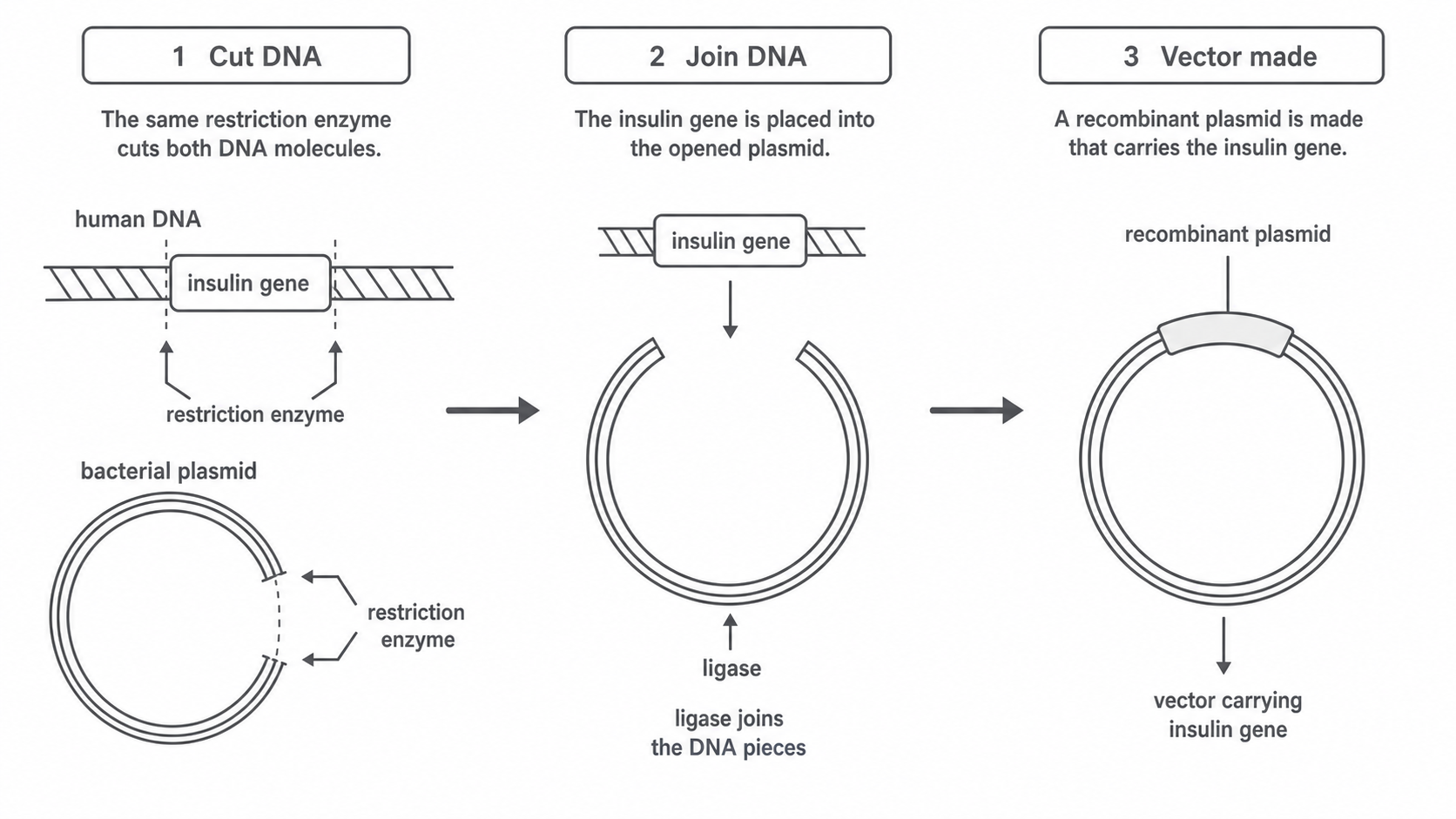
The useful gene is a piece of DNA. To move that gene into another cell, the gene and the vector DNA both need to be cut so the gene can be fitted into the vector. In a simple insulin example, a restriction enzyme cuts out the human insulin gene from human DNA, and the same type of restriction enzyme cuts open a bacterial plasmid.
Ligase enzymes do the opposite job. They join pieces of DNA together after they have been lined up.
Ligase enzyme
A ligase enzyme joins pieces of DNA together.
When a piece of DNA from one source is joined into vector DNA, the new DNA is called recombinant DNA. In the insulin example, the plasmid plus the human insulin gene is recombinant DNA.
[DIAGRAM: asset_name: Genetic engineering process - diagram 01; asset_slug: b66_genetic_engineering_process__diagram_01; recommended_method: deterministic_drawing; description: Monochrome process diagram showing human DNA with the insulin gene, a bacterial plasmid, the same restriction enzyme cutting both DNA molecules, ligase joining the insulin gene into the opened plasmid, and the resulting recombinant plasmid labelled as a vector carrying the insulin gene.]
Vectors carry recombinant DNA
A vector is a carrier used to move DNA into another cell. In this specification, the two named examples are plasmids and viruses.
Vector
A vector carries DNA into another cell.
A plasmid is a small circular piece of DNA found in bacteria. In genetic engineering, a plasmid can be cut open, take up a useful piece of DNA, and then be inserted into a bacterial cell. The plasmid is useful because it can carry the recombinant DNA into the bacterium.
Viruses can also act as vectors. A virus naturally enters host cells and delivers genetic material, so a modified virus can be used to insert recombinant DNA into cells. For this lesson, you only need the vector role: plasmids and viruses can carry recombinant DNA into other cells.
Keep the jobs separate. The useful gene gives the genetic instruction. The vector carries that DNA into a cell. The receiving cell then uses the inserted DNA.
Making GM bacteria
The insulin example is the main process you need for this cluster. A good answer is a sequence, not a loose list of words.
- A restriction enzyme cuts out the human insulin gene from human DNA.
- A bacterial plasmid is cut open using a restriction enzyme.
- The insulin gene is placed into the cut plasmid.
- Ligase joins the insulin gene into the plasmid, forming a recombinant plasmid.
- The recombinant plasmid is inserted into a bacterium.
- The bacterium is now genetically modified because it contains recombinant DNA with the human insulin gene.
Continue this lesson.
You’re previewing NovaLearn without an account. Create a free account to read the rest.
Create free account