2.93 - Skin and temperature regulation
Body temperature must be kept within a suitable range so that enzyme-controlled reactions can work properly. The skin helps with this by controlling heat loss from the body surface. In this lesson, the three named Edexcel mechanisms are sweating, vasodilation and vasoconstriction.
Skin as a control surface
The skin is the body's main boundary with the surroundings. This makes it a useful place to control heat loss: heat can be lost from blood through the skin surface, and water can evaporate from sweat on the surface.
The specification focuses on two skin features:
- sweat glands, which release sweat onto the skin surface
- blood vessels in the skin, which can change the amount of blood flowing close to the surface
[DIAGRAM: asset_name: skin_control_structures; asset_slug: b38_skin_and_temperature_regulation__diagram_01; recommended_method: deterministic_drawing; description: Monochrome cross-section of skin showing epidermis, dermis, sweat gland, sweat duct and pore, surface capillary network and arteriole, with heat-loss arrows from the skin surface.]
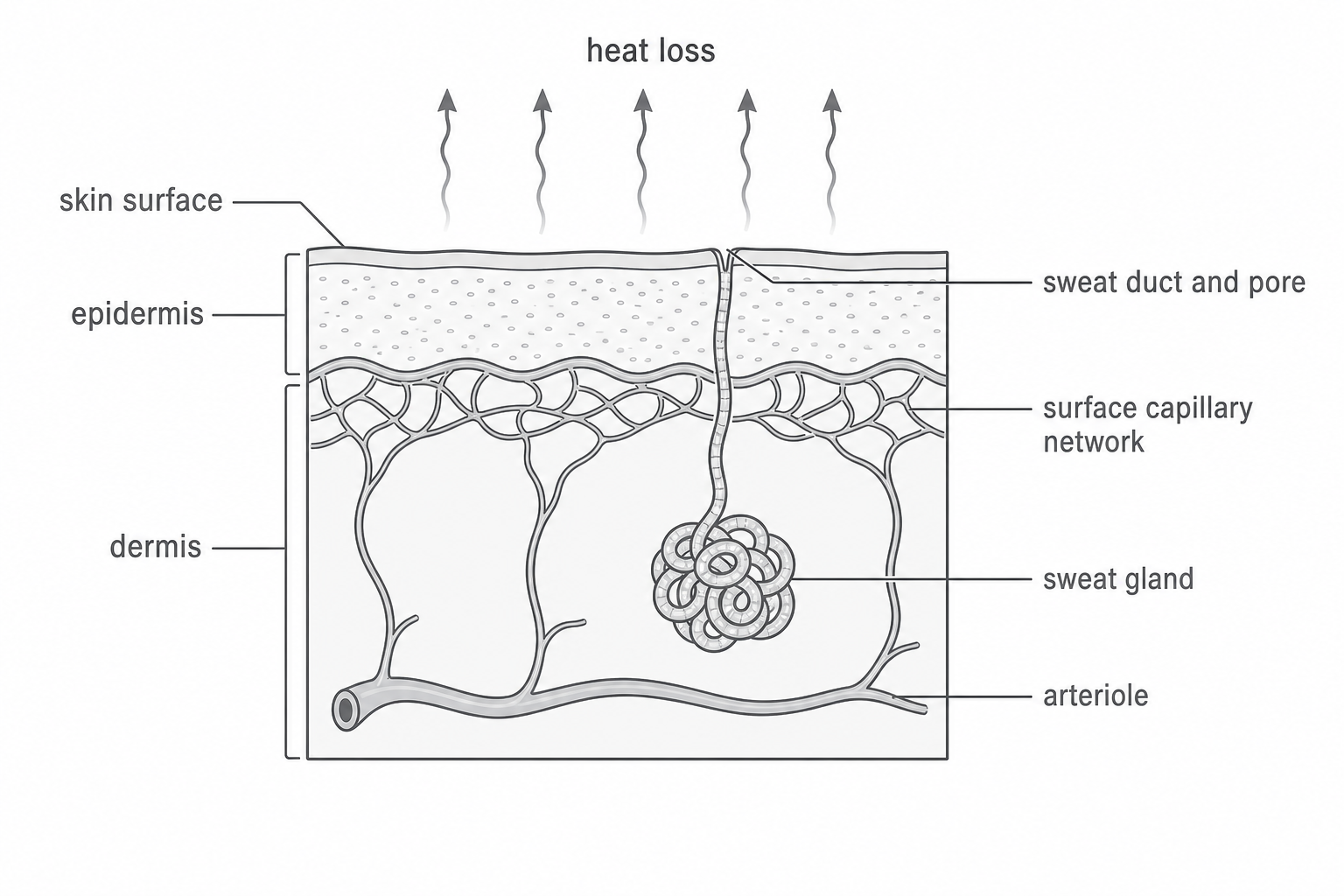
When body temperature rises above the normal range, the body needs to increase heat loss. When body temperature falls below the normal range, the body needs to reduce heat loss. The skin's role is to adjust what happens at the body surface so that temperature moves back towards the suitable range.
Sweating and evaporation
Sweating is a response to a body temperature that is too high. Sweat glands in the skin release sweat, which reaches the skin surface through sweat ducts and pores.
Sweat contains water and dissolved salts. The important cooling substance is the water. When water in sweat evaporates from the skin surface, it changes from liquid water to water vapour. This evaporation transfers heat energy away from the skin, so the skin and the blood flowing near it are cooled.
Sweat does not cool the body just because it is wet or because it is cold. The key event is evaporation. If sweat drips off the skin without evaporating, it removes much less heat. This is why hot, humid conditions can make cooling harder: evaporation from the skin surface is less effective.
The exam answer chain is:
sweat released -> sweat evaporates -> heat lost from skin/blood -> body temperature falls or is maintained
Vasodilation when too hot
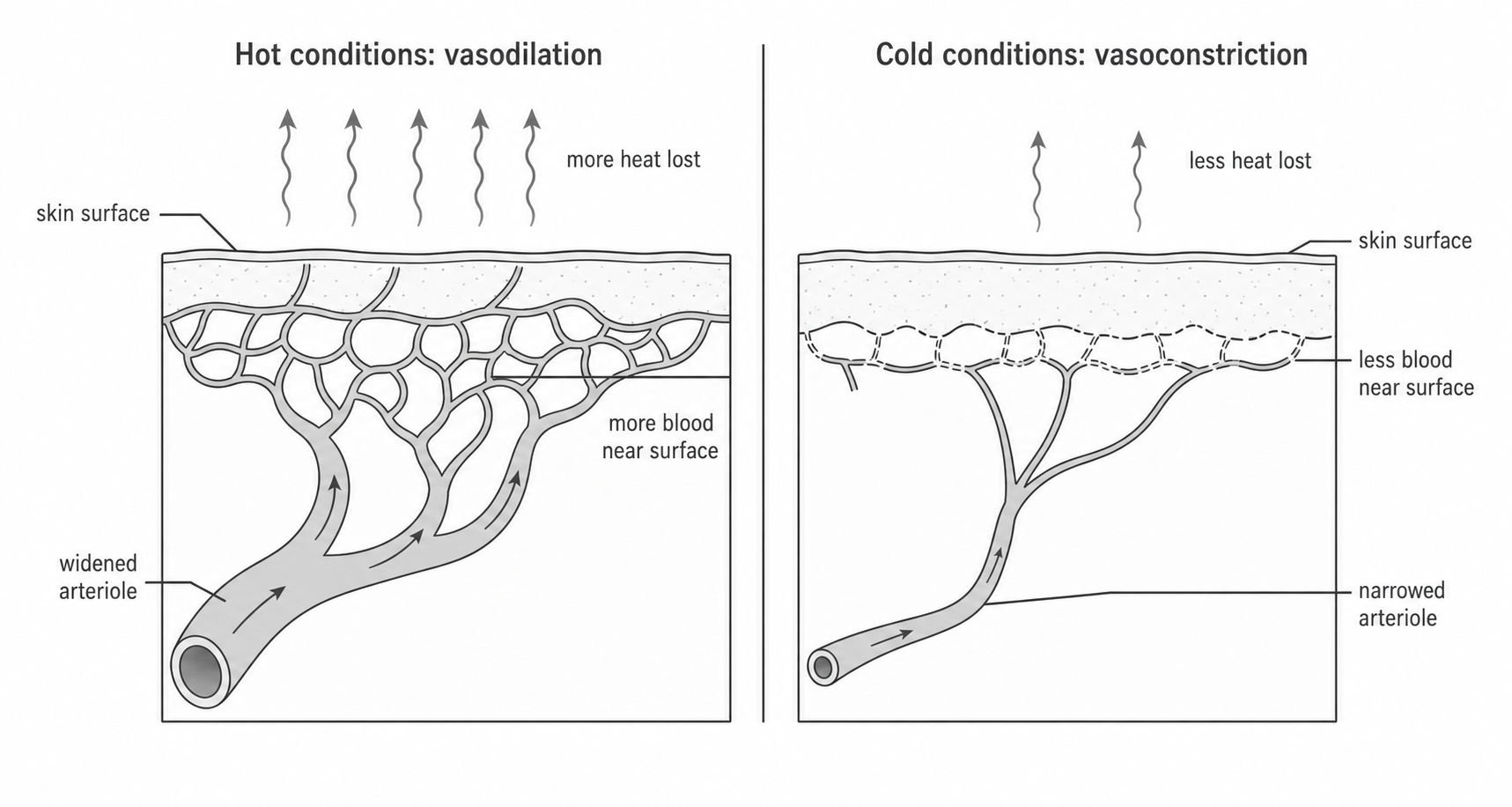
Vasodilation is another response when body temperature is too high. It changes blood flow through the skin, so more heat can be lost from the blood to the surroundings.
Vasodilation
Vasodilation is the widening of blood vessels, especially arterioles supplying the skin.
In warm conditions, arterioles supplying the skin get wider. More blood flows through capillaries close to the skin surface. Because this blood is warm, more heat is transferred from the blood through the skin surface to the surroundings.
[DIAGRAM: asset_name: vasodilation_vasoconstriction; asset_slug: b38_skin_and_temperature_regulation__diagram_02; recommended_method: deterministic_drawing; description: Two-panel monochrome comparison showing hot conditions with widened arteriole and more blood through capillaries near the skin surface, and cold conditions with narrowed arteriole and less surface blood flow.]
Continue this lesson.
You’re previewing NovaLearn without an account. Create a free account to read the rest.
Create free account