3.38-3.39 - Natural selection and antibiotic resistance
Darwin's theory explains how populations can change over many generations without any organism choosing to change. Natural selection depends on inherited variation, different chances of survival and reproduction, and the passing on of advantageous characteristics. Antibiotic resistance is the same selection logic in a fast-reproducing bacterial population, with the antibiotic acting as the selection pressure.
Darwin's theory of natural selection
Darwin's theory of evolution by natural selection explains how populations become better suited to their environment over generations. The theory starts with a simple observation: individuals in a population are not all identical.
Population
A population is a group of organisms of the same species living in the same area.
Some variation is inherited. For example, one organism may inherit a characteristic that helps it survive a particular selection pressure, such as limited food, a predator, disease, or a change in the environment. Other variation may not help survival or reproduction in that environment.
Selection pressure
A selection pressure is an environmental factor that affects which organisms survive and reproduce.
Natural selection happens when individuals with an advantageous inherited characteristic are more likely to survive and reproduce. Their offspring inherit the characteristic, so the characteristic becomes more common in the population over many generations. This change in inherited characteristics of a population over time is evolution.
The word "natural" matters because no person is choosing the parents. The environment is effectively doing the selecting: organisms with characteristics suited to that environment leave more offspring than organisms without those characteristics.
Selection over generations
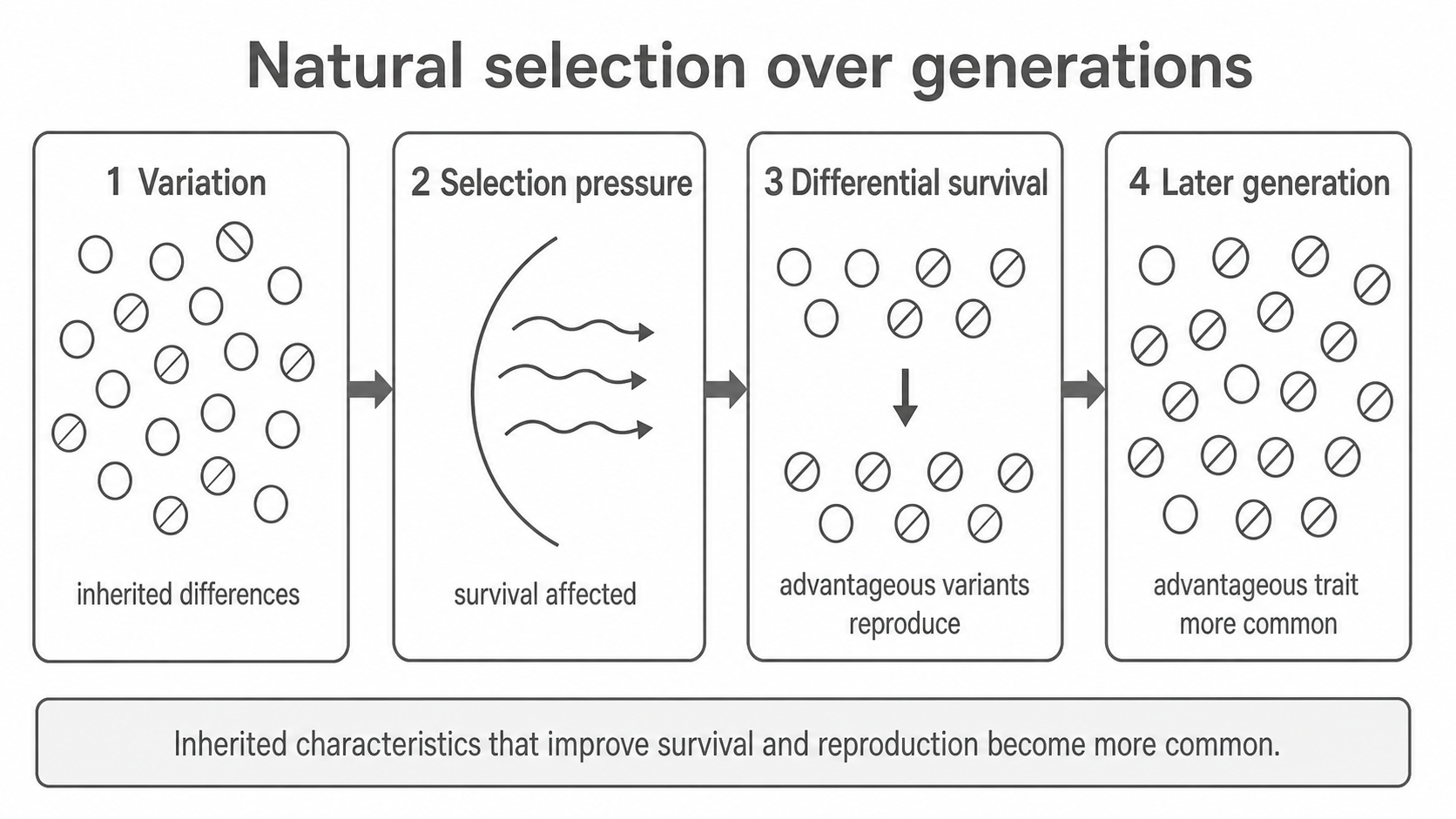
Natural selection is easiest to write as a chain of linked ideas. Each step matters in an exam answer:
- There is inherited variation in a population.
- A selection pressure affects survival or reproduction.
- Individuals with an advantageous inherited characteristic are more likely to survive.
- These individuals reproduce and pass the characteristic to offspring.
- Over many generations, the advantageous characteristic becomes more common in the population.
[DIAGRAM: asset_name: Natural selection and antibiotic resistance - diagram 01; asset_slug: b54_natural_selection_and_antibiotic_resistance__diagram_01; recommended_method: deterministic_drawing; description: Monochrome flow diagram showing a starting population with inherited variation, a selection pressure, differential survival and reproduction, and a later generation where the advantageous inherited characteristic is more common.]
Do not write that an individual organism evolves during its lifetime. An organism may survive or die, but the population changes across generations. Do not write that organisms change because they need to. Natural selection acts on variation that already exists or arises randomly; it does not plan ahead.
The phrase "survival of the fittest" is only useful if "fittest" means best adapted to that environment and more likely to reproduce. In biology, fitness is about passing on inherited characteristics, not about being strongest in the everyday sense.
Antibiotics as a selection pressure
Antibiotics are medicines used to treat bacterial infections. In a bacterial population, a few bacteria may have inherited resistance to an antibiotic. This resistance means they can survive exposure to that antibiotic better than susceptible bacteria.
Continue this lesson.
You’re previewing NovaLearn without an account. Create a free account to read the rest.
Create free account