2.76B-2.79B - Selective reabsorption, ADH and urine composition
The kidney does not simply filter blood and throw everything filtered away. After useful small molecules and water enter the nephron fluid, selected substances are reabsorbed back into the blood so that only waste and excess substances are lost in urine. This lesson follows two key reabsorption decisions: glucose at the proximal convoluted tubule, and water at the collecting duct under the control of ADH.
What selective reabsorption means
Fluid inside the nephron contains a mixture of substances. Some are useful to the body, such as glucose and much of the water. Others need to be removed, such as urea and excess ions.
Selective reabsorption means that useful substances are taken back from the nephron fluid into the blood. It is selective because not every substance is returned in the same way. Useful glucose is reabsorbed, much water is reabsorbed, and waste substances such as urea remain in the fluid that will become urine.
[DIAGRAM: asset_name: Selective reabsorption, ADH and urine composition - diagram 01; asset_slug: b32_selective_reabsorption_adh_and_urine_composition__diagram_01; recommended_method: deterministic_drawing; description: Monochrome simplified nephron schematic showing fluid passing through the proximal convoluted tubule and collecting duct, with glucose reabsorbed from the proximal convoluted tubule into nearby blood and water reabsorbed from the collecting duct into blood, leaving urine containing water, urea and ions.]
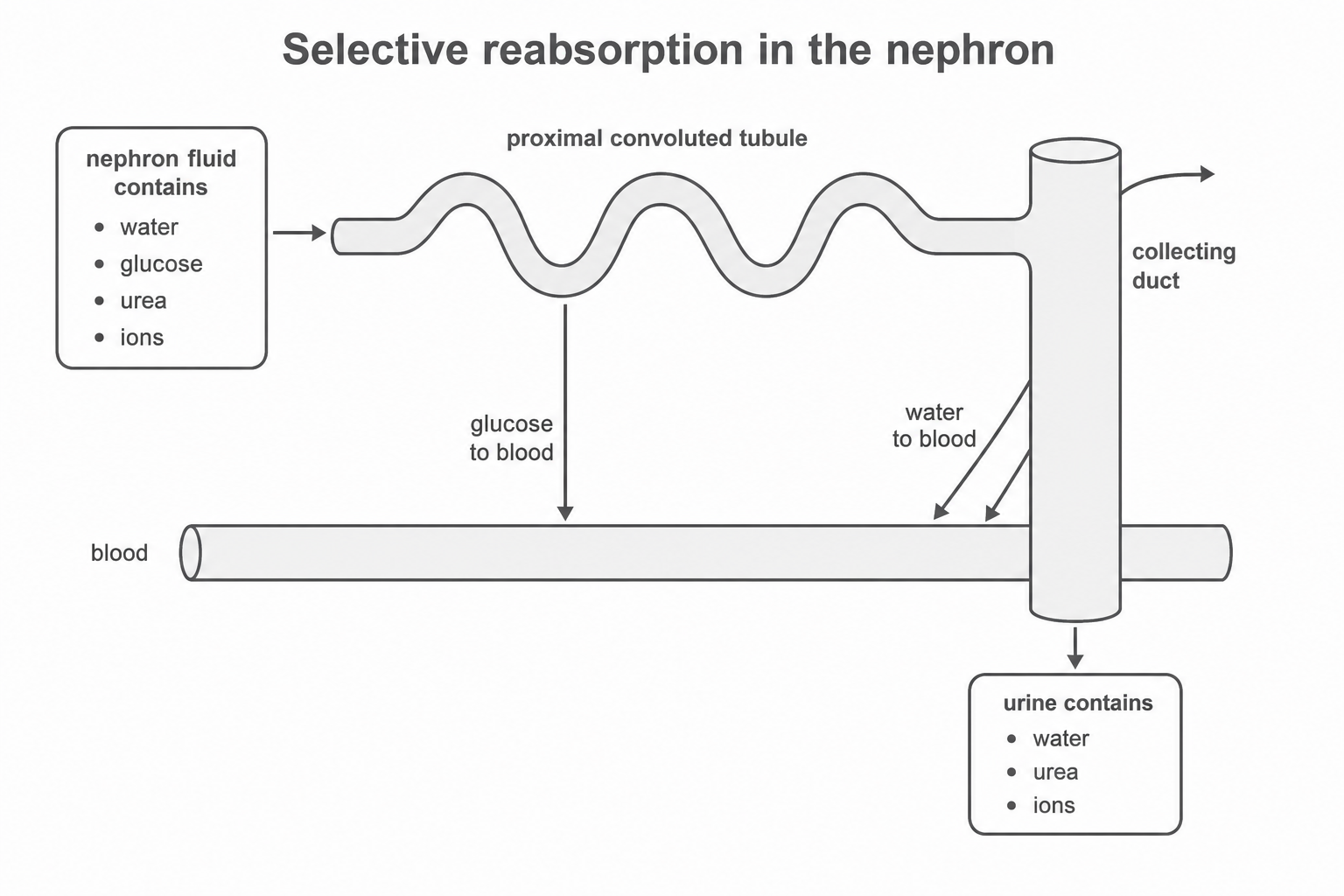
The two named nephron regions in this lesson have different jobs:
| Nephron region | Main B32 idea |
|---|---|
| proximal convoluted tubule | glucose is selectively reabsorbed into the blood |
| collecting duct | water is reabsorbed into the blood, with the amount controlled by ADH |
Glucose at the proximal convoluted tubule
Glucose is a useful small molecule. Body cells need glucose for respiration, so losing glucose in urine would waste a substance the body can use to release energy.
The proximal convoluted tubule is the first named tubule region in this lesson. Here, glucose is selectively reabsorbed from the nephron fluid back into the blood. This keeps glucose available for cells instead of allowing it to be removed from the body in urine.
For this specification point, the important word is why. Glucose is reabsorbed because it is useful: it is needed by cells for respiration. Do not answer this point by only saying "because it is filtered". The reason it must be reabsorbed is that useful glucose should be kept in the blood, not lost as urine.
Glucose is selectively reabsorbed at the proximal convoluted tubule because it is useful for respiration and should not be lost from the body.
Water at the collecting duct
By the time nephron fluid reaches the collecting duct, it already contains waste substances and some water. The collecting duct makes a final adjustment to how much water is kept by the body.
Water can be reabsorbed from the collecting duct into the blood. It moves out through the wall of the collecting duct and into the surrounding blood by osmosis. If more water is reabsorbed, less water is left in the urine. If less water is reabsorbed, more water is left in the urine.
Continue this lesson.
You’re previewing NovaLearn without an account. Create a free account to read the rest.
Create free account