2.53-2.55B - Xylem, phloem and water absorption
Plants are multicellular organisms, so leaves, roots, stems and flowers cannot all get the substances they need by short-distance diffusion alone. Flowering plants use two transport tissues with different jobs: phloem moves useful organic substances around the plant, while xylem carries water and mineral ions from the roots. This lesson keeps the focus tight: what each tissue transports, where it transports it, and how water first enters root hair cells.
Two transport tissues, two jobs
Xylem and phloem are transport tissues found in vascular bundles in roots, stems and leaves. The names are easy to muddle, so anchor them to the substances:
| Tissue | Substances transported | Main route in this lesson |
|---|---|---|
| Xylem | Water and mineral ions | From roots to other parts of the plant |
| Phloem | Sucrose and amino acids | Between leaves and other parts of the plant |
[DIAGRAM: asset_name: Xylem, phloem and water absorption - diagram 01; asset_slug: b23_xylem_phloem_and_water_absorption__diagram_01; recommended_method: deterministic_drawing; description: Monochrome schematic of a flowering plant with xylem arrows carrying water and mineral ions upward from roots, and phloem two-way arrows carrying sucrose and amino acids between leaves and other plant parts.]
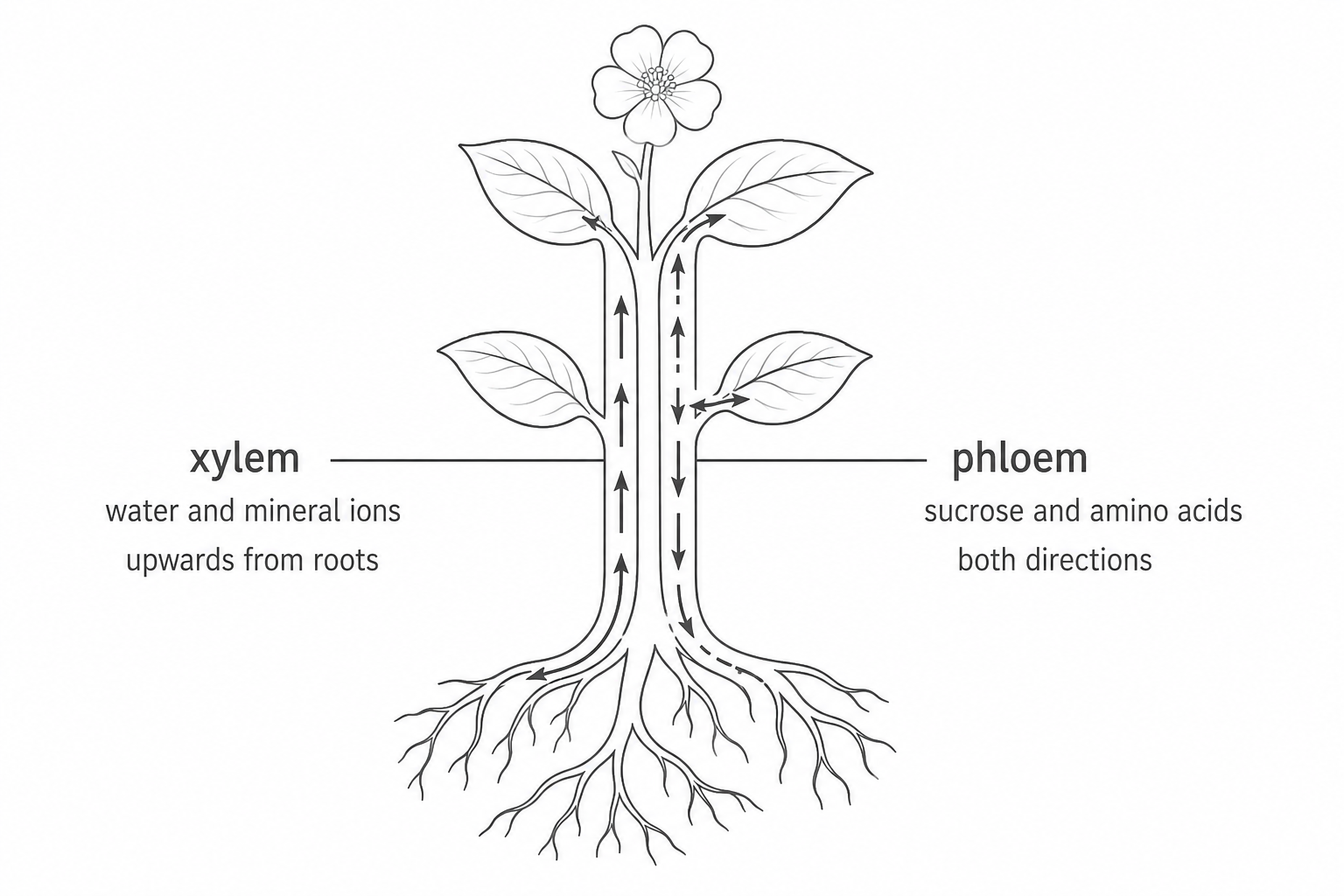
Xylem and phloem are not interchangeable pipes. If an exam question asks for the tissue that transports amino acids, the answer is phloem. If it asks for the tissue that transports water from the roots, the answer is xylem.
Phloem transports products from leaves
Leaves make sugars by photosynthesis. Some of this sugar is transported as sucrose in the phloem, because sucrose is a soluble form that can be moved to parts of the plant that need it. Phloem also transports amino acids, which are needed for making proteins and new cells.
Phloem
Phloem is plant transport tissue that carries sucrose and amino acids between the leaves and other parts of the plant.
"Between the leaves and other parts" matters. Substances in phloem may move from leaves to growing shoots, roots, flowers, fruits or storage organs. They may also move from storage organs to growing parts when the plant needs stored food. That is why phloem transport is best described as movement between sources and places of use or storage, not simply "up" or "down".
Use Pearson's exact substances in answers: sucrose and amino acids. Writing only "food" is too vague, and writing "glucose" when the question wants phloem contents can lose the mark.
Xylem transports water and mineral ions
Water and mineral ions enter the plant through the roots. Xylem then carries them from the roots to the stem, leaves, flowers and other parts of the plant.
Xylem
Xylem is plant transport tissue that carries water and mineral ions from the roots to other parts of the plant.
In most exam answers for this specification point, the key direction is from roots upwards through the plant. The water supplies cells, helps keep plant cells turgid, and is needed as a raw material for photosynthesis in leaves. Mineral ions are dissolved in the water moving through the plant; for example, earlier plant-nutrition work includes nitrate ions for amino acids and magnesium ions for chlorophyll.
Do not turn this into the next lesson on transpiration factors. It is enough here to know the role of xylem: it is the transport tissue for water and mineral ions from roots to the rest of the plant.
Continue this lesson.
You’re previewing NovaLearn without an account. Create a free account to read the rest.
Create free account