3.3-3.4 - Flower structure, pollination and fertilisation
Flowers are reproductive organs in flowering plants. Their structures are arranged so that pollen can move from an anther to a stigma, which is pollination. If pollination is followed by pollen tube growth and fertilisation, ovules can become seeds and the ovary can become a fruit.
Flower parts
A flower contains male and female reproductive structures. The male structure is the stamen: it is made of an anther and a filament. The anther produces pollen grains, and the filament holds the anther in position.
The female structure is often called the carpel or pistil. Its main parts are the stigma, style, ovary and ovules. The stigma receives pollen, the style links the stigma to the ovary, the ovary contains ovules, and each ovule contains a female gamete.
Pollination
Pollination is the transfer of pollen grains from an anther to a stigma.
Petals and sepals are not gamete-producing parts, but they still matter to flower structure. Petals may attract insect pollinators, while sepals protect the flower bud before it opens.
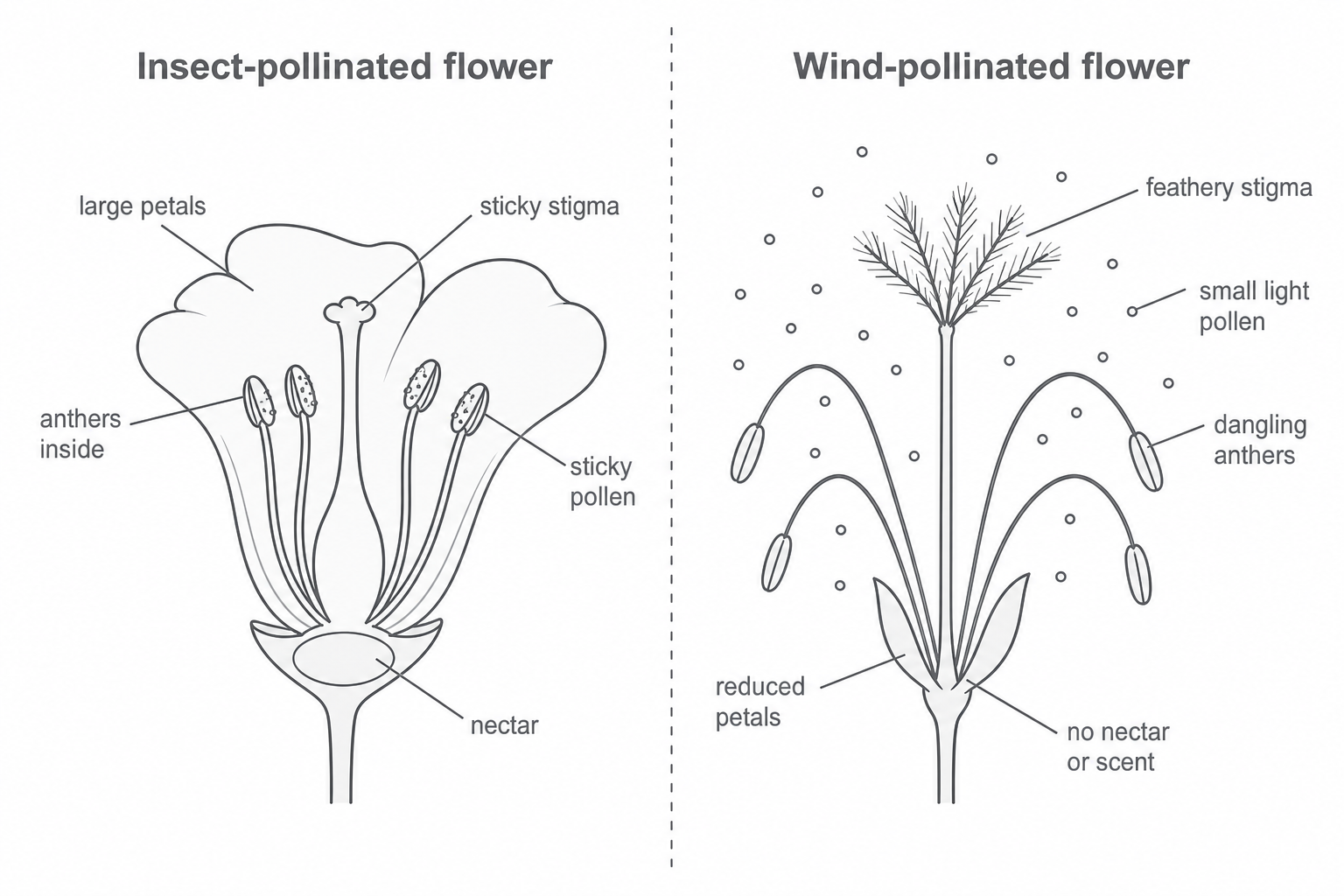
[DIAGRAM: asset_name: Flower structure, pollination and fertilisation - diagram 01; asset_slug: b41_flower_structure_pollination_and_fertilisation__diagram_01; recommended_method: deterministic_drawing; description: Monochrome side-by-side comparison of an insect-pollinated flower and a wind-pollinated flower. The insect-pollinated flower is labelled with large petals, sticky stigma inside the flower, anthers inside on firm filaments, nectar at the base and sticky pollen. The wind-pollinated flower is labelled with reduced petals, exposed dangling anthers on long filaments, exposed feathery stigma, many small light pollen grains and no nectar or scent.]
Insect-pollinated flowers
In an insect-pollinated flower, the structure increases the chance that an insect will pick up pollen from one flower and deposit it on the stigma of another flower of the same species.
| Feature | How it is adapted for insect pollination |
|---|---|
| large, brightly coloured petals | attract insects to the flower |
| scent and nectar | encourage insects to enter the flower; nectar is often near the base so the insect brushes past reproductive structures |
| anthers inside the flower on firm filaments | positioned so that an insect can brush against them and pick up pollen |
| sticky or rough pollen grains | stick to the insect's body instead of blowing away easily |
| sticky stigma inside the flower | catches pollen from an insect as it brushes past |
The key exam skill is to link the structure to the job. For example, "sticky pollen" is not a full explanation by itself; add that sticky pollen is more likely to attach to the insect and be carried to another flower.
Insect pollination is usually more directed than wind pollination because the insect visits flowers. This means insect-pollinated flowers often produce fewer pollen grains than wind-pollinated flowers, but the grains are more likely to be transferred to another flower if the insect contacts the anthers and stigma.
Wind-pollinated flowers
In a wind-pollinated flower, pollen is carried by air currents. Wind is not directed towards one flower in the way an insect visit is, so wind-pollinated flowers are adapted to release large amounts of pollen and catch pollen from the air.
| Feature | How it is adapted for wind pollination |
|---|---|
| small, dull or absent petals | little need to attract insects |
| no scent or nectar | little need to reward insects |
| anthers hanging outside the flower on long filaments | pollen can be shaken loose and carried away by the wind |
| many small, light, smooth pollen grains | increases the chance that some pollen is carried through air to another flower |
| large, feathery stigma hanging outside the flower | gives a large surface area to catch airborne pollen |
Continue this lesson.
You’re previewing NovaLearn without an account. Create a free account to read the rest.
Create free account