3.5-3.7 - Seed germination and plant asexual reproduction
Seeds do not need to photosynthesise before they germinate because they contain stored food reserves. Germination depends on suitable external conditions, and the practical skill is to test one condition at a time. Plants can also make new plants without seeds, using natural runners or artificial cuttings.
Conditions for germination
Germination is the start of growth of the embryo inside a seed. It is visible when the root or shoot begins to emerge from the seed coat.
Germination
Germination is the process in which a seed starts to grow into a seedling.
For most seeds in this lesson, the essential conditions are:
| Condition | Why it is needed |
|---|---|
| Water | The seed takes up water, swells, and chemical reactions can begin inside the cells. |
| Oxygen | The embryo respires aerobically to release energy from stored food. |
| Suitable temperature | Enzymes and other cell processes work fast enough for growth, but very cold conditions slow or prevent germination. |
Light is not one of the three required conditions in the Edexcel practical. Some species have special light requirements, but the core idea here is that a seed can begin germination using its own stored food. Once a seedling has leaves and chlorophyll, it needs light to photosynthesise and keep growing.
Do not say that a seed needs soil or fertiliser to germinate. Soil can support a plant, and mineral ions are useful later for growth, but a seed with water, oxygen and a suitable temperature can germinate on damp cotton wool.
Investigating germination conditions
The practical investigates which conditions are needed for germination by removing one condition from each setup and comparing the result with a control. Small seeds such as cress or mustard are useful because many seeds can be tested at once and the root or shoot appears quickly.
[DIAGRAM: asset_name: Seed germination and plant asexual reproduction - diagram 01; asset_slug: b42_seed_germination_and_plant_asexual_reproduction__diagram_01; recommended_method: deterministic_drawing; description: Monochrome four-tube practical setup for investigating germination conditions. Tube A has dry cotton wool to show no water, tube B has moist cotton wool at room temperature as the control, tube C has boiled cooled water plus an oil layer to reduce oxygen supply, and tube D has moist cotton wool kept in a fridge to show unsuitable temperature. Labels show seeds, cotton wool, oil layer, room temperature, fridge, and expected germination only in the control.]
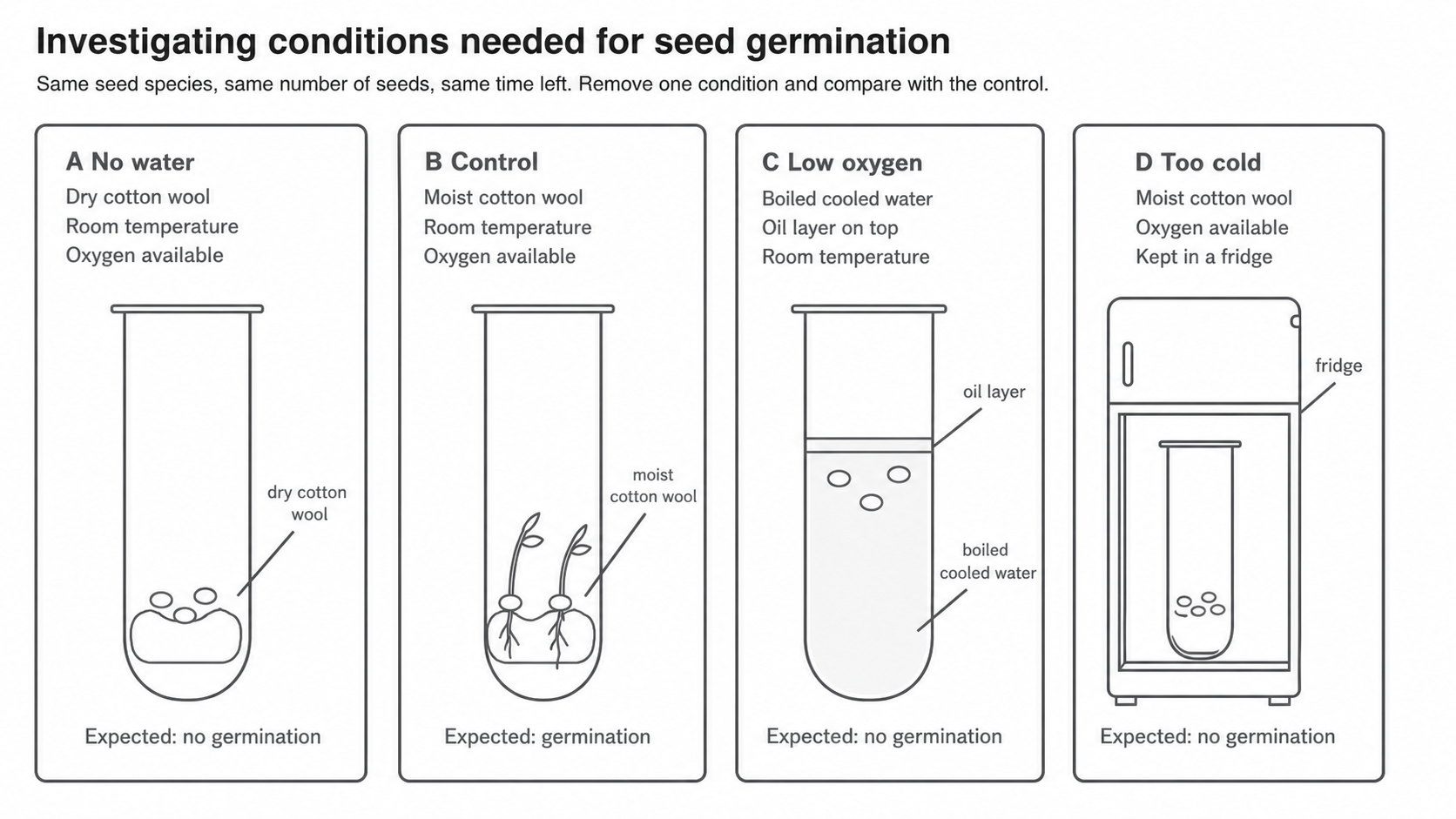
A clear method is:
- Place the same number of seeds on cotton wool in each labelled boiling tube or Petri dish.
- Set up a control with moist cotton wool, oxygen available, and a suitable temperature.
- Remove water from one setup by using dry cotton wool.
- Remove oxygen from one setup, for example by using boiled cooled water with an oil layer above it, or by using an oxygen absorber if instructed by a teacher.
- Remove suitable temperature from one setup by keeping moist seeds in a fridge.
- Leave the setups for the same time, for example 3-5 days.
- Count the number of seeds that germinate in each setup.
The independent variable is the condition being changed, such as water availability, oxygen availability, or temperature. The dependent variable is the number or percentage of seeds that germinate. Control variables include the seed species, number of seeds, age or batch of seeds, volume of water, time left, and the temperature of the room-temperature tubes.
Percentage germination
Safety and validity both matter. Do not eat laboratory seeds. Wash hands after handling seeds and damp cotton wool. If an oxygen absorber or other chemical is used, follow teacher instructions and avoid direct contact. A valid comparison changes only one main condition at a time; otherwise it is hard to know which condition caused the result.
Using food reserves
A seed contains an embryo and food reserves. These reserves may be stored in the cotyledons or endosperm, depending on the plant species. The important Edexcel idea is that the germinating seed uses these reserves until the seedling can photosynthesise.
The stored food is usually insoluble, so it cannot simply move around the seed as it is. During germination, enzymes break stored food into soluble substances. These soluble substances can move to the growing embryo and be used in respiration and growth.
Continue this lesson.
You’re previewing NovaLearn without an account. Create a free account to read the rest.
Create free account