2.83-2.85 - Plant tropisms and auxin
Plants do not have nerves or muscles, but they still respond to changes in their environment. Many plant responses are growth responses: one side of a root or stem grows faster than the other side, so the organ bends. This lesson focuses on two directional responses, phototropism and geotropism, and on how auxin explains the bending of stems towards light.
Plants respond to stimuli
A stimulus is a change in the environment that an organism can respond to. For plants, useful stimuli include light and gravity. The response is often slower than an animal response because it happens by growth rather than by rapid muscle movement.
Tropism
A tropism is a directional growth response by part of a plant to a stimulus.
The word "directional" is important. The direction of growth depends on the direction of the stimulus. If a shoot grows towards light coming from one side, that is a directional response to light.
Tropisms are described as positive or negative:
| Term | Meaning |
|---|---|
| Positive tropism | Growth towards the stimulus |
| Negative tropism | Growth away from the stimulus |
The two tropisms in this lesson are phototropism and geotropism. Phototropism is a growth response to light. Geotropism is a growth response to gravity; some textbooks call the same idea gravitropism, but Edexcel uses the word geotropic in this specification point.
Root and stem responses
Roots and stems do not respond to light and gravity in the same direction. A young stem usually grows towards light and away from gravity. A root usually grows away from light and towards gravity.
[DIAGRAM: asset_name: Plant tropisms and auxin - diagram 01; asset_slug: b34_plant_tropisms_and_auxin__diagram_01; recommended_method: deterministic_drawing; description: Monochrome two-panel schematic comparing phototropism and geotropism in a seedling. The phototropism panel shows light from one side, a stem bending towards light and a root growing away from light. The geotropism panel shows gravity downward, a stem curving upward away from gravity and a root curving downward towards gravity.]
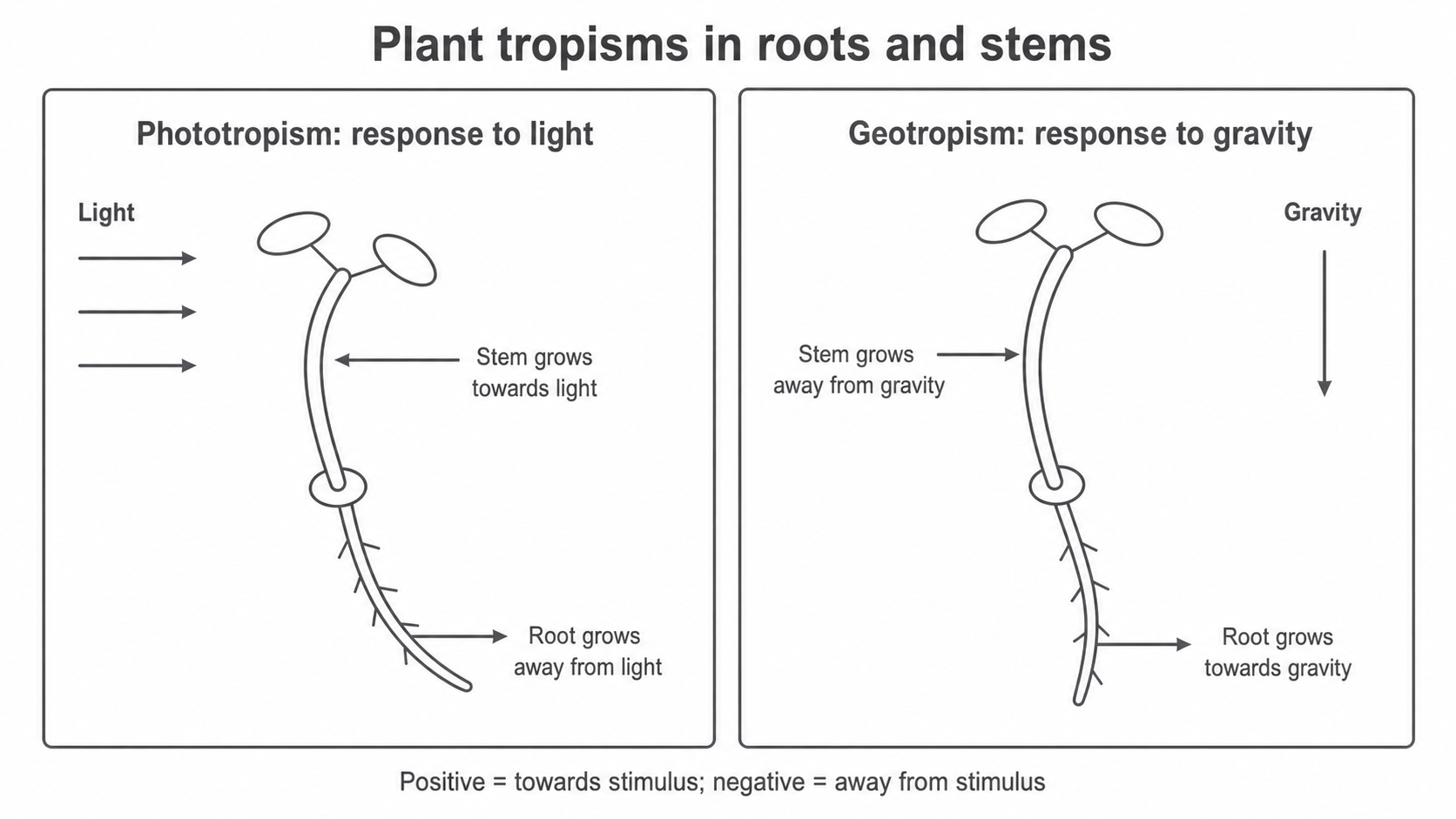
Use this summary table as the core exam pattern:
| Plant part | Phototropic response | Geotropic response |
|---|---|---|
| Stem / shoot | Positive phototropism: grows towards light | Negative geotropism: grows away from gravity |
| Root | Negative phototropism: grows away from light | Positive geotropism: grows towards gravity |
These responses help the plant survive. A stem growing towards light exposes leaves to more light for photosynthesis. A root growing downwards helps anchor the plant and reach soil water and mineral ions. The survival advantage is useful explanation, but the required description is the direction: towards or away from light, and towards or away from gravity.
Avoid saying that roots and stems "move" like animals. In this specification, the response is growth. The cells on one side elongate more than the cells on the other side, so the organ curves.
Continue this lesson.
You’re previewing NovaLearn without an account. Create a free account to read the rest.
Create free account