3.30-3.32 - Meiosis, gametes and chromosome numbers
Sexual reproduction needs gametes, such as sperm cells and egg cells, to join at fertilisation. Meiosis is the cell division that makes this possible: it produces gametes with half the usual chromosome number. That halving, followed by random fertilisation, helps keep the chromosome number stable and produces genetic variation among offspring.
Diploid, haploid and gametes
Chromosomes carry genetic information. In most human body cells, chromosomes are arranged in pairs: one chromosome in each pair was inherited from the mother and one from the father.
Diploid
A diploid cell has two sets of chromosomes.
In humans, the diploid number is 46. This means most human body cells contain 46 chromosomes, arranged as 23 pairs.
Haploid
A haploid cell has one set of chromosomes.
In humans, the haploid number is 23. Human gametes are haploid, so a sperm cell or egg cell contains 23 chromosomes rather than 46.
Gamete
A gamete is a reproductive cell, such as a sperm cell or an egg cell, that can fuse with another gamete during fertilisation.
The key numbers are:
| Cell type in humans | Chromosome number | Word to use |
|---|---|---|
| Most body cells | 46 | Diploid |
| Gametes | 23 | Haploid |
Do not describe a gamete as having "half a chromosome". A haploid human gamete has 23 whole chromosomes, which is half the diploid number.
Meiosis halves chromosome number
Meiosis is a type of cell division that produces gametes. It starts with a cell that has the usual chromosome number and produces four cells, each with half that number of chromosomes.
[DIAGRAM: asset_name: Meiosis, gametes and chromosome numbers - diagram 01; asset_slug: b51_meiosis_gametes_and_chromosome_numbers__diagram_01; recommended_method: deterministic_drawing; description: Monochrome chromosome-number schematic of meiosis using a simplified example cell with two chromosome pairs. It shows one diploid parent cell labelled 2n, chromosomes copied, two meiotic divisions, and four haploid gametes labelled n, each with one chromosome from each pair. Notes distinguish the chromosome-number model from genetic differences and recombination, which are not drawn, and compare the example 4 to 2 with humans 46 to 23.]
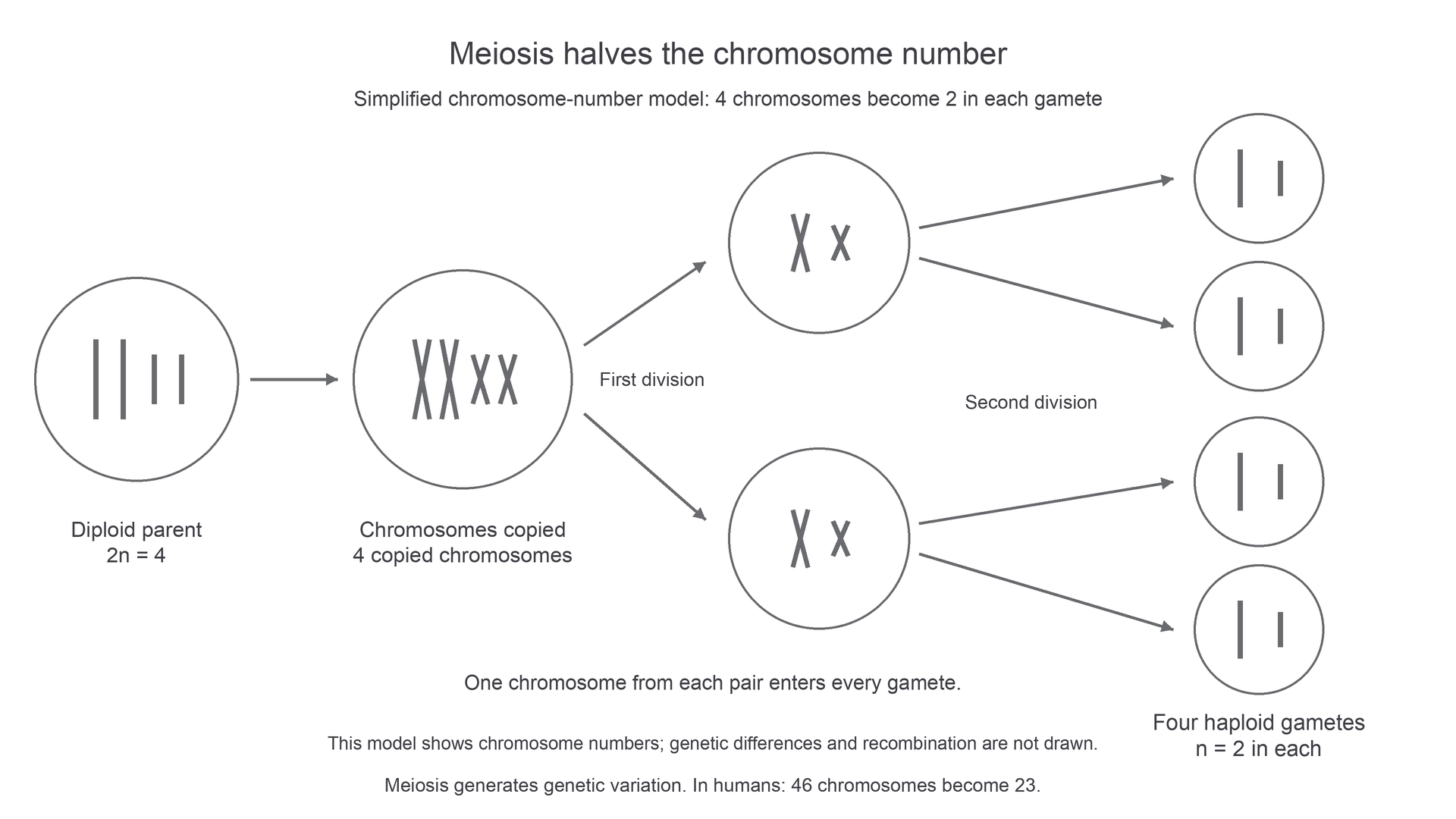
The process is often summarised like this:
- The starting cell has chromosomes in pairs.
- The chromosomes are copied before division.
- The cell divides twice.
- Four haploid cells are produced.
- The four cells are genetically different from each other.
The phrase "genetically different" matters. Meiosis does not make four identical copies of the starting cell. It makes gametes with different combinations of genetic information, so the gametes produced by one parent are not all the same.
For humans, the number change is:
| Before meiosis | After meiosis |
|---|---|
| One diploid cell with 46 chromosomes | Four haploid gametes, each with 23 chromosomes |
Continue this lesson.
You’re previewing NovaLearn without an account. Create a free account to read the rest.
Create free account