5.10-5.11 - Selective breeding in plants and animals
Selective breeding is a human-controlled way of developing organisms with useful inherited characteristics. Pearson Edexcel asks you to understand the same process in two contexts: plants and animals. The key is that breeders choose which organisms reproduce, then repeat this choice over generations so the desired characteristic becomes more common.
What selective breeding means
Selective breeding is also called artificial selection. It means humans choose parents with desired characteristics and breed them together so their offspring are more likely to inherit those characteristics.
Selective breeding
Selective breeding is the process in which humans choose organisms with desired inherited characteristics to reproduce, then select offspring with those characteristics over successive generations.
The desired characteristic must be partly controlled by genes, otherwise breeding will not reliably pass it on. For example, a crop plant may inherit genes linked to higher yield or disease resistance. A dairy animal may inherit genes linked to milk production. Better fertiliser, extra food or careful housing can improve an organism's performance during its life, but those environmental improvements are not themselves inherited.
The basic process is:
- Decide which desired characteristic is wanted.
- Select parents that show that characteristic strongly.
- Breed the selected parents together.
- Choose offspring that show the desired characteristic.
- Repeat the selection and breeding for many generations.
[DIAGRAM: asset_name: Selective breeding in plants and animals - diagram 01; asset_slug: b65_selective_breeding_in_plants_and_animals__diagram_01; recommended_method: deterministic_drawing; description: Monochrome flow diagram showing selective breeding as a repeated cycle: choose a desired characteristic, select parents with inherited variation, breed them, select offspring with the desired characteristic, repeat over generations, and produce a plant or animal population where the characteristic is more common.]
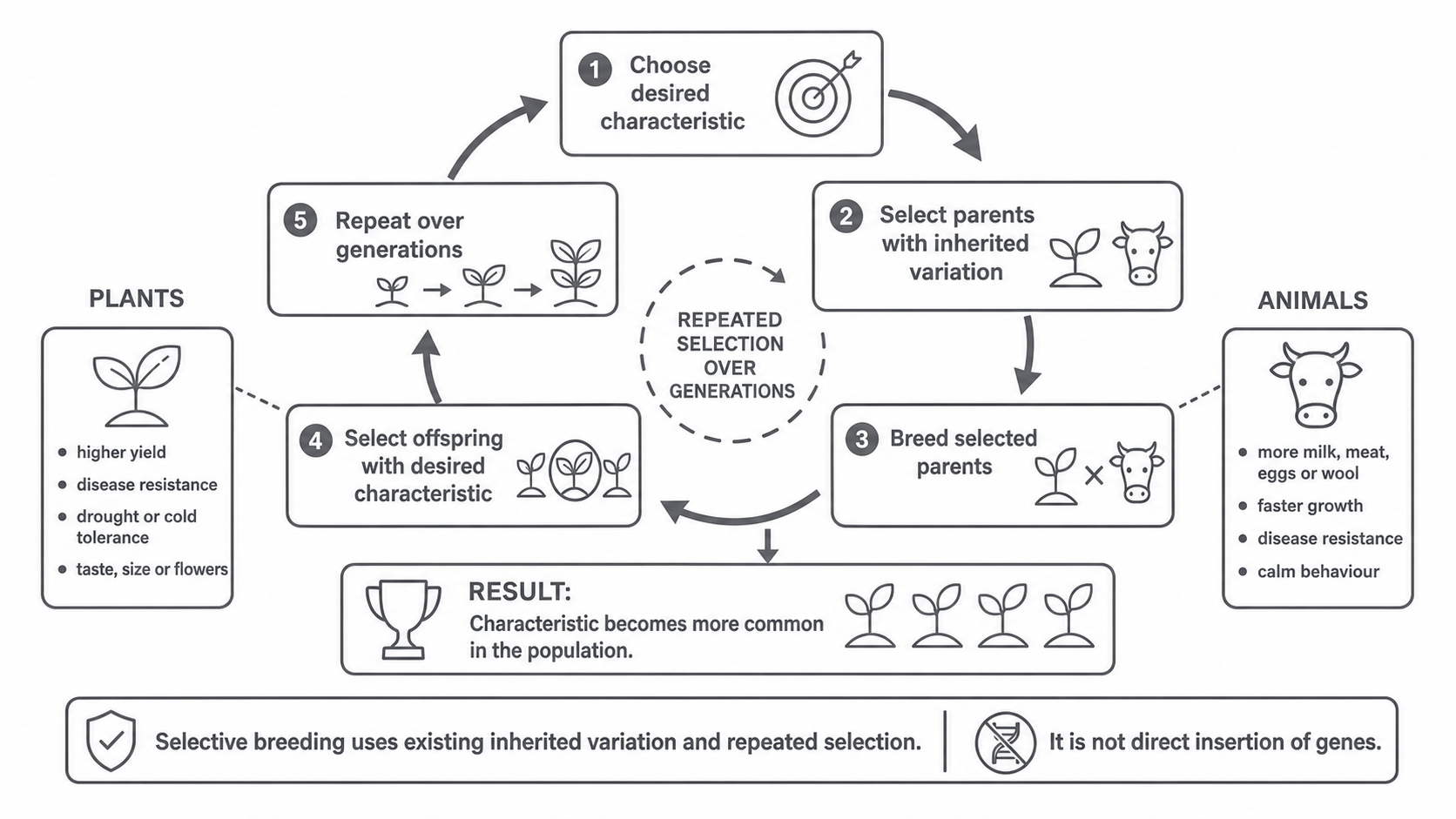
Selective breeding does not mean changing an individual organism during its lifetime. It changes the characteristics seen in the offspring population because selected parents pass inherited information to the next generation.
Developing plant characteristics
Selective breeding can develop plants with desired characteristics because plant breeders can choose which plants provide pollen, ovules or seeds for the next generation. The desired characteristic depends on the crop or ornamental plant.
Plants may be selectively bred for:
| Desired plant characteristic | Why it may be useful |
|---|---|
| high yield | more grain, fruit, seeds or other useful product per plant or per field |
| disease resistance | fewer plants are lost to pathogens |
| tolerance of dry or cold conditions | crops can grow more successfully in difficult conditions |
| better taste, size or appearance | the plant product is more useful or valuable to humans |
| large or unusual flowers | ornamental plants are more attractive |
A plant-breeding answer should show control over reproduction. For example, a breeder might select high-yielding plants, cross-pollinate them, collect the seeds, grow the offspring, and then select the highest-yielding offspring for the next breeding cycle. In crops that self-pollinate, breeders can still choose which plants are allowed to produce the seeds kept for future generations.
Over many generations, the selected alleles linked to the desired characteristic become more common in the breeding population. The result is a variety of plant that more reliably shows the desired characteristic, such as a crop variety with higher yield or improved disease resistance.
Do not drift into genetic engineering here. In selective breeding, the breeder uses reproduction between selected plants. Genes are not cut out and inserted into another organism.
Continue this lesson.
You’re previewing NovaLearn without an account. Create a free account to read the rest.
Create free account