2.40B-2.42B - Leaf structure and gas exchange
Leaves are gas-exchange surfaces: carbon dioxide and oxygen must move between the air and living leaf cells. In a leaf, this movement happens by diffusion, so the direction of movement depends on concentration gradients created by photosynthesis and respiration. The leaf is built to make these diffusion paths short, open and close to the cells that need the gases.
Diffusion drives gas exchange
Gas exchange means the movement of gases into and out of an organism or organ. In leaves, the important gases are carbon dioxide and oxygen.
Diffusion
Diffusion is the net movement of particles from a region of higher concentration to a region of lower concentration, down a concentration gradient.
Diffusion is passive: it does not require energy from respiration. Gas particles are moving randomly all the time, but there is a net movement from the side where there are more particles to the side where there are fewer.
For a gas-exchange surface, three ideas matter most:
| Feature | Why it helps diffusion |
|---|---|
| a concentration gradient | keeps a net movement of gas in one direction |
| a short diffusion distance | gases reach cells faster |
| a large surface area | more gas particles can cross at the same time |
Leaf cells keep changing gas concentrations because they use and produce gases. A respiring cell uses oxygen, so oxygen concentration inside that cell can be lower than in nearby air spaces. That creates a gradient for oxygen to diffuse into the cell.
Two processes, two gases
Photosynthesis and aerobic respiration both affect gas exchange in a leaf, but they affect the two gases in opposite ways.
| Process | Gas taken in by the process | Gas released by the process | Link to gas exchange |
|---|---|---|---|
| photosynthesis | carbon dioxide | oxygen | carbon dioxide can diffuse towards photosynthesising cells; oxygen can diffuse away |
| aerobic respiration | oxygen | carbon dioxide | oxygen can diffuse towards respiring cells; carbon dioxide can diffuse away |
Photosynthesis happens in cells with chloroplasts, especially mesophyll cells. It uses carbon dioxide to make glucose and releases oxygen. This tends to lower the carbon dioxide concentration around photosynthesising cells and raise the oxygen concentration.
Respiration happens in all living leaf cells. It uses oxygen to release energy from glucose and produces carbon dioxide. This tends to lower the oxygen concentration around respiring cells and raise the carbon dioxide concentration.
The same leaf can photosynthesise and respire at the same time. For this lesson, focus on what each process uses and produces, and on the diffusion paths created by those concentration changes.
Pathways through the leaf
A typical flowering plant leaf has pores in the epidermis called stomata. One pore is a stoma. Here, the important point is that stomata provide openings between the outside air and the air spaces inside the leaf.
[DIAGRAM: asset_name: Leaf structure and gas exchange - diagram 01; asset_slug: b18_leaf_structure_and_gas_exchange__diagram_01; recommended_method: deterministic_drawing; description: Monochrome cross-section of a flowering plant leaf showing upper epidermis, palisade mesophyll, spongy mesophyll with large air spaces, lower epidermis with one stoma, and arrows showing carbon dioxide diffusing inward to mesophyll cells and oxygen diffusing outward.]
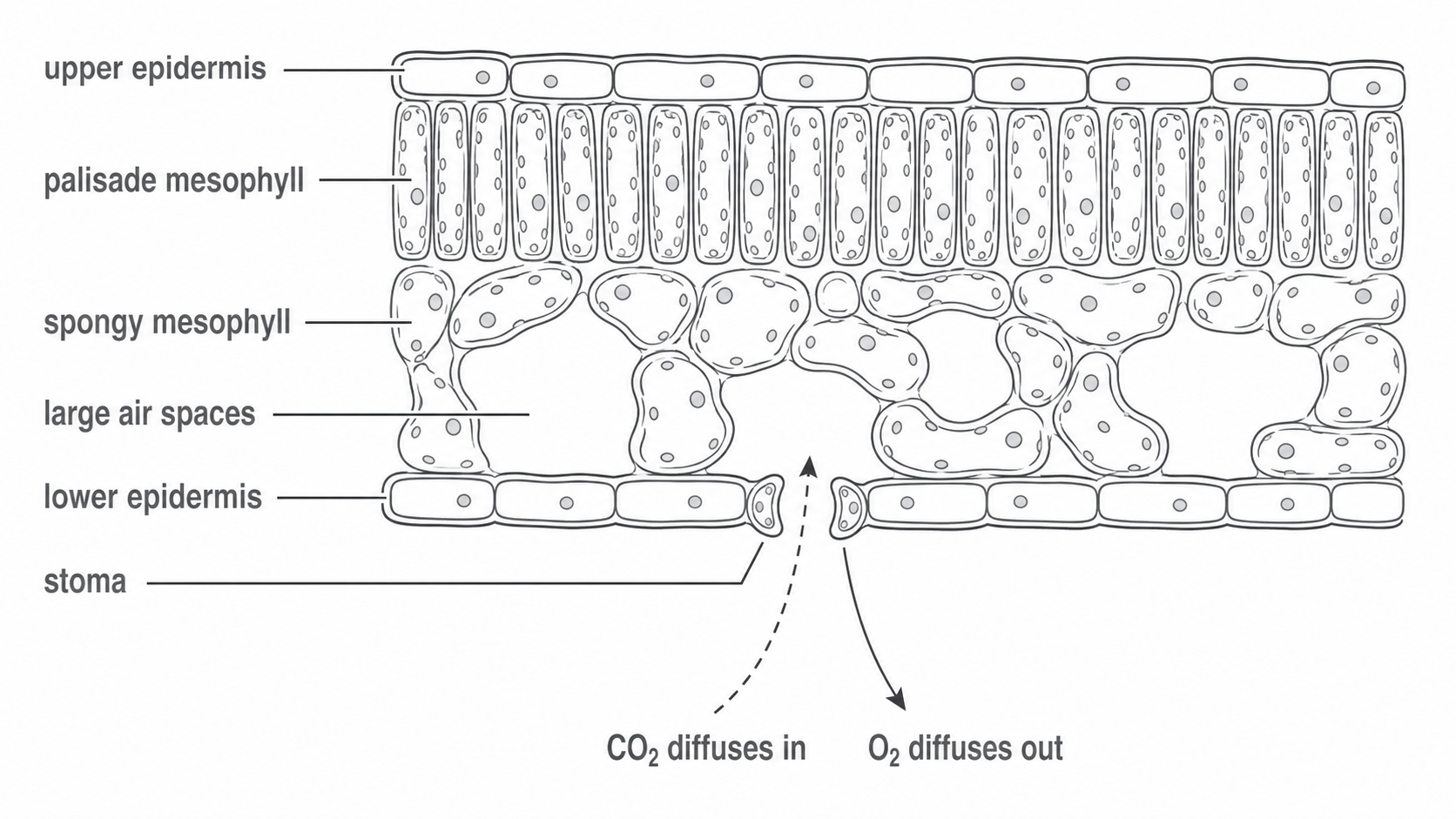
Carbon dioxide can follow this route when photosynthesis is using it:
- carbon dioxide in the air outside the leaf
- through a stoma in the lower epidermis
- through air spaces in the spongy mesophyll
- dissolves at moist mesophyll cell surfaces
- diffuses into photosynthesising cells
Continue this lesson.
You’re previewing NovaLearn without an account. Create a free account to read the rest.
Create free account