4.6-4.9 - Feeding relationships and energy transfer
Ecosystems can look complicated, but the feeding relationships inside them follow a few useful patterns. A food chain shows one pathway of feeding, while a food web shows several connected pathways. In every case, substances and energy are transferred by feeding, but only a small fraction of the energy becomes available to the next trophic level.
Trophic levels
A trophic level is a feeding level in a food chain, food web or ecological pyramid. The names tell you how an organism obtains food and where it sits in the feeding sequence.
Producer
A producer is an organism that makes its own food, usually by photosynthesis, and forms the first trophic level.
Plants and algae are common producers because they make organic substances such as glucose using light energy. Consumers cannot make their own food in this way, so they obtain food by feeding on other organisms.
| Trophic level | Name | What it feeds on | Example in a simple chain |
|---|---|---|---|
| 1 | Producer | Makes its own food | Grass |
| 2 | Primary consumer | Producer | Grasshopper |
| 3 | Secondary consumer | Primary consumer | Frog |
| 4 | Tertiary consumer | Secondary consumer | Heron |
Decomposers do not fit neatly as one extra step at the end of a single chain. They break down dead organisms and waste material from every trophic level. Bacteria and fungi are common decomposers; they use dead or waste organic material as a food source and return useful substances to the environment.
[DIAGRAM: asset_name: feeding_relationships_overview; asset_slug: b57_feeding_relationships_and_energy_transfer__diagram_01; recommended_method: deterministic_drawing; description: Monochrome overview showing a food chain from producer to tertiary consumer, arrows from food to feeder labelled as transfer of energy and substances, decomposers receiving dead organisms and waste from all trophic levels, and a small linked food web.]
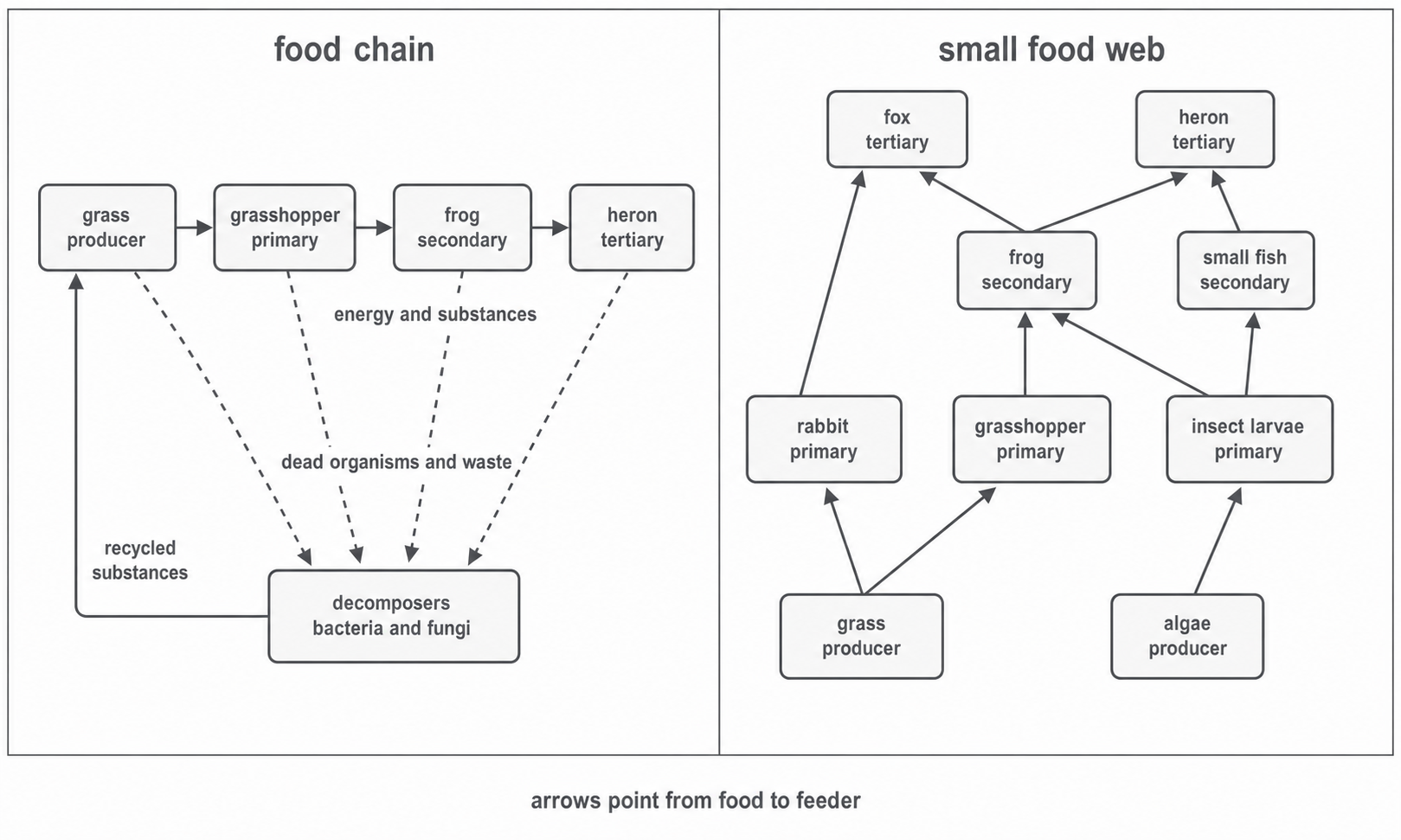
The arrow direction is a frequent exam trap. In Biology food chains, arrows point from the organism being eaten to the organism that eats it, because they show the direction of transfer of substances and energy.
Food chains and food webs
A food chain is a simple line of feeding relationships. It follows one route through an ecosystem:
grass -> grasshopper -> frog -> heron
This chain means grass is eaten by the grasshopper, the grasshopper is eaten by the frog, and the frog is eaten by the heron. It also means substances and energy are transferred from grass to grasshopper to frog to heron.
A food web is a network of linked food chains in the same ecosystem. Food webs are more realistic because most organisms have more than one food source or more than one predator. For example, a frog might eat grasshoppers and flies, while a heron might eat frogs and small fish.
Food webs still use the same trophic-level names, but the name can depend on the exact feeding path. If an organism eats a producer in one chain, it is acting as a primary consumer in that chain. If it eats a primary consumer in another chain, it is acting as a secondary consumer in that chain.
When interpreting a food web, trace one chain at a time. Start with a producer, follow the arrow direction, and name each consumer according to what it eats in that path.
Ecological pyramids
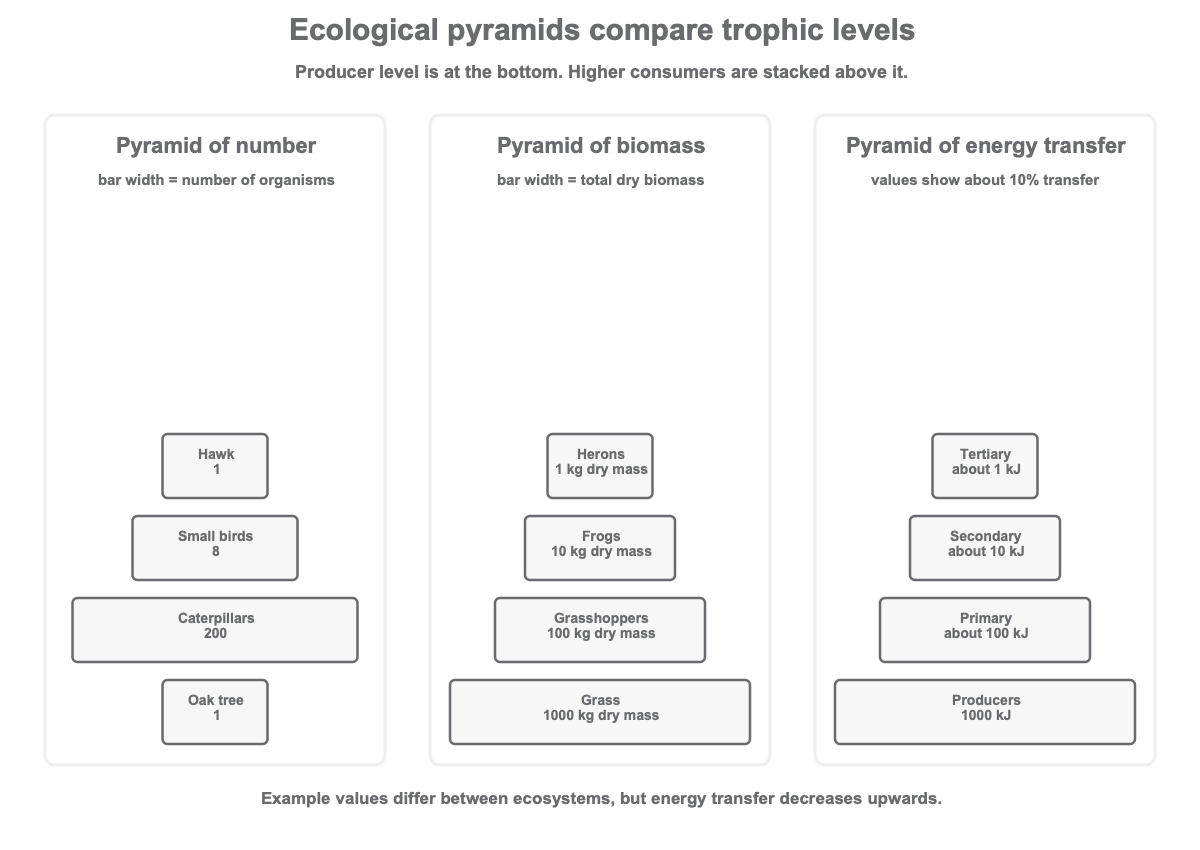
Ecological pyramids represent trophic levels as stacked bars. The producer level is at the bottom, and higher consumer levels are placed above it. Edexcel names three pyramid types: pyramids of number, pyramids of biomass and pyramids of energy transfer.
[DIAGRAM: asset_name: ecological_pyramids_comparison; asset_slug: b57_feeding_relationships_and_energy_transfer__diagram_02; recommended_method: deterministic_drawing; description: Monochrome three-panel comparison of a pyramid of number, pyramid of biomass and pyramid of energy transfer, with labelled trophic levels and values showing number of organisms, dry biomass and about 10% energy transfer.]
Continue this lesson.
You’re previewing NovaLearn without an account. Create a free account to read the rest.
Create free account