2.59-2.61, 2.64B - Blood components, transport and clotting
Blood is a transport tissue: it carries useful substances to cells, removes wastes from cells, helps defend the body, and can seal damaged blood vessels. In this lesson, the focus is the composition of blood, the substances carried in plasma, the adaptations of red blood cells for oxygen transport, and the Biology-only extension on platelets in clotting. Keep the roles separate in your mind: plasma carries many dissolved substances, red blood cells carry oxygen, and platelets are involved in blood clotting.
The four components of blood
Blood is not just one liquid. It is a mixture of a liquid part, called plasma, and suspended cells or cell fragments. When an exam asks for the composition of blood, it is asking you to name the four components:
| Component | What it is | Main idea to remember |
|---|---|---|
| Red blood cells | Specialised cells packed with haemoglobin | Transport oxygen |
| White blood cells | Cells involved in body defence | Help protect against pathogens |
| Platelets | Small cell fragments | Involved in blood clotting |
| Plasma | The liquid part of blood | Transports blood cells and many dissolved substances |
[DIAGRAM: asset_name: Blood components, transport and clotting - diagram 01; asset_slug: b25_blood_components_transport_and_clotting__diagram_01; recommended_method: deterministic_drawing; description: Monochrome labelled view of blood in a vessel, showing plasma as the liquid background with red blood cells, one white blood cell, small platelets, and label arrows to each component.]
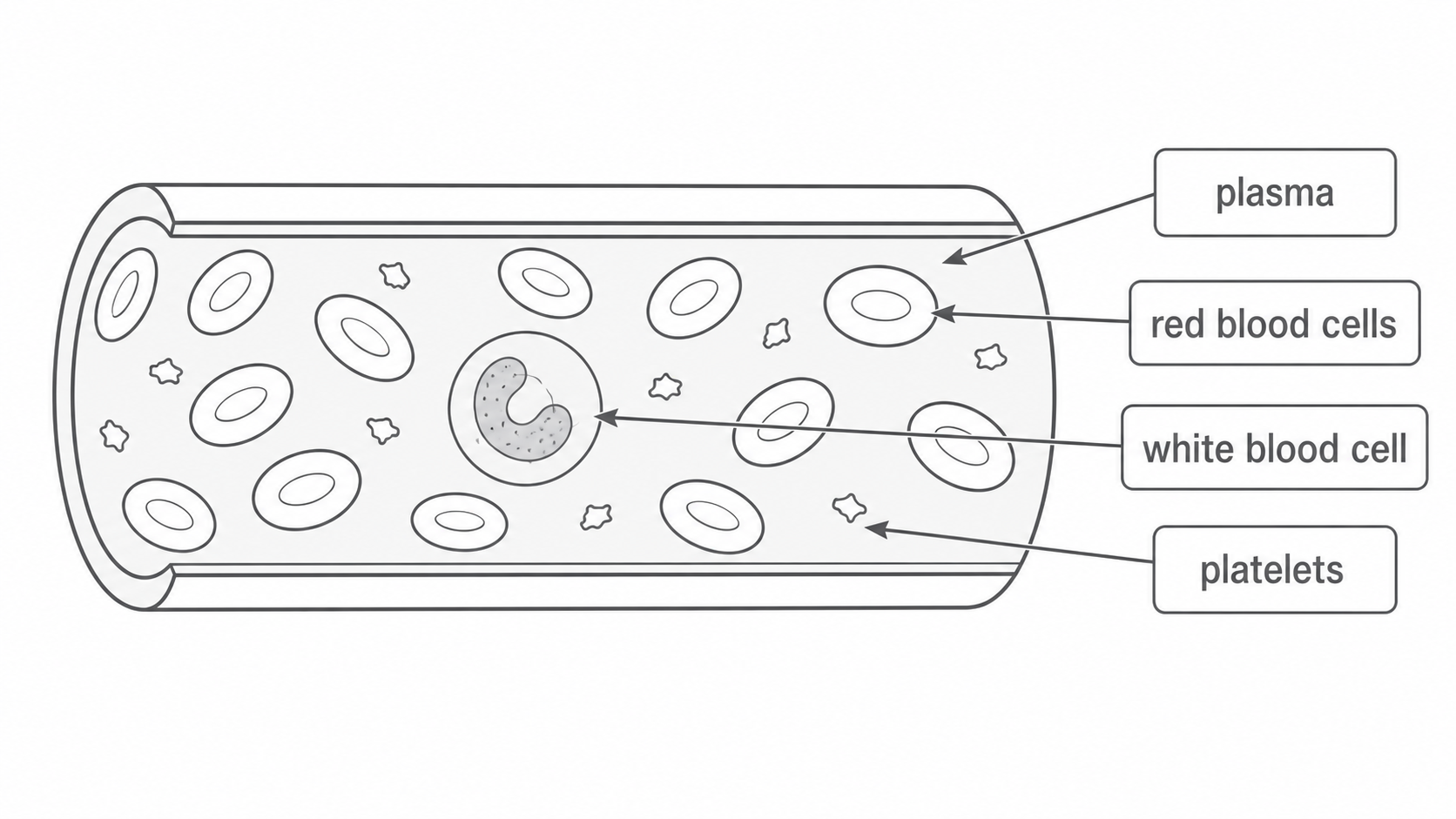
White blood cells are included in this composition list, but their detailed immune responses are taught in the next cluster. Here, it is enough to recognise them as one of the four blood components and not confuse them with platelets or red blood cells.
What plasma transports
Plasma is the liquid part of the blood. It carries the blood cells and platelets around the body, but the specification also expects you to know five important substances or forms of energy transported in plasma:
| Transported in plasma | Where it is being moved |
|---|---|
| Carbon dioxide | From respiring cells towards the lungs |
| Digested food | From the small intestine towards body cells, or to organs such as the liver |
| Urea | From the liver towards the kidneys for excretion |
| Hormones | From glands to target organs |
| Heat energy | From warmer areas of the body to other areas, helping distribute body heat |
This is a common place for muddled answers. Oxygen is transported mainly by red blood cells because haemoglobin binds oxygen. Plasma is the answer for carbon dioxide, digested food, urea, hormones and heat energy in this lesson.
The short version is: plasma is the transport fluid for many dissolved substances; red blood cells are the specialised oxygen carriers.
Continue this lesson.
You’re previewing NovaLearn without an account. Create a free account to read the rest.
Create free account