4.1, 4.5 - Populations, communities and distribution factors
Ecology questions often start with four words that look similar but describe different things: population, community, habitat and ecosystem. Once those words are precise, you can explain why organisms are common in one place but rare in another. The main skill in this lesson is to link a named abiotic or biotic factor to population size and distribution.
Ecology terms
Ecology is the study of organisms and how they interact with their surroundings. In this lesson, the surroundings include both living organisms and non-living conditions.
These four terms are the foundation:
| Term | Meaning |
|---|---|
| Population | All the organisms of one species living in the same area at the same time. |
| Community | All the populations of different species living in the same area. |
| Habitat | The place where an organism lives. |
| Ecosystem | A community of organisms and the abiotic factors they interact with in an area. |
A population must be one species. "All the snails in a pond" could be a population if they are the same species, but "all the animals in a pond" is not one population because it includes different species.
A community contains living organisms only. An ecosystem is wider: it includes the community plus non-living factors such as light intensity, temperature, water, oxygen, mineral ions and soil pH.
How the terms fit together
It helps to keep the terms linked to an example rather than memorising them as separate labels. In a woodland, all the bluebells of one species in the woodland are a population. The bluebells, oak trees, fungi, beetles, birds and other living populations together form the community.
The woodland is a habitat for many of those organisms because it is the place where they live. The woodland ecosystem includes that living community and the non-living conditions it interacts with, such as light under the trees, soil water, temperature and mineral ions in the soil.
[DIAGRAM: asset_name: Populations, communities and distribution factors - diagram 01; asset_slug: b55_populations_communities_and_distribution_factors__diagram_01; recommended_method: deterministic_drawing; description: Monochrome woodland example showing one population of the same species, a community made of several populations, the habitat as the place where they live, and the ecosystem as the community interacting with abiotic factors.]
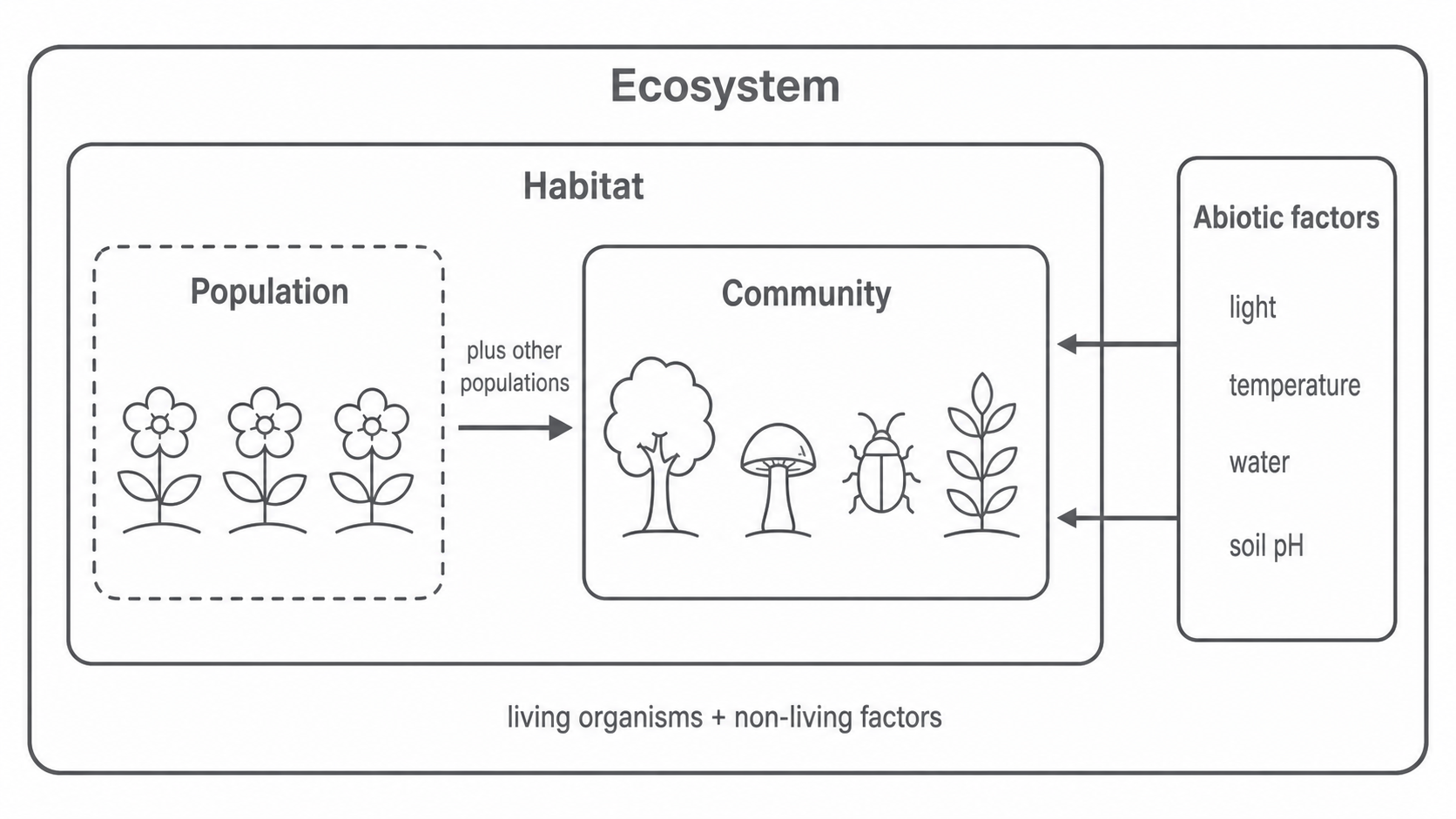
The common exam trap is to make the community too large or the ecosystem too small. A community does not include light, water or soil pH because these are abiotic factors. An ecosystem does include them because it is about interactions between living and non-living parts.
A population is one species; a community is all the living populations; an ecosystem is the community plus abiotic factors.
Abiotic factors
Abiotic factor
An abiotic factor is a non-living factor in the environment that can affect organisms.
Abiotic factors affect population size because they change how well organisms survive and reproduce. They affect distribution because organisms are usually found in places where the conditions suit them.
For plants, light intensity can affect photosynthesis. If light intensity is too low, the plant may make less glucose, grow more slowly and produce fewer seeds, so the population size may be smaller in shaded areas. Water availability can also affect survival and growth; some organisms are more common in damp areas because they lose water easily or need water for reproduction.
Continue this lesson.
You’re previewing NovaLearn without an account. Create a free account to read the rest.
Create free account