4.12-4.15 - Air pollution, greenhouse gases and global warming
Air pollution can damage living organisms directly, while greenhouse gases change how much heat is retained by Earth's atmosphere. This lesson keeps those ideas separate: sulfur dioxide and carbon monoxide are air pollutants with biological effects, and the named greenhouse gases are linked to the enhanced greenhouse effect. The key skill is to write cause-and-effect chains clearly, because Edexcel mark schemes often reward each correct link.
Air pollutants and biological consequences
Pollution means adding harmful substances to the environment. In this cluster, the air pollutants you need are sulfur dioxide and carbon monoxide. Do not treat every air pollutant as if it has the same biological effect.
Biological consequence
A biological consequence is an effect on living organisms, such as humans, plants, animals or microorganisms.
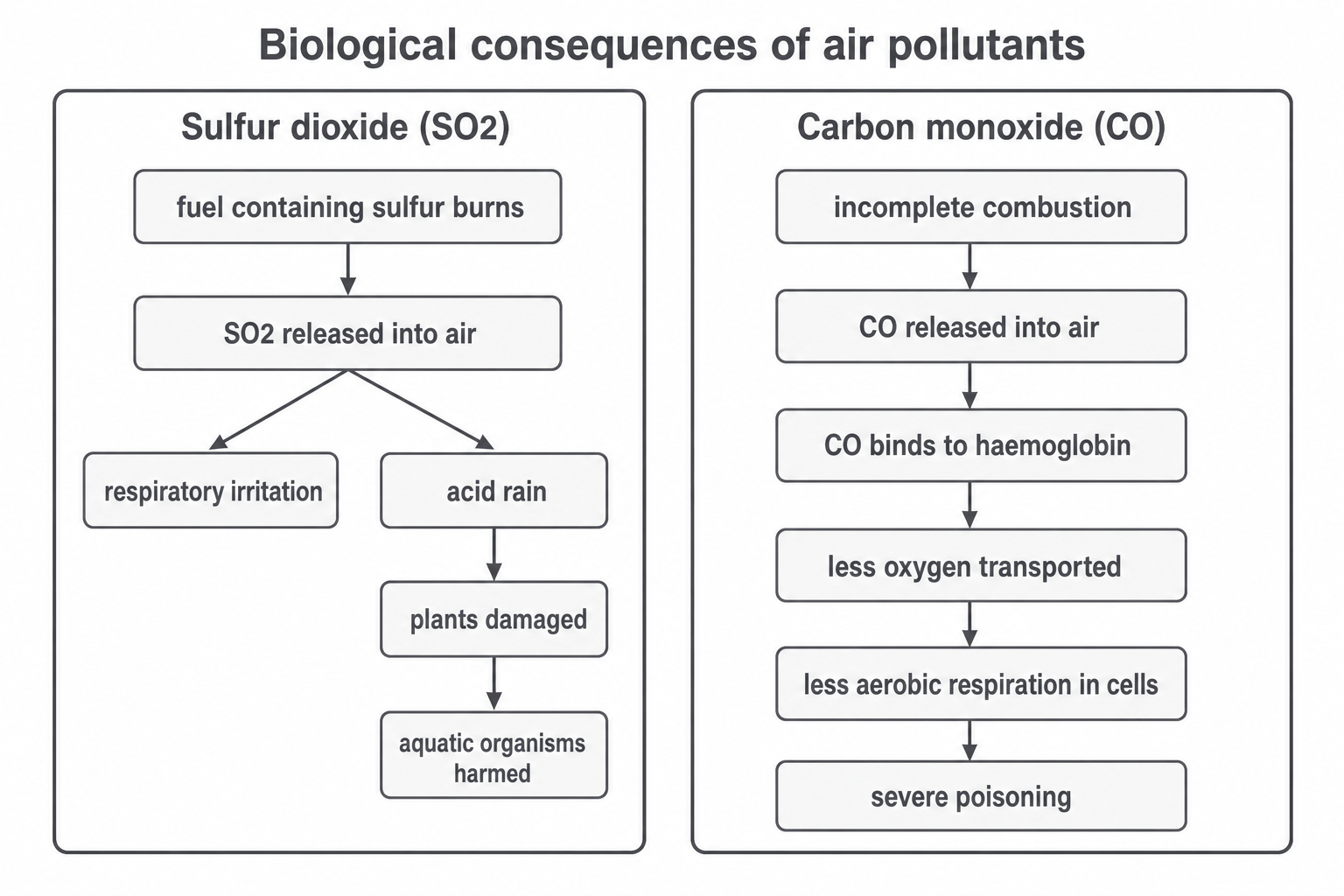
Sulfur dioxide, SO2, is released when fuels containing sulfur are burned, for example in some power stations and industrial processes. It can irritate the human respiratory system and make breathing difficult. It can also contribute to acid rain, which can damage plant leaves, reduce plant growth and harm organisms in sensitive aquatic ecosystems.
Carbon monoxide, CO, is produced during incomplete combustion of carbon-containing fuels. It is dangerous because it binds strongly to haemoglobin in red blood cells. This reduces the amount of oxygen transported in the blood, so body cells receive less oxygen for aerobic respiration. Severe exposure can cause unconsciousness or death.
[DIAGRAM: asset_name: Air pollution, greenhouse gases and global warming - diagram 01; asset_slug: b59_air_pollution_greenhouse_gases_and_global_warming__diagram_01; recommended_method: deterministic_drawing; description: Monochrome two-panel flow diagram comparing sulfur dioxide and carbon monoxide. The sulfur dioxide side shows fuel combustion releasing SO2, respiratory irritation, and acid rain damaging plants and aquatic organisms. The carbon monoxide side shows incomplete combustion releasing CO, CO binding to haemoglobin, reduced oxygen transport, reduced aerobic respiration in cells, and severe poisoning consequences.]
A common exam trap is confusing CO and CO2. Carbon monoxide is the poisonous air pollutant in this specification point. Carbon dioxide is a greenhouse gas in the next specification point.
The named greenhouse gases
A greenhouse gas is a gas in the atmosphere that absorbs infrared radiation emitted by Earth and helps retain heat. The natural greenhouse effect is important because it keeps Earth warmer than it would be without an atmosphere. The problem in this lesson is the enhanced greenhouse effect, where extra greenhouse gases cause more heat to be retained.
For Edexcel 4BI1 Biology, the named greenhouse gases are:
| Greenhouse gas | Formula or abbreviation | Exam note |
|---|---|---|
| Water vapour | H2O | The most abundant greenhouse gas; often acts as a feedback as warming increases evaporation. |
| Carbon dioxide | CO2 | Increased mainly by burning fossil fuels and land-use change. |
| Nitrous oxide | N2O | Increased by agriculture, especially fertiliser use, and some combustion. |
| Methane | CH4 | Increased by livestock, rice fields, landfill waste and fossil fuel extraction. |
| Chlorofluorocarbons | CFCs | Industrial chemicals formerly used in refrigerants, solvents and spray can propellants. |
Only some gases in air are greenhouse gases. Nitrogen and oxygen make up most of the atmosphere, but they are not the named greenhouse gases for this lesson.
Be precise with names. Nitrous oxide is not the same as "nitrogen oxide" in an exam answer, and carbon dioxide is not the same as carbon monoxide.
Human activities that add greenhouse gases
Human activities increase the concentration of greenhouse gases in the atmosphere. In exam answers, link the activity to the gas it releases or increases.
| Human activity | Main greenhouse gas link |
|---|---|
| Burning fossil fuels in power stations, transport and industry | Releases carbon dioxide because carbon in the fuel combines with oxygen during combustion. |
| Deforestation and land clearance | Releases carbon dioxide if trees are burned or decay; also reduces carbon dioxide uptake by photosynthesis. |
| Livestock farming, rice cultivation and landfill sites | Release methane from anaerobic decay or digestion by microorganisms. |
| Use of nitrogen-containing fertilisers | Increases nitrous oxide release from soil microorganisms. |
| Industrial use and leakage of CFCs | Adds CFCs to the atmosphere, although their use has been greatly reduced in many countries. |
Continue this lesson.
You’re previewing NovaLearn without an account. Create a free account to read the rest.
Create free account