3.24, 3.26-3.27 - Family pedigrees and sex determination
Pedigrees and sex-determination diagrams are both ways of turning inheritance into evidence you can read. A family pedigree shows how a characteristic appears in different family members across generations. A sex-determination genetic diagram shows how X and Y chromosomes combine at fertilisation to produce XX or XY offspring.
Reading a family pedigree
A family pedigree is a family tree used in genetics. It shows the relationships between family members and which people have a particular inherited characteristic.
Family pedigree
A family pedigree is a chart that shows how a characteristic or condition appears in members of a family across generations.
Pedigrees use a small set of standard symbols. A square usually represents a male and a circle usually represents a female. An unshaded symbol represents a person who does not show the characteristic being followed. A shaded symbol represents a person who does show it.
[DIAGRAM: asset_name: Family pedigrees and sex determination - diagram 01; asset_slug: b49_family_pedigrees_and_sex_determination__diagram_01; recommended_method: deterministic_drawing; description: Monochrome pedigree-symbol key and small three-generation example showing square for male, circle for female, shaded symbols for affected people, unshaded symbols for unaffected people, a horizontal parent line, a vertical offspring line, sibling line, and generation labels I, II and III.]
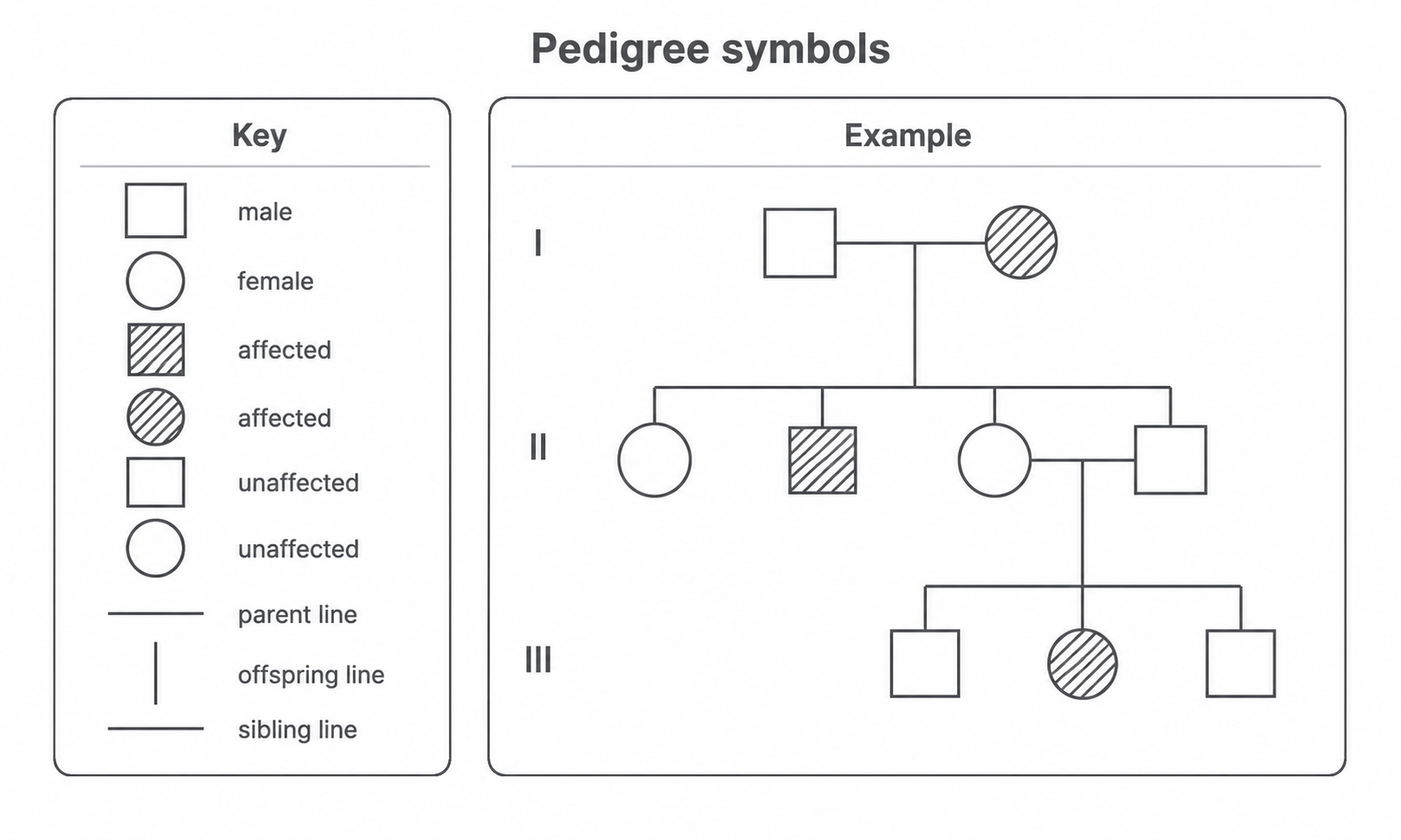
Read a pedigree in a steady order:
- Use the key to identify what each symbol means.
- Look for the generations, usually labelled I, II and III.
- Follow parent lines and offspring lines to work out relationships.
- Compare affected and unaffected individuals across the family.
- Use the pattern as evidence, not as a guess.
The word "affected" means the person shows the characteristic being studied in that pedigree. It does not automatically mean the allele is dominant, recessive, harmful or useful. The inheritance pattern has to be inferred from the family evidence and any allele information given in the question.
Using pedigree evidence
Pedigree questions often ask you to use a visible pattern to decide whether a characteristic is controlled by a dominant or recessive allele. The safest approach is to make a claim and then support it with named people or a clear parent-offspring relationship from the pedigree.
A very important pattern is two unaffected parents having an affected child. In a simple dominant/recessive inheritance pattern, this is evidence that the affected phenotype is recessive. If the condition were caused by a dominant allele, an affected child would need at least one affected parent to provide that dominant allele.
[DIAGRAM: asset_name: Family pedigrees and sex determination - diagram 02; asset_slug: b49_family_pedigrees_and_sex_determination__diagram_02; recommended_method: deterministic_drawing; description: Monochrome worked pedigree example showing two unaffected parents labelled A? and A? with an affected child labelled aa, plus annotation that an affected child from two unaffected parents is evidence for a recessive phenotype and carrier parents.]
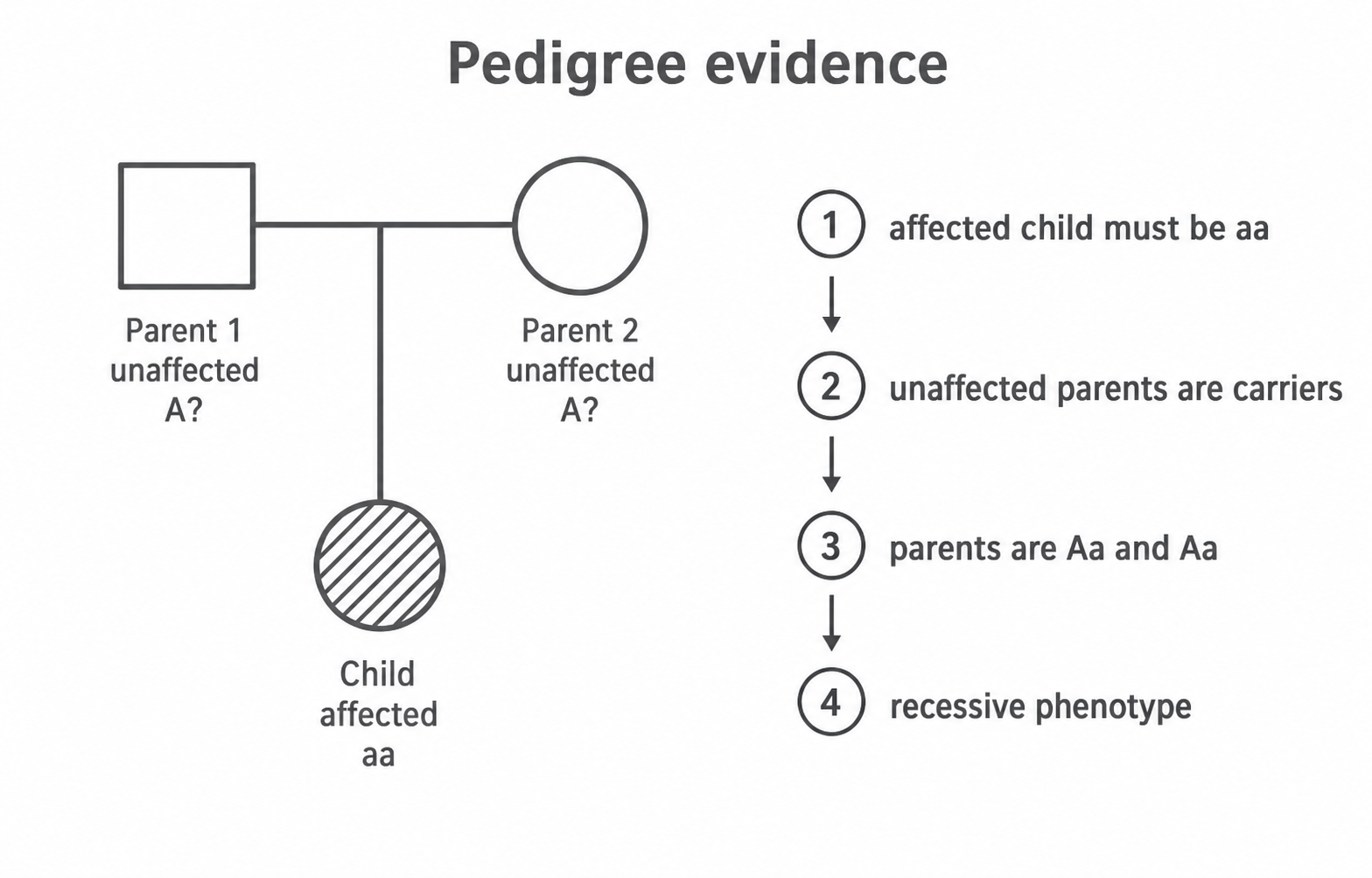
For a recessive condition, an affected individual has two recessive alleles, such as aa. If two unaffected parents have an affected child, each parent must have passed on one recessive allele. The parents are therefore carriers: they do not show the condition, but each has one recessive allele.
Good pedigree explanations use evidence from the family. For example:
| Evidence from the pedigree | What it suggests |
|---|---|
| Two unaffected parents have an affected child | The affected phenotype is recessive |
An affected child has genotype aa | Each parent must have passed on a |
The parents are unaffected but pass on a | The parents are carriers, Aa |
Avoid saying "it skips a generation" as your whole explanation. That phrase is too vague on its own. Say exactly which family relationship provides the evidence and what it shows about the alleles.
Continue this lesson.
You’re previewing NovaLearn without an account. Create a free account to read the rest.
Create free account