3.14-3.16B - DNA, genes and chromosomes
DNA is the molecule that carries genetic information. In this lesson, you will connect three levels of organisation: the whole genome, chromosomes in the nucleus, and genes as sections of DNA. The separate-science extension then adds the shape of DNA and the base-pairing rule that holds its two strands together.
Genome and gene
The genome is the complete set of genetic material in an organism. For Edexcel International GCSE, the key wording is that the genome is the entire DNA of an organism.
Genome
The genome is the entire DNA of an organism.
A gene is smaller than a genome. It is one section of a molecule of DNA with a particular job: it codes for a specific protein.
Gene
A gene is a section of a molecule of DNA that codes for a specific protein.
That difference matters in exam answers. The genome is all the DNA. A gene is only one section of DNA. A gene should not be described as the whole chromosome, the whole nucleus, or every piece of DNA in an organism.
Chromosomes in the nucleus
In a cell, DNA is organised into chromosomes. The Edexcel statement you need is that the nucleus contains chromosomes, and genes are located on those chromosomes.
[DIAGRAM: asset_name: DNA, genes and chromosomes - diagram 01; asset_slug: b45_dna_genes_and_chromosomes__diagram_01; recommended_method: deterministic_drawing; description: Monochrome hierarchy diagram showing a cell with a nucleus, chromosomes inside the nucleus, a chromosome containing DNA, a highlighted gene as a section of DNA, and an arrow from the gene to a specific protein.]
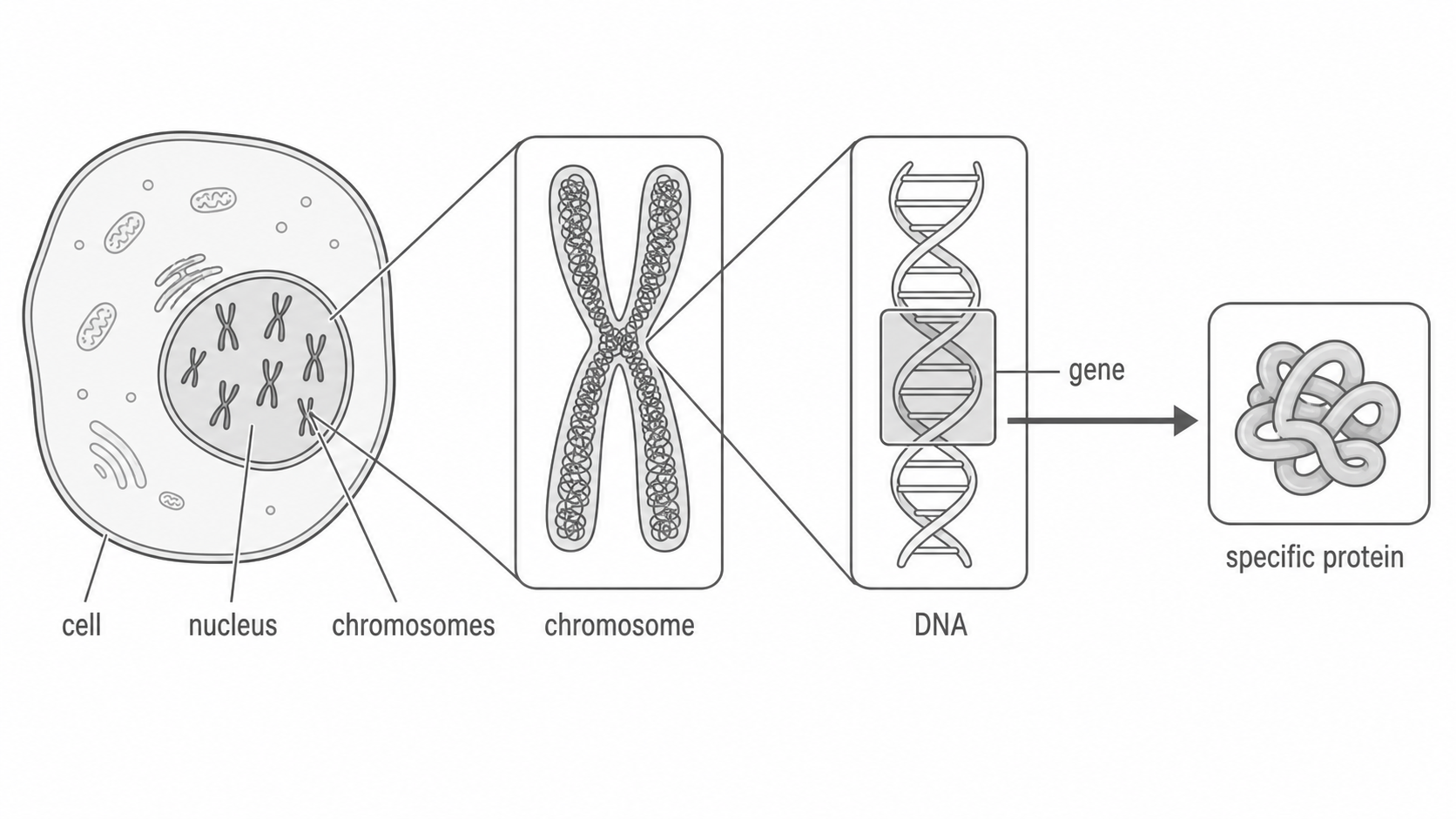
The order is:
cell -> nucleus -> chromosomes -> genes
This does not mean that a chromosome is a gene. A chromosome is a larger DNA-containing structure. Many genes can be located on chromosomes, but each gene is a particular section of DNA.
When a question asks where genes are located, the creditworthy answer is: on chromosomes in the nucleus.
The DNA double helix
The separate-science extension describes the structure of a DNA molecule. A DNA molecule has two strands. These strands are coiled around each other to form a double helix.
The two strands are linked by a series of paired bases. The four bases named in this specification point are:
- adenine, written as A
- thymine, written as T
- cytosine, written as C
- guanine, written as G
Continue this lesson.
You’re previewing NovaLearn without an account. Create a free account to read the rest.
Create free account