5.5-5.8 - Microorganisms, fermentation and food production
Microorganisms are useful in food production because their respiration changes raw materials into products humans want. In this lesson, yeast is used to explain bread making and a required yeast practical, Lactobacillus is used to explain yoghurt production, and industrial fermenters are used to show how microorganisms can be grown under controlled conditions.
Yeast and bread
Yeast is a single-celled fungus. In food production, its useful role is usually linked to fermentation: yeast releases energy by anaerobic respiration when oxygen is absent or limited.
Fermentation
Fermentation is anaerobic respiration by microorganisms, producing useful products such as carbon dioxide, ethanol or lactic acid.
In yeast, the key reaction for this lesson is:
Bread dough contains carbohydrates. Enzymes in the dough and in yeast make sugars available, and the yeast respires the sugar anaerobically. The carbon dioxide forms bubbles that become trapped in the sticky dough, causing the dough to rise. During baking, the heat kills the yeast and much of the ethanol evaporates, leaving the expanded texture of the bread.
The exam point is not that yeast "makes bread" in a vague way. It is that yeast ferments sugar and produces carbon dioxide; the carbon dioxide bubbles cause the dough to rise.
Investigating yeast respiration
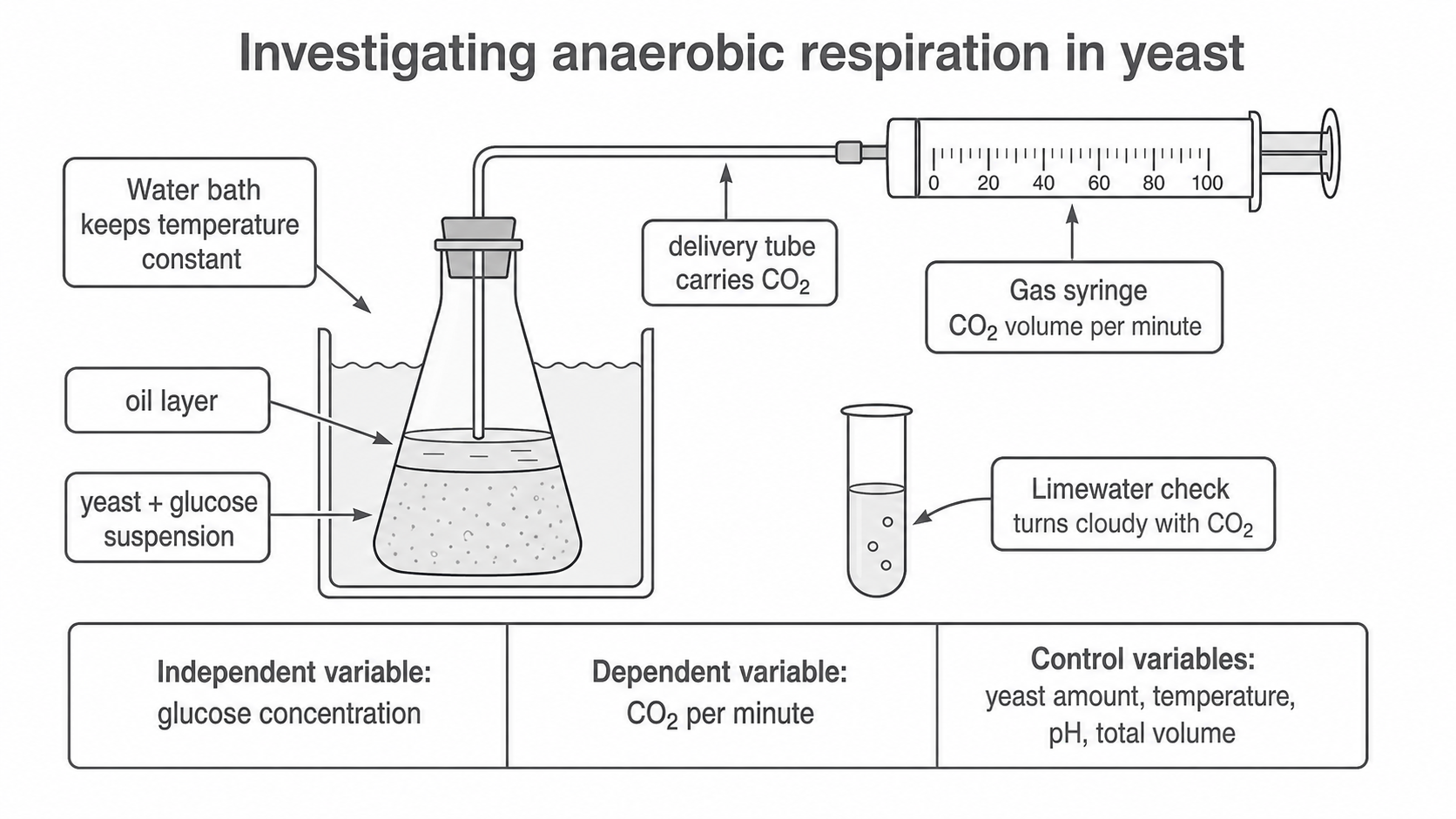
The required practical investigates anaerobic respiration by yeast in different conditions. A common version changes glucose concentration and measures the rate of carbon dioxide production.
[DIAGRAM: asset_name: Microorganisms, fermentation and food production - diagram 01; asset_slug: b63_microorganisms_fermentation_and_food_production__diagram_01; recommended_method: deterministic_drawing; description: Monochrome labelled practical setup for investigating anaerobic respiration in yeast. It shows yeast and glucose suspension in a tube or flask, an oil layer excluding oxygen, a water bath keeping temperature constant, a delivery tube to a gas syringe for carbon dioxide volume, a limewater check for carbon dioxide, and a variables strip showing glucose concentration as the independent variable, carbon dioxide per minute as the dependent variable, and yeast amount, temperature, pH and total volume as control variables.]
A valid method needs a fair comparison:
- Put the same volume of yeast suspension into each tube or flask.
- Add glucose solutions of different concentrations.
- Add a thin oil layer, or otherwise prevent oxygen entering, so the yeast respires anaerobically.
- Keep the temperature constant using a water bath.
- Measure the carbon dioxide produced in a fixed time using a gas syringe, measuring cylinder or bubble count.
- Repeat each concentration and calculate a mean rate.
The independent variable is the condition changed, such as glucose concentration. The dependent variable is the rate of anaerobic respiration, usually shown by carbon dioxide volume produced per minute. Control variables include the mass or volume of yeast, total volume of solution, temperature, pH, time allowed before measuring, and the apparatus used.
Limewater is useful for identifying carbon dioxide because it turns cloudy. However, a gas syringe or measuring cylinder gives better quantitative data because it measures a volume of gas. Wear eye protection, take care with glassware and hot water baths, and avoid sealed apparatus that could build up pressure.
Lactobacillus and yoghurt
Yoghurt is made when bacteria in the genus Lactobacillus ferment milk. The important sugar in milk is lactose. Lactobacillus uses lactose in respiration and produces lactic acid.
As lactic acid is produced, the pH of the milk decreases. That means the milk becomes more acidic, not more alkaline. The acidic conditions cause milk proteins to coagulate, so the milk thickens and sets into yoghurt.
The key sequence is:
| Step | What happens |
|---|---|
| Lactobacillus is added to milk | bacteria are the microorganism responsible for the change |
| lactose is used in respiration | the sugar in milk is broken down |
| lactic acid is produced | acidity increases and pH decreases |
| milk proteins coagulate | the yoghurt thickens and sets |
Yoghurt production often starts by heating milk to reduce unwanted microorganisms, then cooling it before adding the Lactobacillus culture. If the milk is too hot when the culture is added, the bacteria may be killed. For Edexcel, the central role is still the biological one: Lactobacillus converts lactose into lactic acid, which lowers pH and helps yoghurt set.
Continue this lesson.
You’re previewing NovaLearn without an account. Create a free account to read the rest.
Create free account