5.15-5.16 - GM organisms and genetic-engineering applications
Genetically modified plants have had their genetic material changed to give them useful characteristics. In this cluster, the important question is not the full engineering process, but how those characteristics can improve food production. You also need the precise meaning of transgenic, because Edexcel often rewards exact biology vocabulary.
GM and transgenic
A genetically modified, or GM, organism has had its genetic material changed using genetic engineering. In a GM plant, the change is chosen because it gives the plant a useful characteristic, such as resistance to an insect pest or a plant virus.
Genetically modified plant
A genetically modified plant is a plant whose genetic material has been changed using genetic engineering to give a useful characteristic.
The word transgenic is more specific. In this specification, transgenic means that genetic material has been transferred from one species to a different species. For example, if a gene from a bacterium is transferred into a crop plant, that crop plant is transgenic.
Transgenic
Transgenic means involving the transfer of genetic material from one species to a different species.
Do not use "transgenic" as a vague synonym for "bred" or "selected". Selective breeding chooses parents with useful inherited characteristics. A transgenic organism has genetic material from a different species.
Protecting harvests
One way GM plants improve food production is by reducing crop loss. If fewer crop plants are eaten, killed, infected or outcompeted, more of the crop survives until harvest.
[DIAGRAM: asset_name: GM organisms and genetic-engineering applications - diagram 01; asset_slug: b67_gm_organisms_and_genetic_engineering_applications__diagram_01; recommended_method: deterministic_drawing; description: Monochrome trait-to-food-production map for GM plants. A central GM crop plant branches to useful traits including insect pest resistance, disease or virus resistance, herbicide tolerance and environmental stress tolerance. Each trait links to a food-production outcome: less crop damage, fewer plants dying, less weed competition, more reliable growth, and higher or more stable yield.]
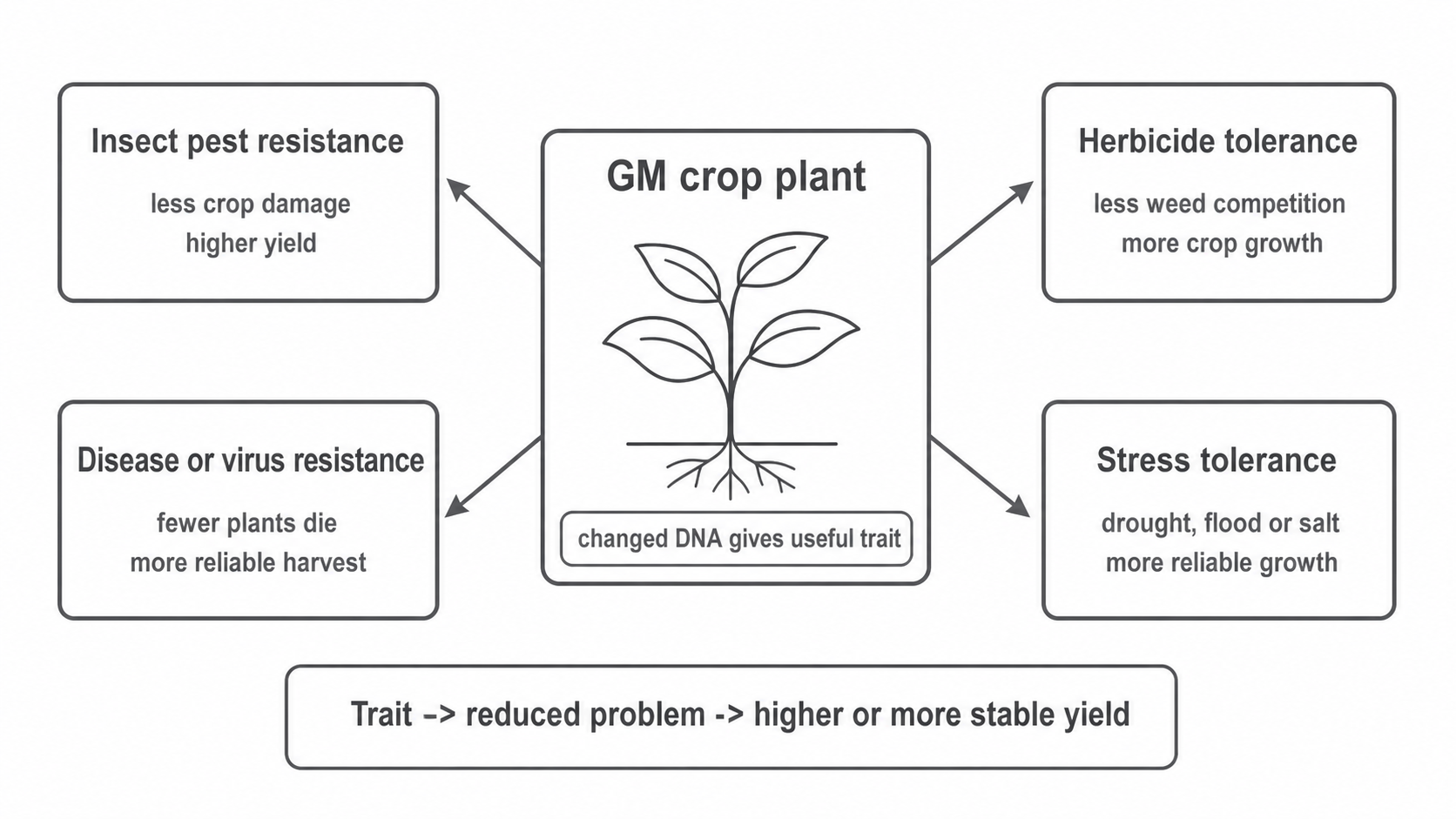
Common crop-protection traits include:
| GM plant characteristic | How it can improve food production |
|---|---|
| Resistance to insect pests | Fewer leaves, stems, flowers or seeds are eaten, so more plant material remains for growth and harvest. |
| Resistance to plant viruses or other diseases | Fewer plants become diseased or die, so the harvest is larger or more reliable. |
| Tolerance to a herbicide | Weeds can be controlled while the crop survives, so the crop has less competition for light, water and mineral ions. |
| Tolerance to difficult conditions, such as drought, flooding or salty soil | Plants are more likely to grow where normal crops would have low yield or fail. |
The exam link is always a cause-and-effect chain. For example: insect-resistant crop -> fewer plants damaged by insects -> more plants survive and grow -> higher yield.
From trait to yield
Yield means the amount of crop produced, often per field area or per plant. A GM plant does not improve food production just because it is "modern" or "high-tech". The genetic change must give a useful trait, and that trait must lead to more usable food.
Use this answer pattern:
- Name the GM trait.
- Say what problem the trait reduces.
- Link that reduction to more growth, survival, harvest or usable food.
Continue this lesson.
You’re previewing NovaLearn without an account. Create a free account to read the rest.
Create free account