2.56B-2.58B - Transpiration factors and transpiration practical
Plants lose water all the time, but the rate is not fixed. In this lesson you will learn the Edexcel definition of transpiration, predict how four environmental factors change its rate, and plan a leafy-shoot investigation using a potometer. The exam focus is usually careful cause-effect wording and practical method: what you changed, what you measured, what you controlled, and how you processed the results.
What transpiration means
Transpiration
Transpiration is the evaporation of water from the surface of a plant.
In a leafy shoot, most of the water loss happens from leaves. Water evaporates from moist cell surfaces inside the leaf, then water vapour diffuses out through stomata into the surrounding air. Edexcel's required definition is shorter than that whole pathway: evaporation of water from the surface of a plant.
Transpiration is linked to water uptake because water lost from the shoot has to be replaced. This is why a potometer can be used to estimate transpiration rate by measuring how quickly water is taken up by a leafy shoot.
Do not write that transpiration is "water moving through xylem". Xylem transport replaces the water lost, but transpiration itself is the evaporation of water from the plant surface.
How environmental factors change the rate
The rate of transpiration depends on how easily water evaporates and how steep the water vapour concentration gradient is between the leaf and the air outside it. A steeper gradient means faster net movement of water vapour out of the plant.
| Environmental factor increases | Effect on transpiration rate | Why this happens |
|---|---|---|
| Humidity | Decreases | Humid air already contains more water vapour, so the gradient from leaf to air is smaller. Less water evaporates and diffuses away per minute. |
| Wind speed | Increases | Moving air removes the humid layer around the leaf, maintaining a steeper gradient for diffusion. |
| Temperature | Increases | Water molecules have more kinetic energy, so evaporation from plant surfaces is faster in normal school-lab conditions. |
| Light intensity | Increases | In brighter light, stomata are usually more open for gas exchange during photosynthesis, so more water vapour can leave. |
The humidity trend is the one students most often reverse. High humidity means wet air outside the leaf; wet air makes it harder for more water vapour to leave. Low humidity means dry air; dry air increases water loss.
When explaining wind, do not just say "wind dries the plant". The mark-scheme link is that wind removes water vapour from around the leaf, increasing the concentration gradient for diffusion.
Using a potometer
A potometer estimates the rate of transpiration from a leafy shoot by measuring water uptake. It is an indirect measure: it assumes that almost all water taken up by the shoot replaces water lost by transpiration. A small amount of water may be used in the plant, so careful exam answers should say "water uptake" or "estimate of transpiration rate" when describing the apparatus.
[DIAGRAM: asset_name: Transpiration factors and transpiration practical - diagram 01; asset_slug: b24_transpiration_factors_and_transpiration_practical__diagram_01; recommended_method: deterministic_drawing; description: Monochrome labelled bubble potometer showing a leafy shoot fitted into an airtight seal, a capillary tube with scale marks, an air bubble in the tube, the tube end in a beaker of water, and an arrow showing bubble movement used to estimate water uptake rate.]
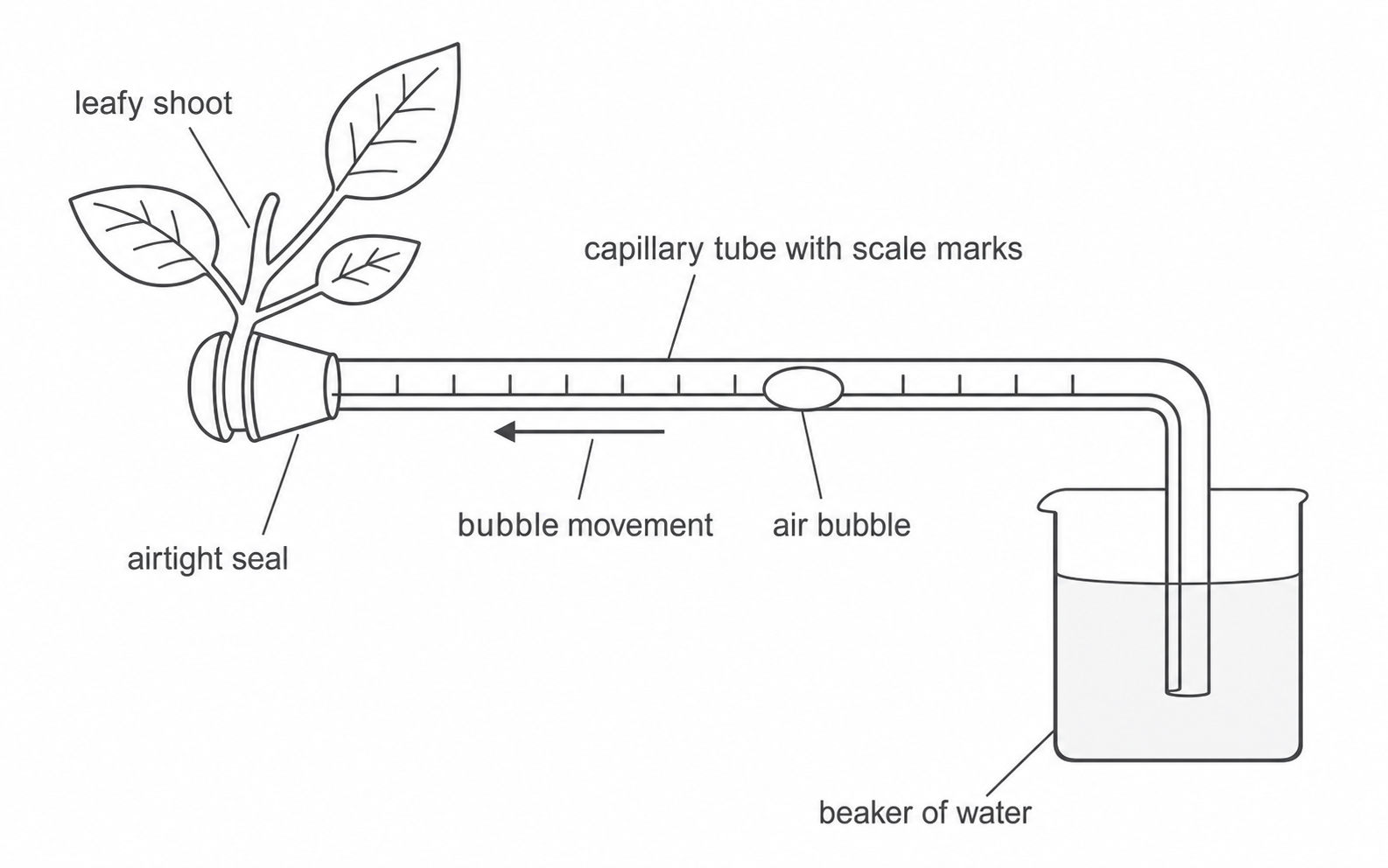
A good setup keeps the water column continuous:
- cut the leafy shoot under water so air does not enter the xylem
- assemble the potometer full of water
- fit the shoot tightly into a rubber bung or plastic collar
- seal joins so the apparatus is airtight and watertight
- dry excess water from the leaves before readings begin
- introduce one small air bubble into the capillary tube
- measure the distance the bubble moves in a fixed time, or the time for a fixed distance
Potometer rate
For example, if the bubble moves 4.8 cm in 3.0 minutes, the estimated rate is 4.8 / 3.0 = 1.6 cm min^-1. If the tube is calibrated by volume, the same idea can be used as volume of water taken up per unit time.
Continue this lesson.
You’re previewing NovaLearn without an account. Create a free account to read the rest.
Create free account