2.62-2.63B - Immune response and vaccination
When pathogens enter the body, the immune system responds using white blood cells. In this lesson, the two named white blood cell roles are phagocytes ingesting pathogens and lymphocytes releasing antibodies specific to the pathogen. The separate-science extension is vaccination: memory cells are made so a future antibody response to the same pathogen happens sooner, faster and in greater quantity.
White blood cells in the immune response
A pathogen is a microorganism that can cause disease. The immune system responds to disease by using white blood cells, but different white blood cells have different roles.
For this specification point, keep the two roles sharply separated:
- phagocytes ingest pathogens
- lymphocytes release antibodies specific to the pathogen
"Specific" is an exam word with weight. A pathogen has surface molecules that antibodies can match. An antibody made against one pathogen has a shape suited to that pathogen, so it should not be described as a general chemical that kills every possible pathogen.
When you answer an Edexcel-style question on this topic, name the cell and state its action. "White blood cells fight disease" is too vague by itself; "phagocytes ingest pathogens" and "lymphocytes release specific antibodies" are creditworthy.
Phagocytes ingest pathogens
Phagocytes are white blood cells that defend the body by engulfing pathogens. Ingesting a pathogen means the phagocyte surrounds it, takes it into the cell and then digests it. This removes the pathogen before it can continue causing disease. Digestive enzymes inside the phagocyte break down the engulfed pathogen.
[DIAGRAM: asset_name: Immune response and vaccination - diagram 01; asset_slug: b26_immune_response_and_vaccination__diagram_01; recommended_method: deterministic_drawing; description: Monochrome process diagram showing pathogens entering body fluid, a phagocyte surrounding and ingesting one pathogen, digestion inside the phagocyte, and a nearby lymphocyte releasing Y-shaped antibodies specific to matching pathogen surface markers.]
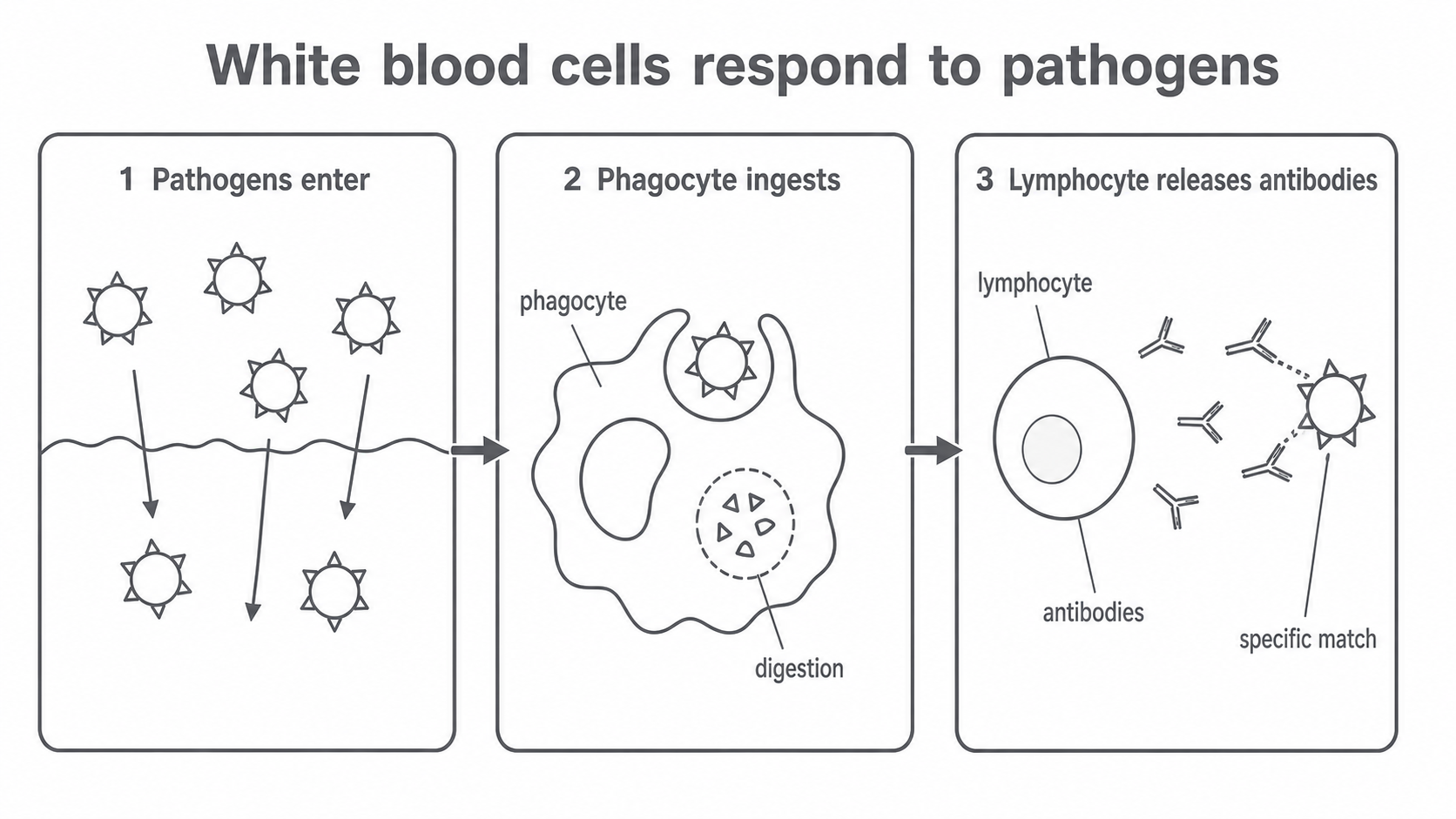
A clear phagocyte answer can be written as a short sequence:
- The phagocyte recognises or encounters a pathogen.
- The phagocyte moves around the pathogen and engulfs it.
- The pathogen is inside the phagocyte.
- The phagocyte digests or destroys the pathogen.
Do not write that phagocytes make antibodies. That is the lymphocyte role in this lesson.
Lymphocytes release specific antibodies
Lymphocytes are white blood cells involved in the specific immune response. They release antibodies, which are proteins that bind to a matching pathogen. The match matters: the antibody is specific to the pathogen that triggered the response.
You can think of a lymphocyte response as selective rather than random. Many different lymphocytes exist, but only the lymphocytes able to make antibodies matching that pathogen are useful against it. Those lymphocytes release many copies of the matching antibody.
Continue this lesson.
You’re previewing NovaLearn without an account. Create a free account to read the rest.
Create free account