2.86-2.87 - Nervous system and receptors
Humans use communication systems to control responses. Some responses need fast electrical messages through the nervous system. Others are controlled by chemical hormones carried in the blood. This lesson compares those two systems and shows how sense organs are linked to the central nervous system by nerves.
Messages that control responses
A response is a change in behaviour or body activity after a stimulus has been detected. For a response to be controlled, information must be passed from the place where the change is detected to the body part that will respond.
In humans, two communication systems do this:
| Communication system | Main type of message | Main route |
|---|---|---|
| Nervous communication | Electrical impulses | Along nerves, usually through the central nervous system |
| Hormonal communication | Chemical hormones | In the blood |
Both systems can control effectors, such as muscles or glands, by changing what those effectors do. The important difference is how the message travels. A nervous message is an electrical impulse carried along nerve cells. A hormonal message is a chemical released into the blood and carried around the body.
[DIAGRAM: asset_name: Nervous and hormonal response routes; asset_slug: b35_nervous_system_and_receptors__diagram_01; recommended_method: deterministic_drawing; description: Monochrome two-route flow diagram comparing nervous communication from stimulus to receptor to electrical impulses in nerves to CNS to effector to rapid response, with hormonal communication from change to endocrine gland to hormone in blood to target cells with receptors to slower longer-lasting response.]
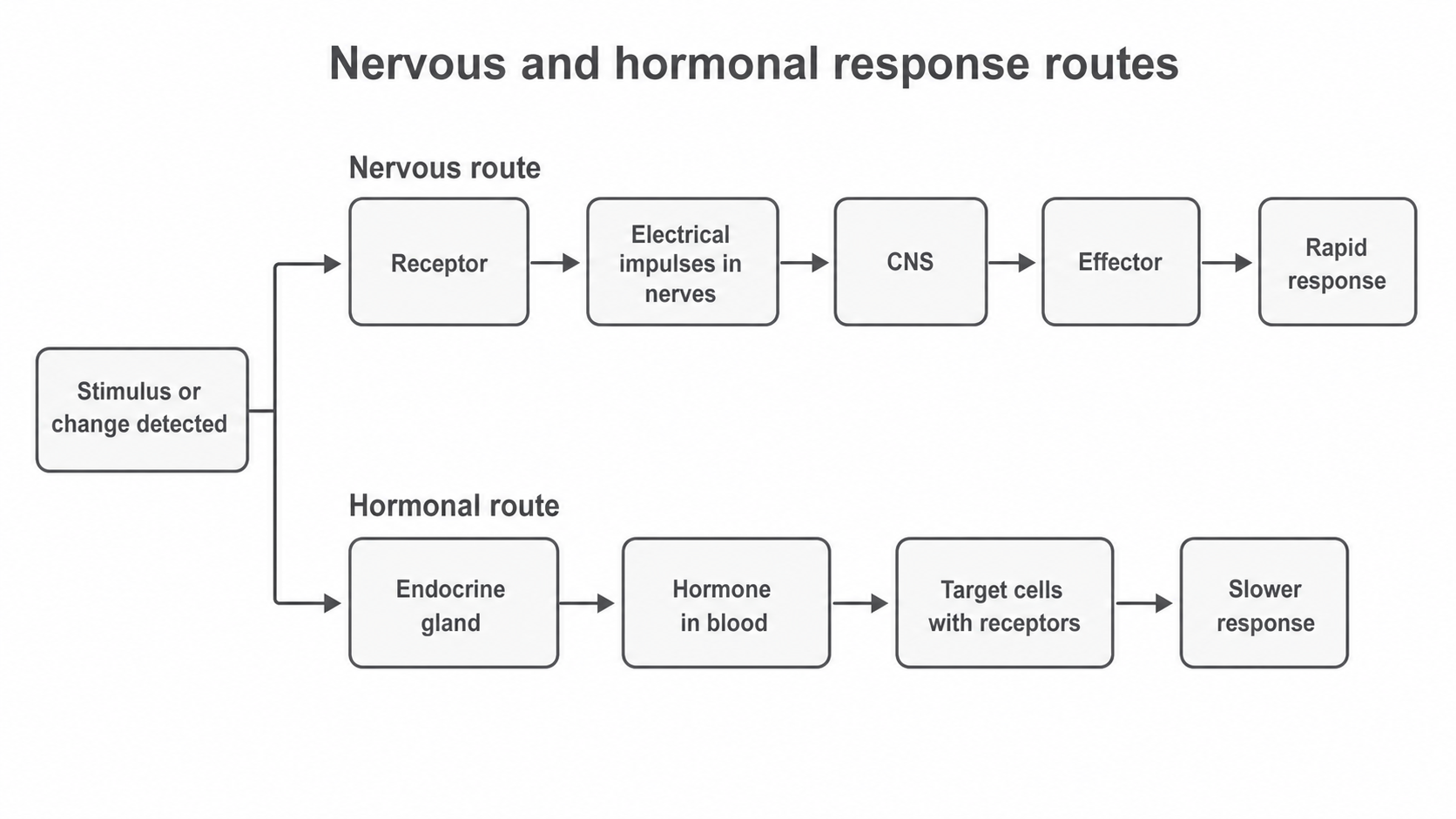
Do not treat the two systems as separate from the idea of response. The point of the communication is to control a useful change, such as movement, gland secretion or a longer-lasting adjustment in body activity.
Nervous communication
Nervous communication uses electrical impulses. These impulses travel along nerves, so messages can move quickly between receptors, the central nervous system and effectors.
Nervous communication
Communication using electrical impulses that travel along nerves.
This system is suited to rapid responses. If a message needs to make a muscle contract quickly, nervous communication can send a precise instruction to that muscle. The response is usually short-lived because the impulse is brief and directed.
A nervous response is also specific. A nerve impulse travels along a pathway to particular cells, so it does not automatically affect every part of the body. This is why nervous communication is useful for controlled movement and quick changes in gland activity.
For this lesson, keep the scale correct: you need to know the broad communication system, not the detailed structure of synapses or reflex arcs. Those details belong to the next specification points.
Hormonal communication
Hormonal communication uses hormones. A hormone is a chemical messenger released by an endocrine gland and carried in the blood.
Hormonal communication
Communication using chemical hormones carried in the blood.
Because hormones travel in blood, they may pass around much of the body. However, they only cause a response in cells or organs that can respond to that hormone. These are called target cells or target organs.
Continue this lesson.
You’re previewing NovaLearn without an account. Create a free account to read the rest.
Create free account