3.19-3.22 - Alleles, inheritance terms and variation types
Inheritance uses precise vocabulary. A gene can have different versions, and those versions can affect the characteristics an organism inherits. This lesson builds the terms needed before genetic diagrams: allele, genotype, phenotype, dominant, recessive, homozygous, heterozygous, codominance and polygenic inheritance.
Genes and alleles
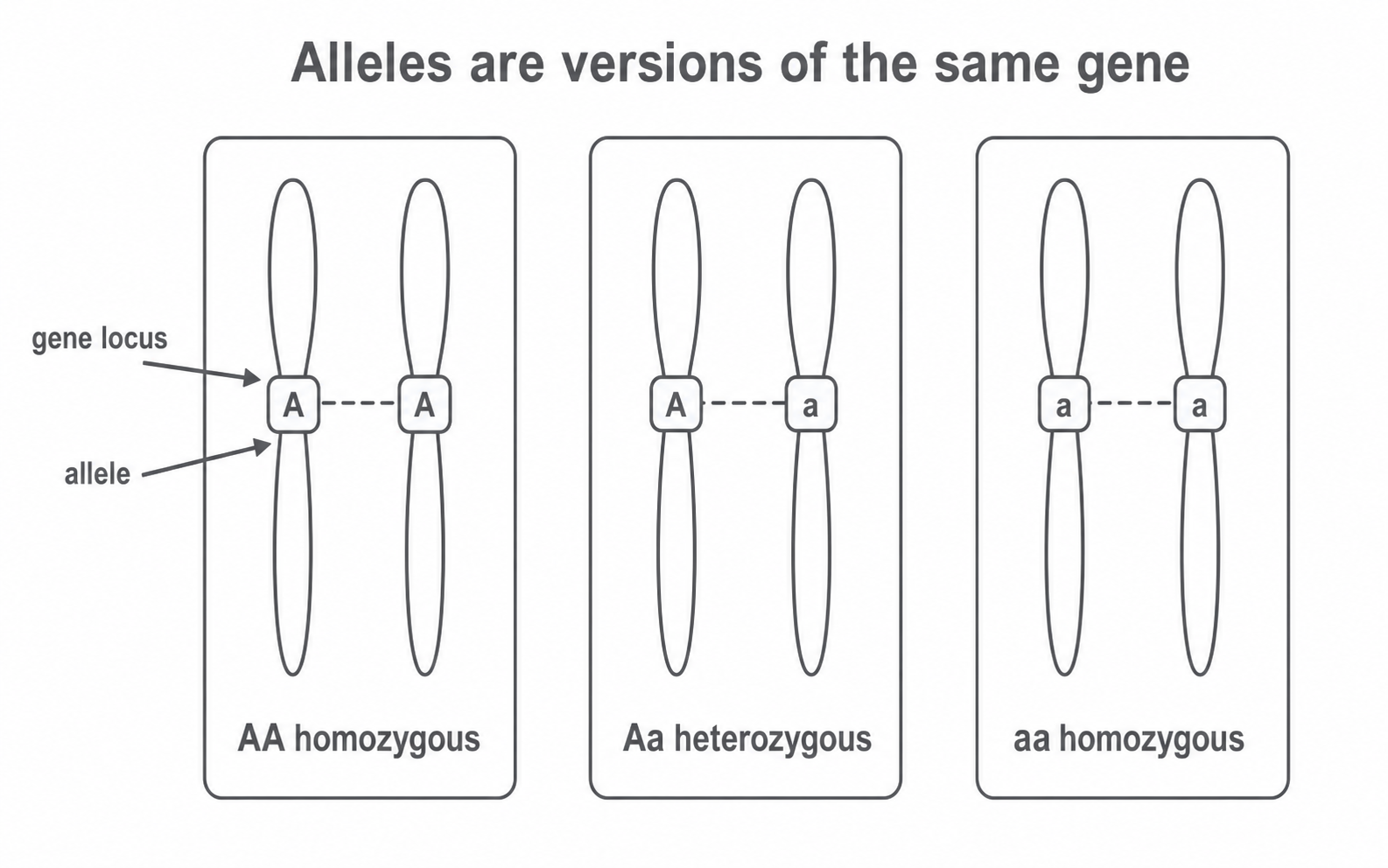
A gene is a section of DNA that codes for a specific protein. Different versions of the same gene are called alleles. Alleles are found at the same position on matching chromosomes, but the DNA sequence of the allele can be different.
Allele
An allele is an alternative form of a gene.
Alleles can give rise to differences in inherited characteristics. For example, a gene involved in flower pigment may have one allele that allows purple pigment to be made and another allele that does not. The inherited characteristic is affected by which alleles the organism has.
In many simple examples, an organism has two alleles for a gene: one inherited from each parent. Those two alleles may be the same, or they may be different. The important point for this lesson is that alleles are versions of the same gene, not completely different genes.
[DIAGRAM: asset_name: Alleles, inheritance terms and variation types - diagram 01; asset_slug: b47_alleles_inheritance_terms_and_variation_types__diagram_01; recommended_method: deterministic_drawing; description: Monochrome schematic of a pair of matching chromosomes with the same gene locus marked, showing allele combinations AA, Aa and aa and labels for gene, allele, homozygous and heterozygous.]
Genotype and phenotype
Two terms keep the genetic information separate from the visible result.
Genotype
The genotype is the alleles an organism has for a particular gene.
This is the genetic information for the characteristic being considered.
Phenotype
The phenotype is the observable characteristic shown by an organism.
For a single-gene example, letters can be used to show the genotype. If a flower-colour gene has alleles B and b, possible genotypes include BB, Bb and bb. The phenotype would be what you can observe, such as purple flowers or white flowers.
| Term | What it means | Example |
|---|---|---|
| Genotype | The allele combination | Bb |
| Phenotype | The observable characteristic | purple flowers |
The same genotype can be written without describing the whole organism. For example, Bb only tells you about the allele combination for one gene. A phenotype is broader in wording: it describes the characteristic that is actually shown.
Dominant and recessive alleles
Some alleles are described as dominant or recessive. These words describe how two alleles affect the phenotype when they are together in the same organism.
Dominant
A dominant allele is expressed in the phenotype when it is present, even if only one copy is present.
A dominant allele is usually shown with a capital letter, such as B. If B gives purple flowers, both BB and Bb would show the purple-flower phenotype in a simple dominant/recessive example.
Recessive
A recessive allele is expressed in the phenotype only when no dominant allele for that gene is present.
A recessive allele is usually shown with the matching lower-case letter, such as b. If b gives white flowers, the white-flower phenotype would be shown by bb, because there is no dominant B allele present.
Continue this lesson.
You’re previewing NovaLearn without an account. Create a free account to read the rest.
Create free account