5.17B-5.20B - Cloning - micropropagation and cloned animals
Cloning means producing genetically identical copies. In this lesson, cloning appears in two different contexts: plants copied by micropropagation, and mammals copied by nuclear transfer. Keep those processes separate: a plant explant can be grown into many new plants in vitro, but cloned mammals are produced using an enucleated egg cell, a diploid nucleus, an embryo and a surrogate mother.
Core cloning terms
A clone is a genetically identical copy. Clones can be cells, tissues or whole organisms. The important point for this cluster is that the copied organisms have the same genetic information as the original source, unless a mutation occurs.
Clone
A genetically identical copy of a cell or organism.
Micropropagation is plant cloning by tissue culture. It starts with an explant, which is a small piece of plant tissue taken from a selected parent plant.
Explant
A small piece of plant tissue used to start a tissue culture.
The explant is grown in vitro. This means it is grown outside a living organism, in artificial laboratory conditions such as on sterile agar in a dish or tube. Do not confuse in vitro with "inside the plant" or "controlling variables"; it literally means grown outside the organism.
In vitro
In vitro means outside a living organism, in artificial conditions such as a dish, tube or culture vessel.
The animal-cloning part uses different vocabulary. A mature body cell has a diploid nucleus, meaning it contains the full set of chromosomes. An enucleated egg cell is an egg cell whose nucleus has been removed.
| Term | Meaning in this lesson |
|---|---|
| mature cell | a body cell from an adult or developed mammal, not a gamete |
| diploid nucleus | a nucleus with the full set of chromosomes |
| enucleated egg cell | an egg cell with its nucleus removed |
| surrogate mother | a female that carries the cloned embryo in her uterus |
Micropropagation method
Micropropagation uses tissue culture to produce plant clones. It works because small pieces of plant tissue can divide and develop into whole plants when they are given the right sterile conditions, nutrients and plant growth substances.
The usual Pearson-style sequence is:
- Choose a parent plant with desirable characteristics, such as high yield, disease resistance or attractive flowers.
- Cut very small pieces of tissue, called explants, from the plant using sterile forceps or a scalpel.
- Sterilise the explants, for example with bleach, hypochlorite or ethanol, then handle them using aseptic technique.
- Place the explants onto sterile agar or another growth medium.
- The medium contains nutrients, such as glucose, minerals or amino acids, and plant growth substances or hormones.
- Incubate the explants in controlled conditions so cells divide by mitosis and form a callus, shoots or small plantlets.
- Transfer the plantlets to a rooting medium if needed, then grow them in a glasshouse before planting outside.
Callus
A mass of undifferentiated plant cells that can develop into shoots and roots under suitable tissue-culture conditions.
[DIAGRAM: asset_name: Cloning: micropropagation and cloned animals - diagram 01; asset_slug: b68_cloning_micropropagation_and_cloned_animals__diagram_01; recommended_method: deterministic_drawing; description: Monochrome flow diagram showing micropropagation from a selected parent plant with desirable characteristics to small explants, sterilisation, sterile agar with nutrients and plant growth substances, in vitro growth into callus/shoots/rooted plantlets, glasshouse hardening and many genetically identical plants.]
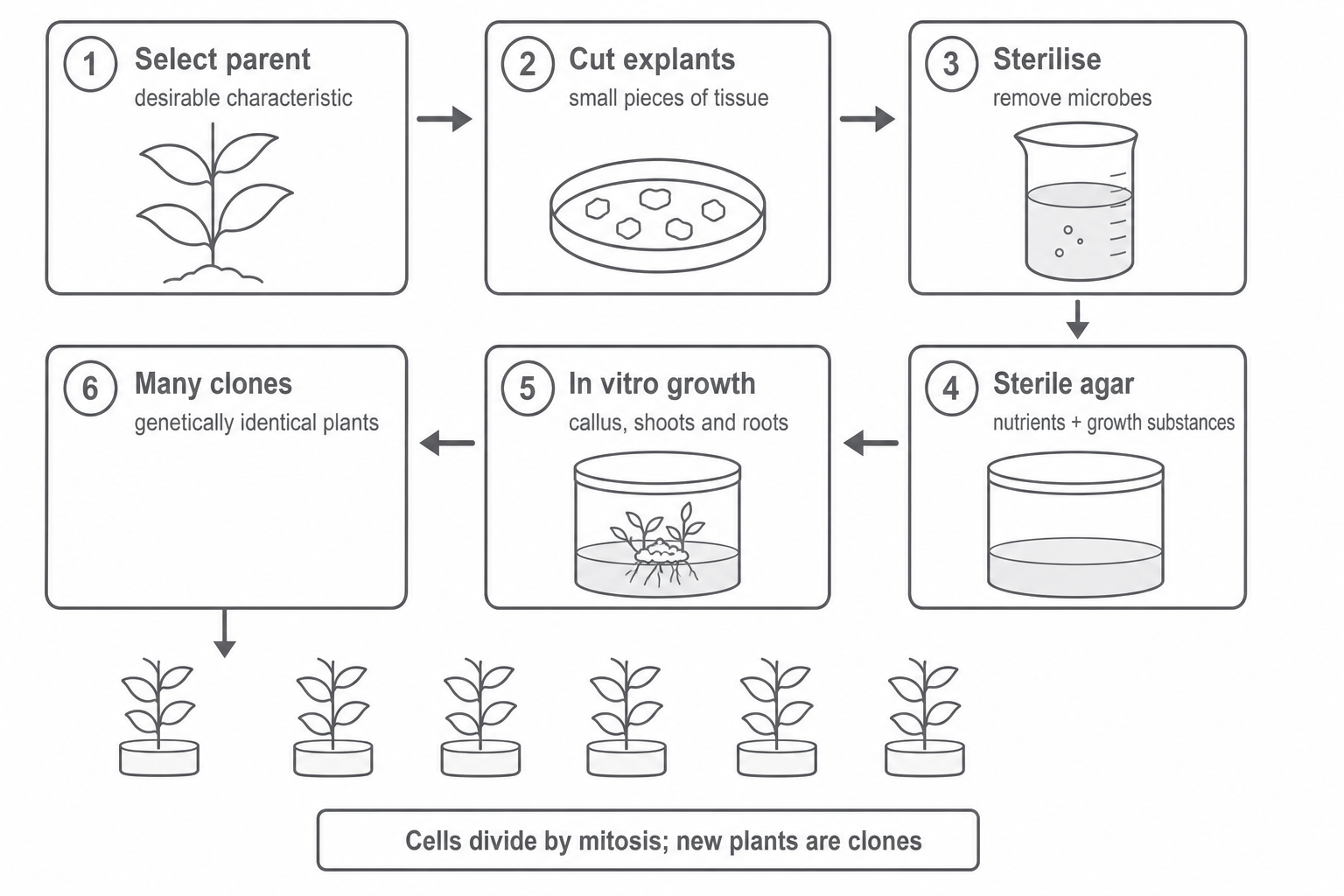
Sterile technique matters because bacteria and fungi grow well on nutrient agar too. If microorganisms contaminate the culture, they can outcompete or kill the plant tissue. In exam answers, "put the explant in soil" is not enough for micropropagation; the key setting is sterile in vitro culture.
Commercial plant clones
Micropropagation is useful commercially because it can make many copies from one valuable parent plant. If the parent has a desirable characteristic, the clones should have the same characteristic because they are produced by mitosis and are genetically identical.
| Commercial aim | Why micropropagation helps |
|---|---|
| Produce many plants for sale | Many explants and subcultures can be grown in a small laboratory space. |
| Keep a desirable characteristic | The new plants are clones of the selected parent plant. |
| Copy a rare, valuable or transgenic plant | A small amount of starting tissue can produce many plantlets. |
| Supply uniform crops | Genetically identical plants tend to grow with similar features under the same conditions. |
The phrase "commercial quantities" means large numbers suitable for nurseries, farms or horticulture, not just one or two classroom samples. A strong answer often says both parts: many plants are produced and the plants are genetically identical with the desired characteristic.
Micropropagation is asexual reproduction, so it does not use pollination, gametes or fertilisation. Pollination and sexual reproduction can create genetic variation, which is useful in some situations but not when growers need many identical copies of one successful plant.
Continue this lesson.
You’re previewing NovaLearn without an account. Create a free account to read the rest.
Create free account