5.1-5.4 - Crop yield and pest control
Crop yield is the amount of useful crop harvested from a given area or from a set of plants. Farmers can increase yield by improving the conditions for photosynthesis and growth, and by reducing losses caused by pests. In this lesson, keep the scope tight: protected growing, carbon dioxide and temperature in glasshouses, fertilisers, and pest control in crop plants.
Protected growing
Glasshouses and polythene tunnels are transparent structures used to grow certain crops in a more controlled environment. They are most useful for high-value crops such as tomatoes, cucumbers, peppers, lettuce, soft fruit and young plants, where extra yield or an earlier harvest can justify the cost.
Crop yield
Crop yield is the amount of useful crop produced, usually measured as mass of harvested crop per plant, per field area or per season.
A glasshouse is a more permanent structure with glass or rigid transparent panels. A polythene tunnel is usually a curved frame covered in transparent plastic sheeting. Both can increase yield because they let light reach the plants while reducing some uncontrolled effects of the outside environment.
[DIAGRAM: asset_name: Crop yield and pest control - diagram 01; asset_slug: b62_crop_yield_and_pest_control__diagram_01; recommended_method: deterministic_drawing; description: Monochrome comparison of a glasshouse and a polythene tunnel growing crop plants. Labels show transparent cover lets light in, warmer air and soil, reduced wind and rain damage, controlled watering and mineral supply, ventilation to prevent overheating, reduced pest entry, and higher harvestable yield.]
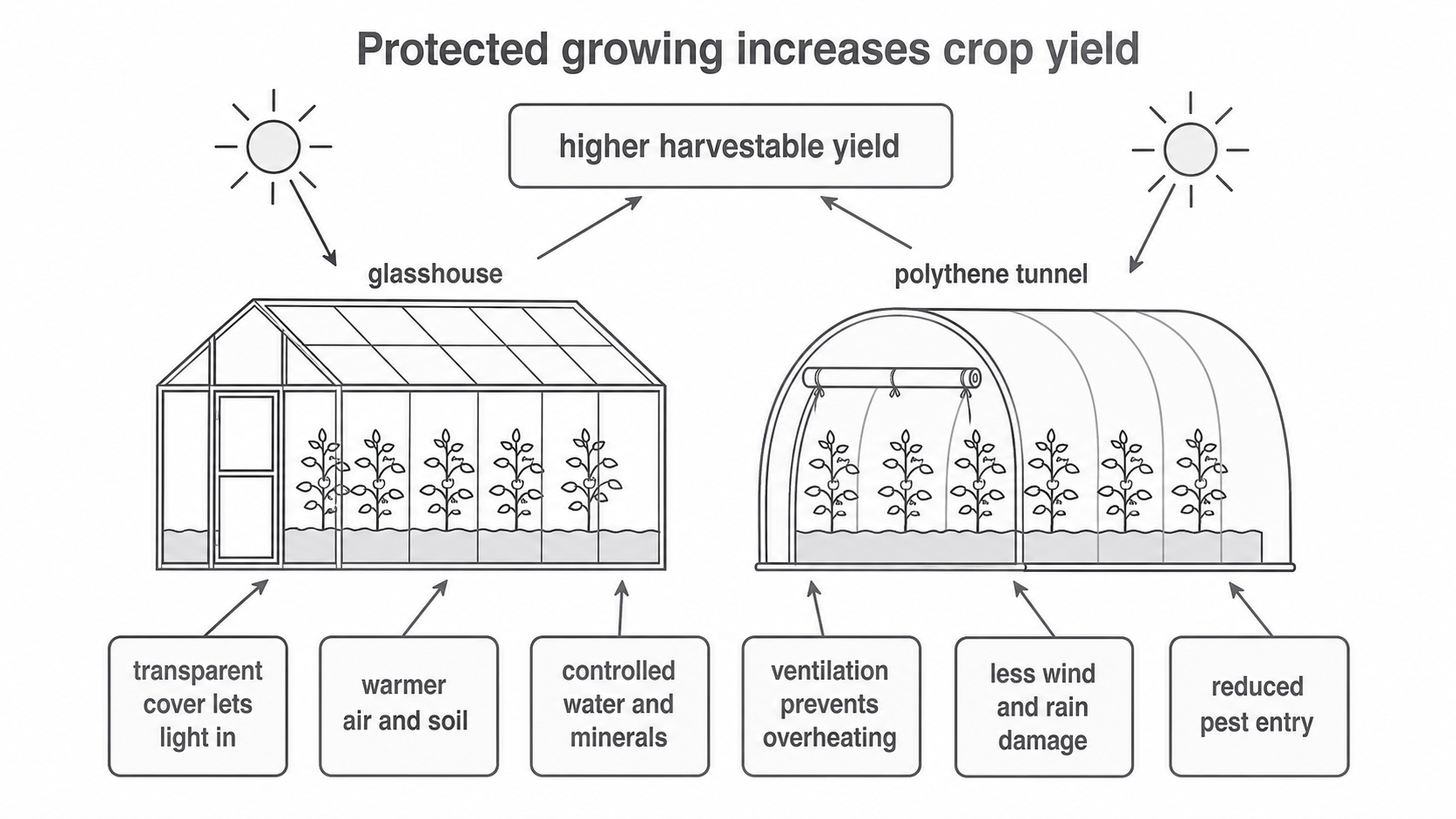
Protected growing can increase yield by:
| Feature | How it can increase yield |
|---|---|
| Transparent cover | Light enters, so plants can photosynthesise. |
| Warmer air and soil | Growth and photosynthesis can be faster when temperature is below the crop optimum. |
| Controlled watering | Plants are less likely to have water shortage, so cells stay turgid and stomata can remain open for gas exchange. |
| Controlled mineral supply | Fertiliser can be added in measured amounts, supporting protein, chlorophyll and other plant materials. |
| Reduced wind, rain and frost damage | More leaf area and flowers or fruits survive. |
| Reduced pest entry | Fewer plants are eaten or damaged before harvest. |
Glasshouses are easier to heat, ventilate, enrich with carbon dioxide and monitor automatically. Polythene tunnels are usually cheaper and are often used to extend the growing season, especially in cooler months. In both cases, the aim is not just "more heat"; the aim is conditions closer to the crop's optimum.
Carbon dioxide and temperature
In a glasshouse, farmers can control carbon dioxide concentration and temperature more precisely than in an open field. These factors matter because photosynthesis makes glucose, which can be used in respiration, converted to starch, or used to build cellulose, proteins and other plant materials. More plant biomass, flowers, fruits or seeds can mean a higher yield.
Carbon dioxide is a raw material for photosynthesis. If carbon dioxide concentration is low, it can be a limiting factor. Increasing carbon dioxide concentration can increase the rate of photosynthesis, so more glucose is produced. If light, temperature, water or mineral ions then become limiting, adding still more carbon dioxide will not keep increasing yield.
Temperature affects enzyme-controlled reactions in photosynthesis and growth. Increasing temperature can increase kinetic energy, so molecules move faster and collide more often with enzymes. This can increase the rate of photosynthesis and growth up to the crop's optimum temperature. Above the optimum, enzymes and membranes are affected, respiration may rise relative to photosynthesis, plants may lose more water, and yield can fall.
[DIAGRAM: asset_name: Crop yield and pest control - diagram 02; asset_slug: b62_crop_yield_and_pest_control__diagram_02; recommended_method: deterministic_drawing; description: Monochrome two-panel graph. Left panel shows crop yield rising as carbon dioxide concentration increases, then levelling off when another factor becomes limiting. Right panel shows crop yield or photosynthesis increasing with temperature up to an optimum, then falling when temperature is too high. Both panels are clearly labelled as conceptual relationships, not fixed numerical values.]
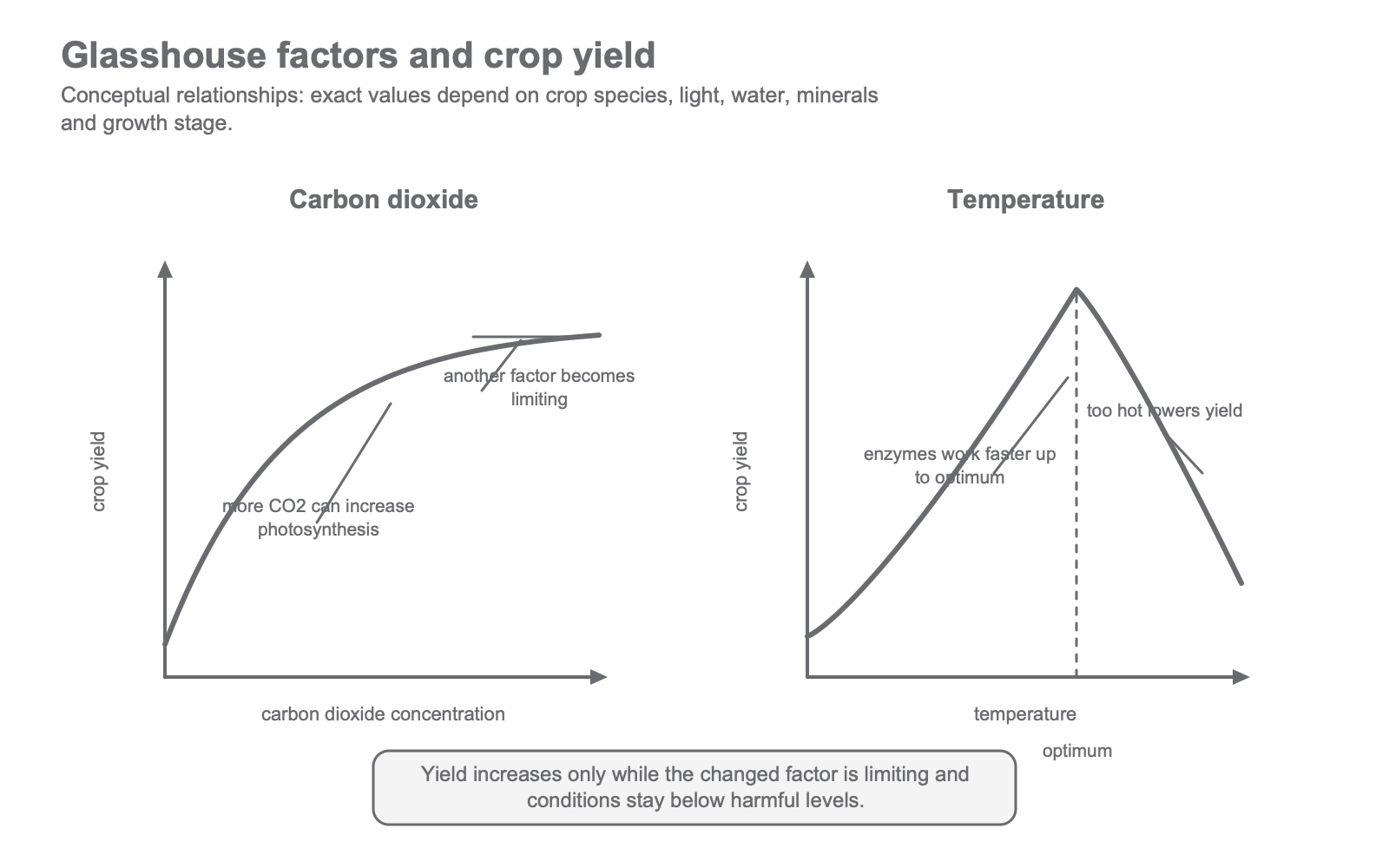
Gas or oil heaters can have two useful effects in a glasshouse: they release heat, increasing temperature, and their combustion can release carbon dioxide. In exam answers, link both effects to photosynthesis. Heat can raise the crop closer to its optimum temperature; carbon dioxide can remove a limiting factor for photosynthesis.
However, glasshouse conditions must be balanced. A hot, sealed glasshouse may overheat, so ventilation or shading may be needed. Opening vents can reduce carbon dioxide enrichment because carbon dioxide escapes. Farmers therefore control temperature, carbon dioxide, water, humidity and minerals together rather than treating one factor as magic.
Fertilisers and crop growth
Fertilisers are added to soil or growing media to supply mineral ions needed by plants. Crop plants remove mineral ions from soil as they grow. If the soil does not replace those ions quickly enough, mineral ions can become a limiting factor for growth and yield.
Fertiliser
A fertiliser is a substance added to soil or a growing medium to supply mineral ions needed for plant growth.
Important mineral ions include:
| Mineral ion | Why it helps crop growth |
|---|---|
| Nitrate ions | Used to make amino acids, which are used to make proteins for growth. |
| Magnesium ions | Needed to make chlorophyll, so leaves can absorb light for photosynthesis. |
| Phosphate ions | Used in DNA, cell membranes and energy-transfer molecules such as ATP. |
| Potassium ions | Help enzyme activity, stomatal function and general plant growth. |
The strongest Edexcel answers usually name a mineral ion and link it to its function. "Fertiliser gives plants food" is weak because plants make glucose by photosynthesis. Fertiliser supplies mineral ions, not glucose.
Fertiliser can increase yield by allowing plants to make more proteins, chlorophyll and new cells. More chlorophyll can support more photosynthesis, and more protein synthesis supports growth of roots, stems, leaves, flowers, fruits and seeds.
Continue this lesson.
You’re previewing NovaLearn without an account. Create a free account to read the rest.
Create free account