2.51-2.52 - Why multicellular organisms need transport
Every living cell needs substances from its surroundings and must remove waste substances. For very small, simple organisms, diffusion alone can be enough because every part of the cell is close to the cell surface. Multicellular organisms have a different problem: many cells are deep inside the body, so they need transport systems to move substances between exchange surfaces and internal cells.
Diffusion in unicellular organisms
Diffusion is the net movement of particles from a region where they are at a higher concentration to a region where they are at a lower concentration. It is passive, so it does not need energy released by respiration.
Diffusion
Diffusion is the net movement of particles from an area of higher concentration to an area of lower concentration, down a concentration gradient.
A simple unicellular organism is made of one cell. Its cell membrane is the boundary between the cell and the external environment, so substances only have to cross one surface to enter or leave the organism.
Examples of useful substances moving in by diffusion include oxygen for aerobic respiration and dissolved nutrients. Examples of substances moving out include carbon dioxide and other waste products.
Diffusion can supply a simple unicellular organism because:
- the organism has a large surface area compared with its volume
- the diffusion distance from the cell surface to the middle of the cell is very short
- all of the cytoplasm is close to the cell membrane
- substances do not have to be carried through tissues or organs
That is why a simple unicellular organism can rely on diffusion for movement of substances in and out of the cell.
Surface area:volume ratio
The surface area:volume ratio compares how much outer surface an organism has with how much living material it contains. The surface area is where substances can diffuse in and out. The volume represents how much cytoplasm or tissue must be supplied.
A small object has a high surface area:volume ratio. A larger object has a lower surface area:volume ratio, because volume increases faster than surface area as size increases.
[DIAGRAM: asset_name: surface_area_volume_scaling; asset_slug: b22_why_multicellular_organisms_need_transport__diagram_01; recommended_method: deterministic_drawing; description: Monochrome diagram comparing a 1 unit cube with surface area 6, volume 1 and SA:V 6:1 against a 2 unit cube with surface area 24, volume 8 and SA:V 3:1, with a note that volume increases faster than surface area.]
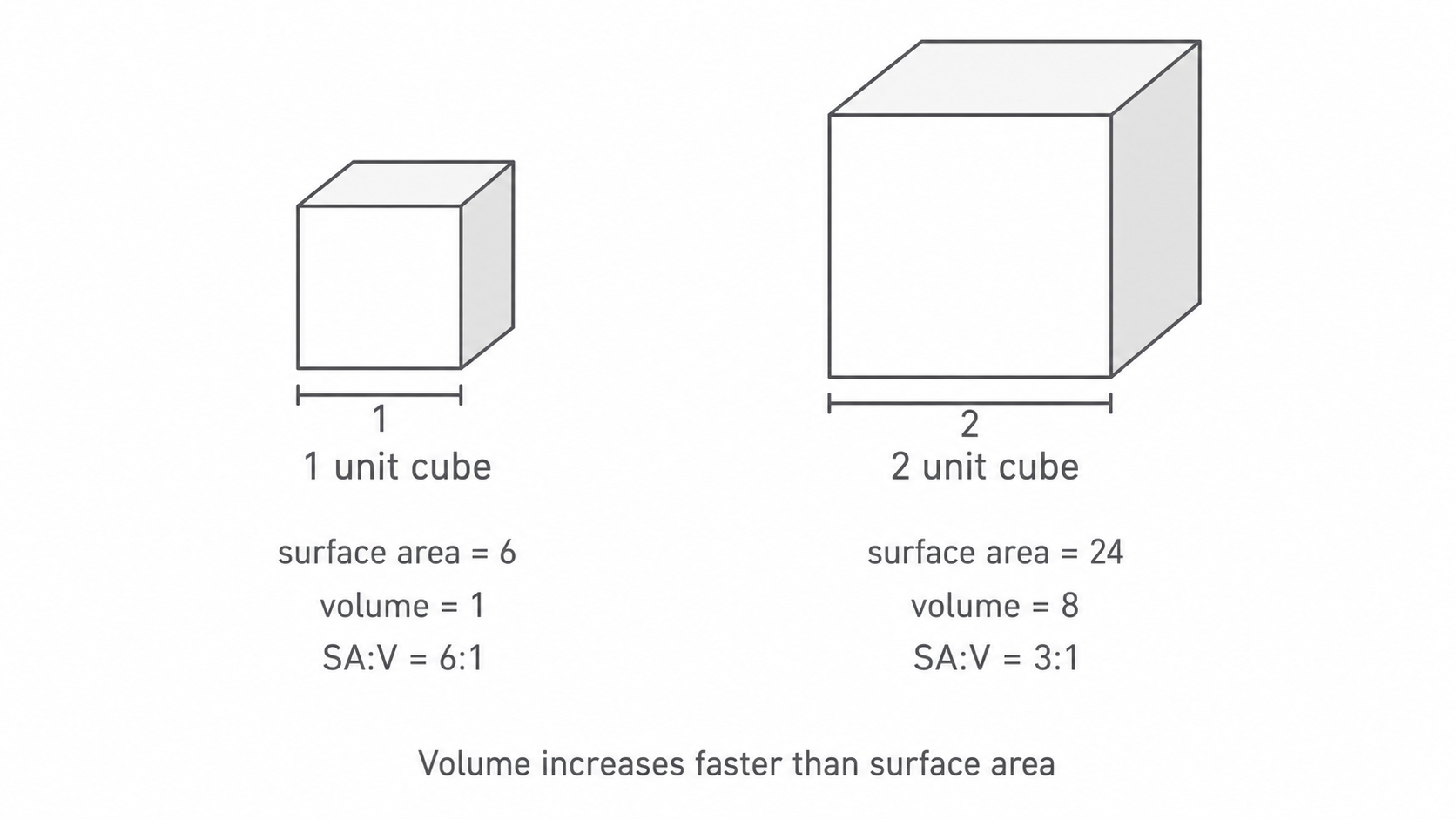
For example, imagine a cube-shaped cell:
- side length 1 unit: surface area = 6 square units, volume = 1 cubic unit, so surface area:volume = 6:1
- side length 2 units: surface area = 24 square units, volume = 8 cubic units, so surface area:volume = 3:1
The larger cube has more surface area in total, but not enough surface area for its much larger volume. This is the key point: as size increases, each unit of volume has less surface available for exchange.
A low surface area:volume ratio means diffusion across the outside surface may not supply enough oxygen or nutrients quickly enough, and may not remove carbon dioxide or other wastes quickly enough.
Limits of diffusion in multicellular organisms
Multicellular organisms are made of many cells. Their size gives them a low surface area:volume ratio, and many cells are not in direct contact with the external environment.
Diffusion is still important at cell membranes, but it is only efficient over short distances. In a large multicellular organism, a molecule entering at the body surface might have to travel through many layers of cells before reaching cells deep inside the body. That journey would be too slow by diffusion alone.
Multicellular organisms also have high demand. Many cells need oxygen and glucose for respiration at the same time, and many cells produce carbon dioxide and other waste products. The larger and more active the organism is, the more important it becomes to move substances quickly and continuously.
The problem is not simply "multicellular organisms are big". The full explanation links three ideas:
Continue this lesson.
You’re previewing NovaLearn without an account. Create a free account to read the rest.
Create free account