4.10-4.11B - Carbon and nitrogen cycles
Carbon and nitrogen atoms are reused again and again in ecosystems. The carbon cycle describes how carbon moves between carbon dioxide, living organisms, dead material and fuels. The nitrogen cycle describes how nitrogen moves between nitrogen gas, soil compounds and the proteins and other nitrogen-containing compounds in organisms.
Matter is recycled
Energy is transferred through ecosystems and is eventually lost to the surroundings, but matter is different. The atoms in carbon dioxide, glucose, protein, waste and dead organisms can be recycled into new substances.
Cycle of matter
A cycle of matter is a set of processes that moves atoms between organisms and the non-living environment so the atoms can be reused.
In this lesson, the two important reservoirs in the non-living environment are the atmosphere and the soil:
| Cycle | Main forms to track |
|---|---|
| carbon cycle | carbon dioxide in air, carbon compounds in organisms, dead organic material and fuels |
| nitrogen cycle | nitrogen gas in air, ammonium compounds and nitrate ions in soil, nitrogen compounds in organisms |
Decomposers link living organisms back to the non-living environment. They break down dead organisms and waste materials. That matters in both cycles: carbon is returned as carbon dioxide during decomposer respiration, and nitrogen in dead material is returned to soil compounds that can later be used by plants.
Carbon cycle stages
The carbon cycle is mostly about carbon moving into and out of carbon dioxide.
[DIAGRAM: asset_name: Carbon and nitrogen cycles - diagram 01; asset_slug: b58_carbon_and_nitrogen_cycles__diagram_01; recommended_method: deterministic_drawing; description: Monochrome flow diagram of the carbon cycle showing carbon dioxide in the atmosphere, producers, consumers, dead organic material and decomposers, and fossil fuels, with arrows for photosynthesis, feeding, respiration, decomposition and combustion.]
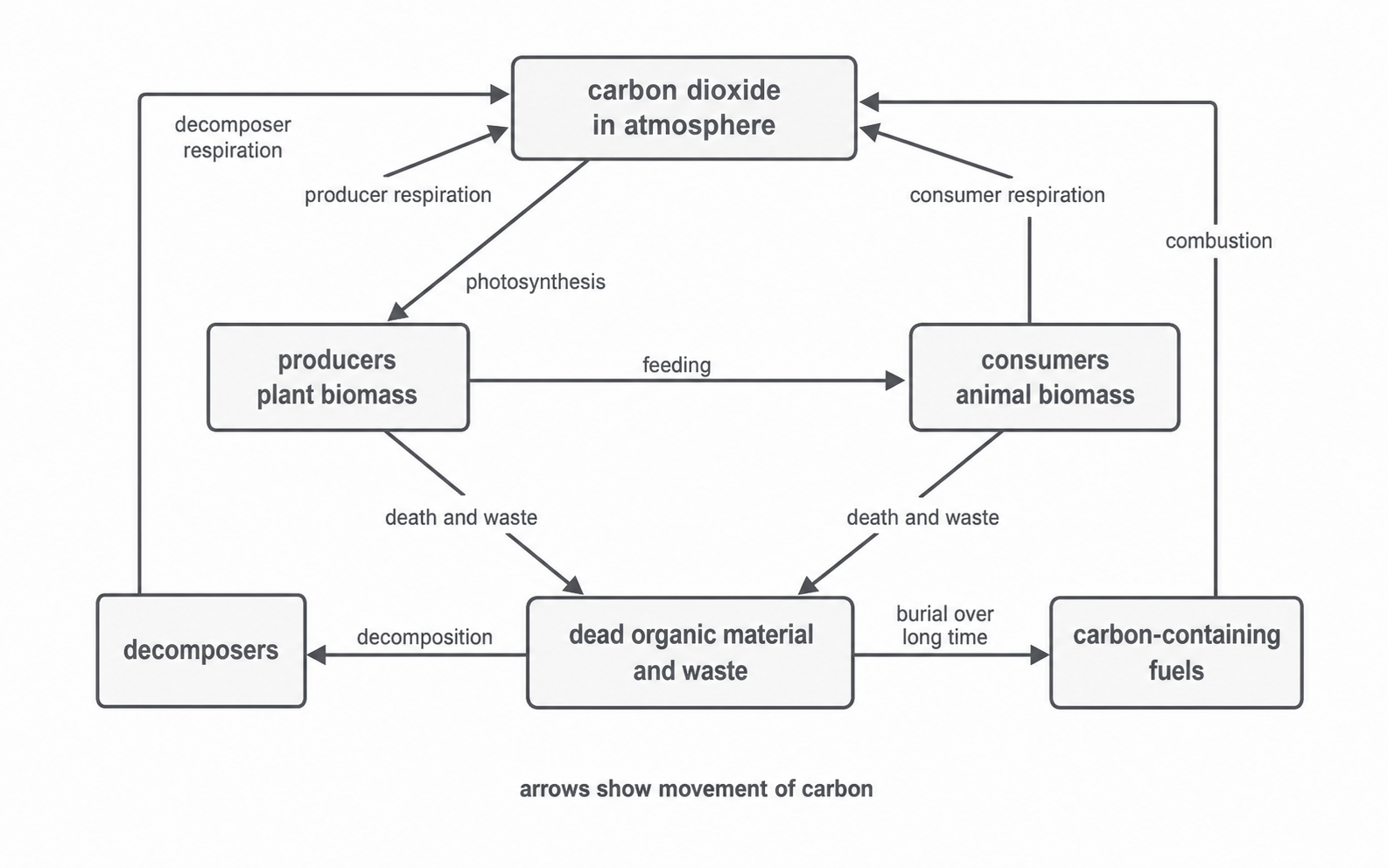
Photosynthesis removes carbon dioxide from the atmosphere. Producers, such as plants and algae, use carbon dioxide to make glucose. That carbon becomes part of the plant's biomass, including carbohydrates, lipids and proteins.
Feeding passes carbon compounds through food chains. When an animal eats a plant, carbon in plant biomass becomes carbon in animal biomass. When a consumer is eaten, carbon passes to the next consumer.
Respiration releases carbon dioxide. Producers, consumers and decomposers all respire. During respiration, carbon compounds such as glucose are broken down and carbon dioxide is released to the surroundings.
Decomposition returns carbon from dead organisms and waste. Decomposers, such as bacteria and fungi, feed on dead material and waste. As they respire, they release carbon dioxide. Some dead organic material may be buried for a very long time and eventually become fossil fuels.
Combustion releases carbon dioxide when carbon-containing fuels burn. This includes burning wood and fossil fuels. For this cluster, the key carbon-cycle point is the direction of movement: carbon that was stored in fuel is released to the atmosphere as carbon dioxide.
Nitrogen for growth
Nitrogen is needed to make amino acids and proteins. It is also found in DNA and other important biological molecules. The difficulty is that most nitrogen in the atmosphere is nitrogen gas, N2, which most organisms cannot use directly.
Plants mainly take in nitrogen as soluble nitrate ions from the soil. They use this nitrogen to make amino acids, then proteins. Animals get nitrogen by feeding on plants or on other animals that have already built nitrogen into their biomass.
This means the nitrogen cycle has to solve two problems:
- convert nitrogen gas from the air into nitrogen compounds in the soil
- return nitrogen from dead organisms and waste to soil compounds that plants can absorb again
The main workers in this cycle are bacteria and other decomposers. Edexcel does not require the specific names of the bacteria, but it does require the roles of nitrogen-fixing bacteria, decomposers, nitrifying bacteria and denitrifying bacteria.
Continue this lesson.
You’re previewing NovaLearn without an account. Create a free account to read the rest.
Create free account