3.11-3.13 - Placenta, amniotic fluid and secondary sexual characteristics
After fertilisation, the embryo grows inside the uterus and needs a steady supply of useful substances. The placenta and amniotic fluid support this early development in different ways: one supplies, the other protects. Later, sex hormones trigger the changes of puberty called secondary sexual characteristics.
The placenta as a supply surface
The placenta is an organ that develops in the uterus during pregnancy. It is attached to the wall of the uterus and connected to the developing embryo by the umbilical cord.
Placenta
An organ in the uterus that allows substances to pass between the mother's blood and the developing embryo's blood.
The embryo cannot feed, digest food or breathe using lungs. Instead, soluble substances from the mother's blood are transferred across the placenta into the embryo's blood. The umbilical cord then carries these substances between the placenta and the embryo.
For nutrition, the key substances are food molecules such as glucose and amino acids. Glucose is used in respiration to release energy, and amino acids are used to build proteins for growth. Mineral ions, vitamins and water can also be supplied across the placenta.
The placenta is not a stomach for the embryo. It does not digest food. Its role is to provide an exchange surface so useful substances in the mother's blood can enter the embryo's blood.
How exchange happens at the placenta
The mother's blood and the embryo's blood pass close to each other in the placenta. They are kept separate, but the distance between them is small enough for substances to move across the placental exchange surface.
[DIAGRAM: asset_name: Placenta, umbilical cord and amniotic fluid - diagram 01; asset_slug: b44_placenta_amniotic_fluid_and_secondary_sexual_characteristics__diagram_01; recommended_method: deterministic_drawing; description: A monochrome labelled schematic showing a developing embryo inside amniotic fluid, the placenta attached to the uterus wall, the umbilical cord, and an inset of placental exchange. The inset shows mother's blood and embryo's blood close but separate, with separate labelled lanes for glucose/oxygen diffusion to the embryo, amino acid carrier/active transport to the embryo, and carbon dioxide/urea movement back to the mother.]
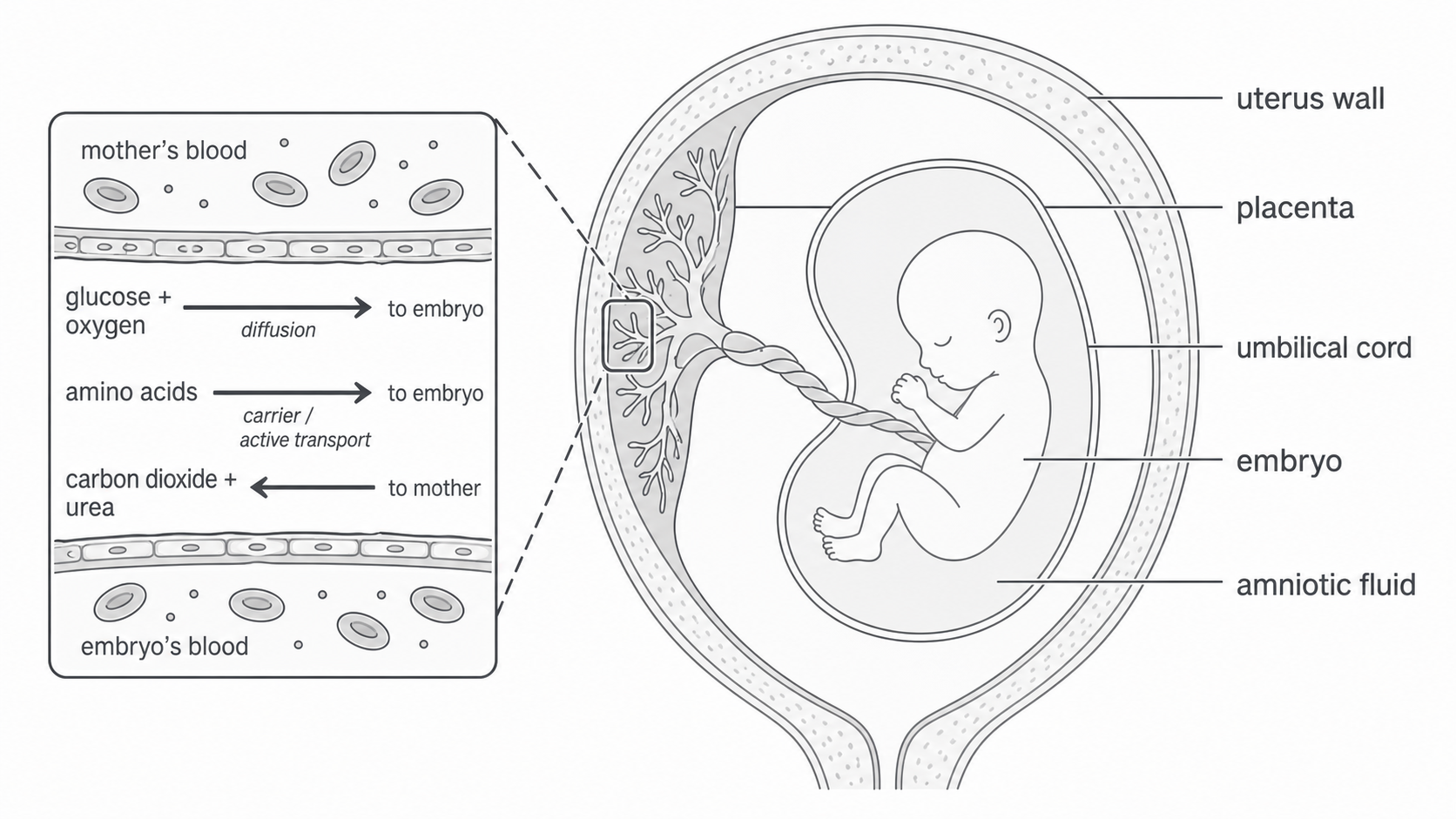
Glucose and oxygen diffuse from the mother's blood into the embryo's blood down concentration gradients. Oxygen is not a nutrient, but it is often shown with nutrients because it is transferred to the embryo for respiration.
Amino acids are also supplied for growth, but they are transferred by specific carrier mechanisms, often using active transport.
Some waste substances move in the opposite direction, from the embryo's blood to the mother's blood. This includes carbon dioxide and urea. In this lesson, remember the specification focus: the placenta's named role here is the nutrition of the developing embryo.
Two exam mistakes are common. First, do not say the mother's blood and embryo's blood simply mix together; the important idea is exchange across a surface. Second, do not say the placenta protects the embryo from physical knocks; that is the role of amniotic fluid.
Continue this lesson.
You’re previewing NovaLearn without an account. Create a free account to read the rest.
Create free account