4.5 - PGFs of independent sums
Adding independent counts corresponds to multiplying their probability generating functions. You will explain that connection, recognise binomial and Poisson sum distributions, and use coefficients and derivatives to find probabilities and moments of a total.
The product rule
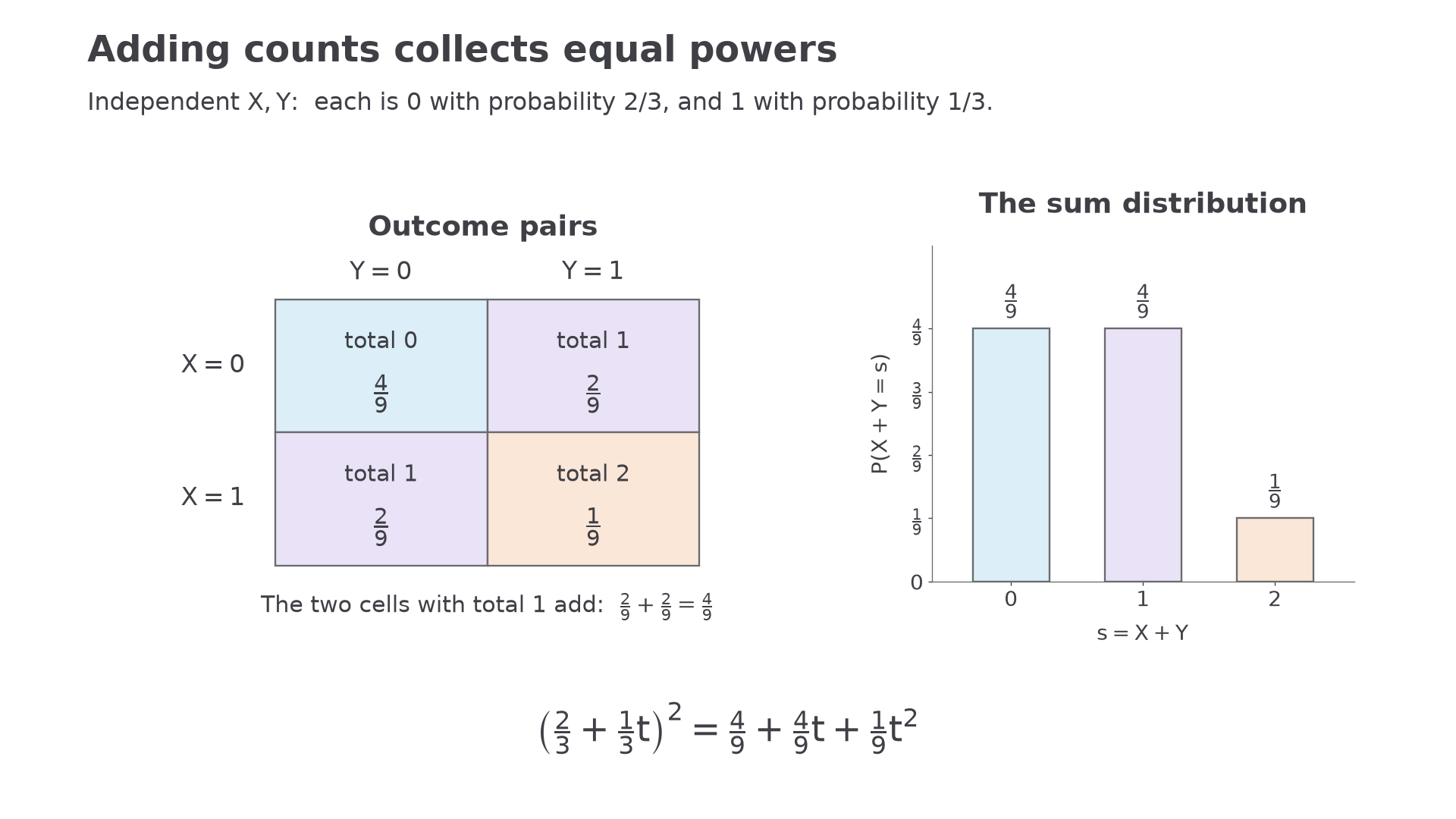
If two counts each have a short probability distribution, can you find their total without listing every outcome separately? Suppose independent variables each take values , with probabilities . A total of one can occur as or , so its probability is .
Multiplication of their PGFs makes exactly the same calculation:
An exponent in a product is the sum of the original exponents, so collecting equal powers collects all pairs giving the same total.
[DIAGRAM: asset_name: Collecting probabilities for a total; asset_slug: cam9231-pgf-sum-coefficients; caption: The two outcome pairs with total one contribute to the same coefficient; description: Exact probability grid for independent X and Y, each taking zero with probability two thirds and one with probability one third. The four cells show totals zero, one, one and two with probabilities four ninths, two ninths, two ninths and one ninth. A neighbouring bar chart shows the sum distribution four ninths, four ninths, one ninth on zero, one, two, using matching pale colours.]
For independent , the general argument is
Independence justifies splitting the expectation of a product. Having the same distribution does not imply independence.
PGF of an independent sum
For independent nonnegative integer-valued variables , where the PGFs converge (in particular, ),
If the variables also have the same distribution, with PGF , the result is .
The product rule is not listed in the formula booklet: learn the result and its independence condition.
The variables need not have identical distributions. Each factor belongs to the corresponding independent count.
Worked example 1: two independent observations
Question. Independent variables each satisfy and . Find the PGF and distribution of .
Plan. Multiply the PGFs and read the three coefficients.
Answer. The PGF is . The probabilities of are , respectively.
Check. Directly, both variables are zero with probability , exactly one is one with probability , and both are one with probability .
Change only the dependence: use the same observation twice instead of taking a second independent observation. The individual distributions stay the same, but the total changes.
Worked example 2: repeating the same observation
Question. takes values , with probabilities . Define and . Find , and explain why is unsuitable.
Plan. Express as , then encode its actual possible values.
There is no outcome : either both summands are zero or both are one.
Answer. . The product of the two individual PGFs would give a positive probability for , because it would incorrectly treat and as independent.
Check. Directly, and . These agree with the two coefficients and sum to one.
More generally, for nonnegative integers ,
This is a transformation of one observation. In particular, , whereas two independent copies of have sum PGF .
Watch out
Squaring the PGF describes a sum of two independent observations. Replacing by describes twice one observation.
Use multiplication for the following independent counts, whose success probabilities differ.
Recognising a sum distribution
A product of PGFs sometimes has a standard form. Since the coefficients determine the whole distribution, recognising that form identifies the sum without a long expansion.
For independent and ,
Hence . The common success probability is essential to this conclusion: different linear factors generally cannot be combined into a power of one common factor.
For independent and ,
Thus . This derives the Poisson sum result from the PGF product rule.
Key idea
Match the entire PGF to a standard form, including its normalisation. A resemblance in one factor is not enough to identify the distribution.
First recognise a sum within the binomial family.
Worked example 3: combining binomial counts
Question. and are independent. Use PGFs to identify the distribution of .
Plan. Multiply the two binomial PGFs and combine equal bases.
Answer. .
Check. The means add to , matching . Independence makes the variances add to , matching the identified binomial variance.
Continue this lesson.
You’re previewing NovaLearn without an account. Create a free account to read the rest.
Create free account