2.4 - Lengths of curves
The distance along a curve is longer than the straight line between its endpoints. You will build its length from small straight segments, then calculate lengths from Cartesian, parametric and polar equations without counting a traced arc twice.
Cartesian arc length
How long is the curved path from to ? Its horizontal width is , but its length must also include the vertical movement.
A short chord has horizontal change , vertical change , and length . As the chords become shorter, their slope approaches the derivative. Adding their lengths and taking a limit gives the arc-length integral.
[DIAGRAM: asset_name: A short chord builds the length element; asset_slug: cam9231-cartesian-length-element; caption: Pythagoras combines horizontal and vertical changes before the limiting integral; description: Exact graph of y equals x squared over two on zero to 1.4. Two points on the curve at x equals 0.6 and 1.1 are joined by a chord. A right triangle labels delta x, delta y and delta s. A separate panel gives the positive length element ds equals square root of one plus y prime squared times dx for increasing x.]
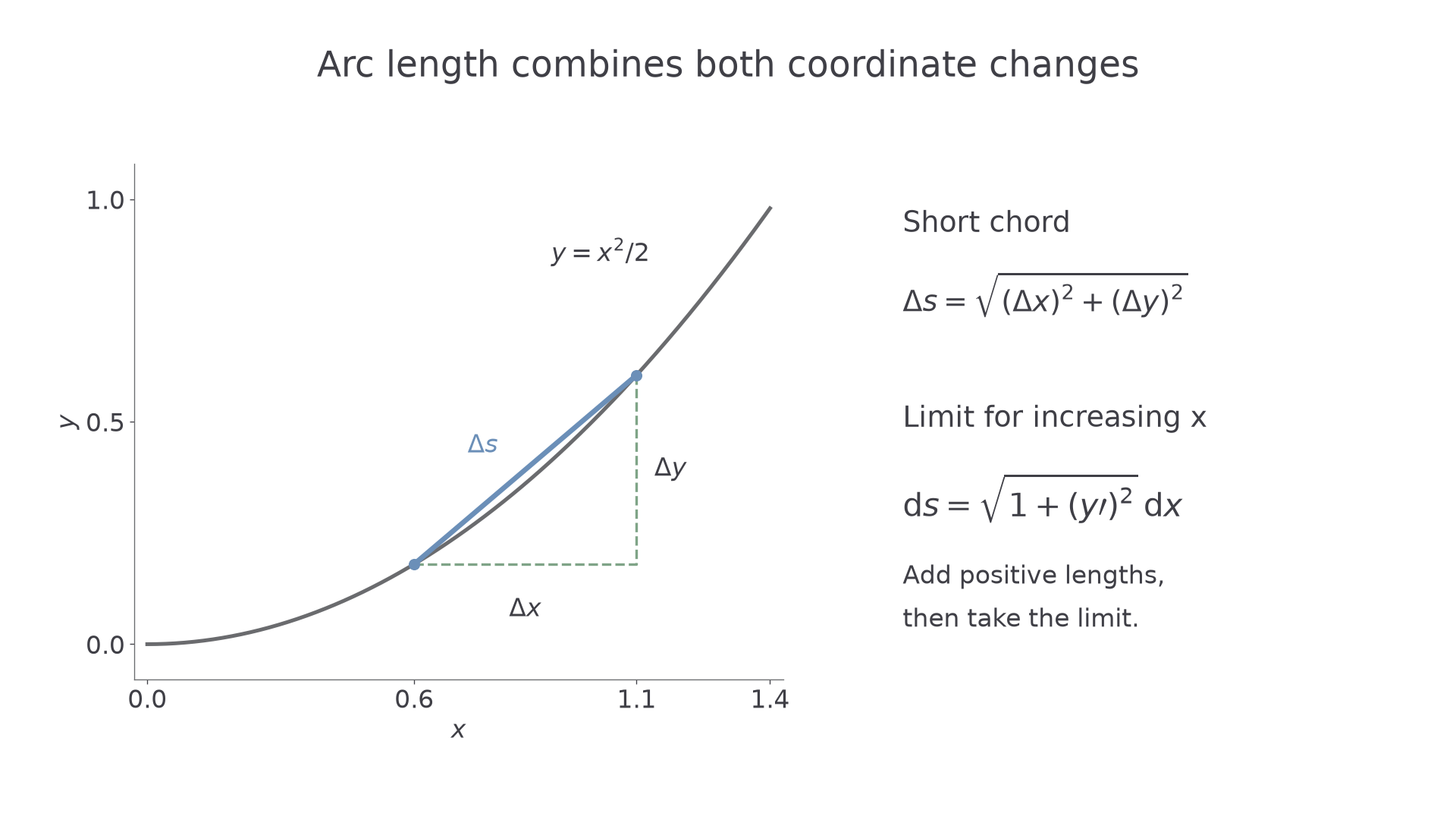
Cartesian arc length
For a continuously differentiable curve , traversed once with ,
For , use , with . Split a piecewise smooth curve into suitable pieces.
Not in the formula booklet: learn it.
The positive square root matters: length cannot cancel when the gradient changes sign. These are lengths along the curve, rather than signed displacements or areas underneath it.
Worked example 1: a Cartesian parabola
Question. Find the exact length of from to .
Plan. Differentiate, then use to integrate the square root.
Since , the required integral is . Under , and . Thus
Here , and .
Answer. .
Check. The chord between and has length . Moving horizontally then vertically has length . The result lies between them, as a monotone curved path should.
Change only the upper endpoint. The antiderivative can now be reused, but both its algebraic and inverse-hyperbolic terms need the new input.
Worked example 2: a longer part of the same curve
Question. Find the exact length of from to .
Plan. Use the same length integral and the antiderivative obtained by the substitution above.
Answer. .
Check. The endpoint is , so the chord is . The result exceeds this and is below the horizontal-plus-vertical distance .
Do not replace by : Pythagoras combines squared perpendicular changes before taking the root.
Problem-solving
Simplify the expression under the square root first. A square, a trigonometric identity or a hyperbolic substitution can turn the length integral into familiar calculus.
Use the same curve over a fresh interval.
Parametric arc length
A parameter can describe both coordinate changes at once. If and , the length element comes from and .
Parametric arc length
For a smooth parametrised curve traced once over ,
Use increasing parameter limits; split the interval if necessary. The integral counts every traversal, so choose an interval that does not retrace the required arc.
Not in the formula booklet: learn it.
This formula also works where ; there is no division by that derivative. A zero velocity at an isolated point does not itself invalidate the length integral.
Worked example 3: a square hidden in the speed
Question. Find the exact length of , , for .
Plan. Calculate both derivatives and simplify their squared sum before integrating.
Since , its positive square root is . Also strictly increases, so the curve is not retraced. Therefore
Answer. .
Check. The endpoints are and . Their straight-line distance is , below . Since both coordinates increase, their total changes give the upper bound , also consistent.
Change only the parameter, using . A different speed must give the same geometric length over the matching interval.
Continue this lesson.
You’re previewing NovaLearn without an account. Create a free account to read the rest.
Create free account