1.2 - Finding ranges with a discriminant
Which horizontal lines actually meet a rational curve? You will turn this geometric question into an equation in the input, use a discriminant to find possible outputs, and check exceptional values and holes before stating the range.
A horizontal-line equation
Can ever have output , or does its horizontal asymptote prevent that? An asymptote alone does not answer the question: some curves cross theirs.
Fix an output and ask whether there is a real allowed with . For , cross-multiplication gives , hence . For , it gives , which is impossible.
Range
The range of a function is the set of outputs attained at inputs in its domain. A value is in the range exactly when the horizontal line at height meets the graph.
Keep as a parameter when rearranging. The result may be quadratic in , even though its coefficients contain . Cross-multiplication is equivalent to the original equation only when the original denominator is nonzero.
Worked example 1: setting up a level equation
Question. Rearrange as an equation in , and check .
Plan. Multiply by the positive denominator and collect powers of .
At , the coefficient of vanishes and the equation becomes .
Answer. The level equation is ; the output is not attained.
Check. Independently, for every real input, confirming that is impossible.
Add only the term to the numerator. This time the exceptional equation at is linear rather than impossible.
Worked example 2: an asymptote that is crossed
Question. Repeat the calculation for .
Plan. Collect the linear term as well, then substitute into the level equation.
At , this becomes , giving . The denominator there is .
Answer. The level equation is . The output is attained at , even though is a horizontal asymptote.
Check. Substituting into the original function gives .
The coefficient warns us that a quadratic method will need a separate case. Losing the quadratic term does not automatically lose the output.
Allowed output values
A quadratic level equation has a real solution precisely when its discriminant is nonnegative, provided its quadratic coefficient is nonzero.
Real roots of a quadratic
For real coefficients in , with , real roots exist if and only if
The quadratic formula is in MF19; this real-root criterion is not separately stated there: learn it.
Here are expressions in . Solve the discriminant inequality for , then check every value making in the original level equation. Finally check that the real inputs are allowed. When the denominator is positive for all real inputs, that last check is particularly simple.
Worked example 3: a missing endpoint
Question. Find the range of .
Plan. Use its level equation, then check the exceptional output separately.
For , the equation has
At , the equation gives , which is allowed. At , it gives , so this endpoint is excluded. Every value between them gives real inputs with nonzero denominator.
Answer. The range is .
Check. The independent form has minimum at , and tends to from below without attaining it.
Now use the numerator with the additional linear term from Worked example 2. It changes both discriminant boundaries and makes an interior allowed value.
Worked example 4: two attained endpoints
Question. Find the range of .
Plan. Apply the discriminant to , checking separately.
For ,
The boundary equation has roots
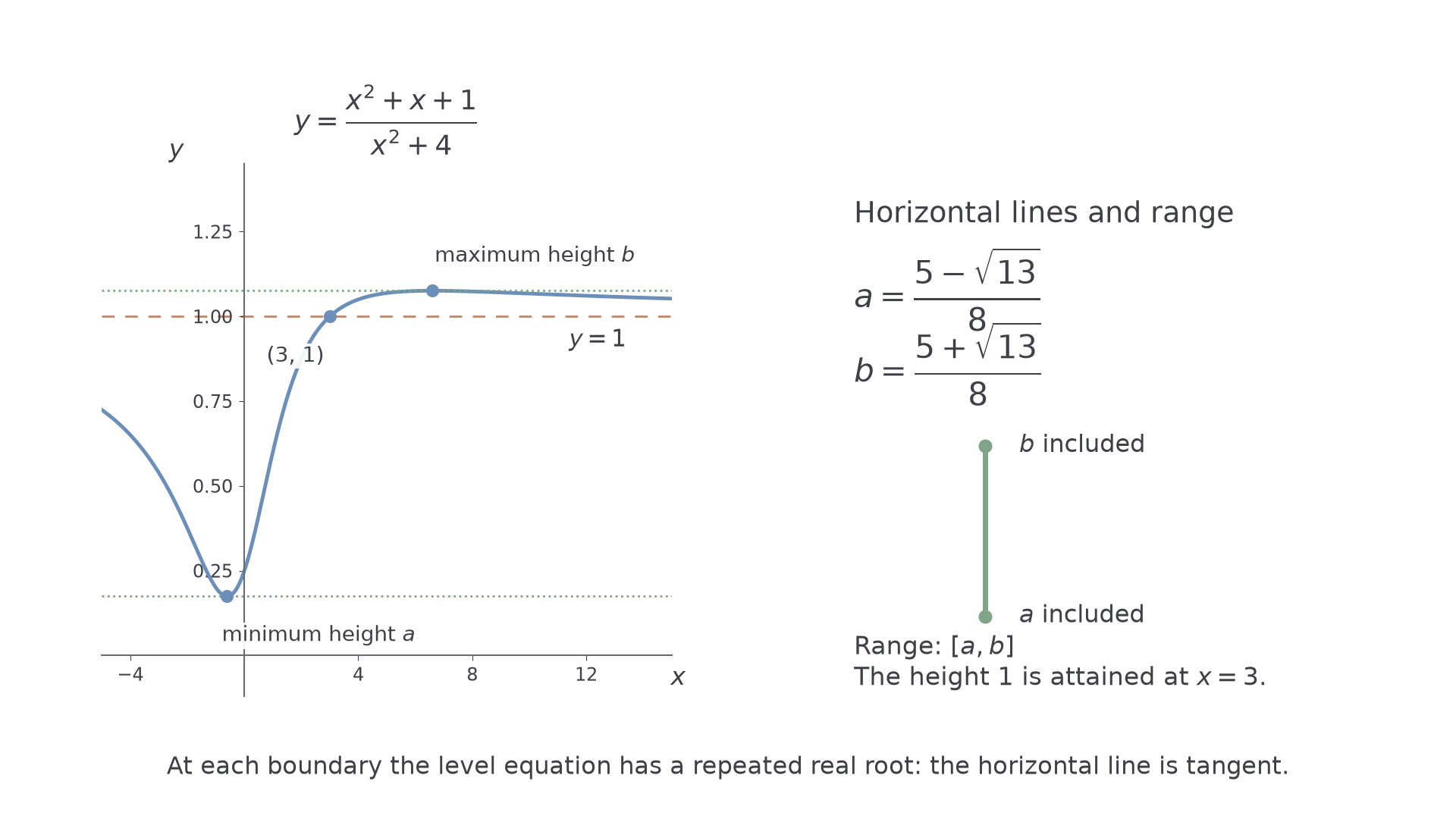
The concave quadratic is nonnegative between these roots. At either boundary, the repeated input is , a real allowed input. At , the linear equation gives the allowed input .
Answer. The range is , including both endpoints.
Check. Differentiating the original function gives . The stationary inputs give heights , respectively, independently checking the range boundaries.
At a boundary the horizontal line is tangent to the curve; between the two boundaries it intersects it. The exceptional height still intersects, but its level equation is linear.
[DIAGRAM: asset_name: Range as horizontal intersections; asset_slug: cam9231-discriminant-range; caption: Boundary heights are attained where horizontal lines are tangent; description: Exact graph of (x squared plus x plus 1)/(x squared plus 4), with stationary inputs 3 minus square root 13 and 3 plus square root 13, horizontal boundary levels (5 minus square root 13)/8 and (5 plus square root 13)/8, and a labelled crossing (3,1) of the dashed horizontal asymptote y equals 1. A side interval shows both boundary heights included.]
Use the level equation as a problem-solving bridge between geometry and algebra. A discriminant answers “is there a real intersection?” without requiring you to find every intersection.
Endpoints and excluded values
Real algebraic roots are useful only if they belong to the original domain; a hole can remove an otherwise possible output.
At , substitute the repeated root into the original denominator before including the boundary. If a level equation becomes linear, solve it directly. If it becomes a contradiction, exclude that output; if it becomes an identity, any allowed input suffices. These checks turn candidate outputs into an actual range.
Worked example 5: an output that no finite input gives
Question. Find the range of .
Plan. Solve for the input and test the exceptional output.
For ,
If , . This cannot equal , since that would require . If , the equation becomes .
Answer. Every real output except is attained: .
Check. The independent form gives every height above on and every height below on , but never itself.
Represent the same simplified expression with an additional cancelled factor. The only change is that its original domain now has one extra hole.
Worked example 6: a hole removes another output
Question. Find the range of .
Plan. Preserve both denominator exclusions, then use the preceding inverse expression.
The output is still impossible. The removed input would have output . For that output, the equation gives only , so no other input restores it. Every other output except has an allowed input.
Answer. The range is .
Check. Substitute directly into the original cross-multiplied quadratic: it reduces to . Its only root is excluded. Thus even a nonnegative discriminant can give no valid point on the original graph.
The opening curve cannot attain , but the curve with an extra linear numerator term can. Always decide by a valid input, rather than a rule about asymptotes.
Watch out
certifies real roots of the rearranged equation, not permission to divide by zero in the original function. Keep the domain beside the calculation.
Identify the missing height as well as the horizontal asymptote in this final check.
Quick Recap
- Fix , then rearrange the horizontal-line equation in .
- Apply only when the quadratic coefficient is nonzero.
- Solve exceptional linear or constant equations separately.
- Include a boundary or other output only when an original-domain input attains it.
For the opening curve, the height gives an impossible equation, so the range ends just below it.