2.5 - Complex roots and roots of unity
A nonzero complex number has several distinct nth roots, arranged at equal angles on a circle. You will find every branch of positive and negative rational powers, locate the roots of unity, and use their geometry and polynomial factorisation to evaluate exact sums and products.
All roots from a rational power
A calculator may display one cube root, but how do you find all the solutions of ? If , then must have modulus . Its argument must satisfy , not just . The three values from are separated by .
The same argument works for every positive integer . Write and compare moduli and arguments in :
Choosing gives every distinct root once. Increasing by adds a full turn to and repeats a root.
All branches of a rational power
Let be in lowest terms, with integers and . For nonzero , the full set of values of means the solutions of
For , this is , so the base and all resulting values must be nonzero. We are finding the full set, not choosing a single principal value.
Reducing the fraction matters. The power is treated as ; solving without reduction would generally introduce two extra values. Rules that select or combine individual branches need care, so use the defining equation instead of assuming that fractional powers obey every real-power manipulation.
Every rational-power branch
If , , and is reduced as above, then
There are distinct values. For a positive rational exponent, zero has the sole value zero; a negative power of zero is undefined.
Not in the formula booklet: learn how to obtain all the branches.
Why does taking all nth roots of and then raising them to give the same set? Their angles are . Since and are coprime, the residues of modulo run through all possibilities. This also explains the lowest-terms condition.
Worked example 1: a positive rational exponent
Question. Let . Find all values of in Cartesian form.
Plan. Solve , using all three possible arguments.
The modulus is . The arguments are
Thus the arguments are .
Answer. The three values are
Check. Here . Direct cubing gives and ; also . All three are distinct, so the degree-three equation has no further roots.
Change only the exponent's sign. The moduli become reciprocals and each individual angle is reflected in the real axis.
Worked example 2: a negative rational exponent
Question. For the same , find all values of in Cartesian form.
Plan. Solve , or equivalently take the reciprocals of the three values in the previous example.
The modulus is . The arguments are
namely .
Answer. The three values are
Check. Cartesian reciprocation gives
Their cubes must therefore be , independently checking both magnitude and sign.
Reciprocation reflects an argument and inverts a modulus. It does not simply negate a complex value.
[DIAGRAM: asset_name: Reciprocal sets of three branches; asset_slug: cam9231-rational-branches; caption: The positive and negative two-thirds powers have reciprocal moduli and reflected arguments; description: Two separate Argand panels with explicitly different scales. The left shows the radius-four roots at arguments pi over six, five pi over six and three pi over two. The right shows the radius-one-quarter reciprocal roots at arguments minus pi over six, pi over two and seven pi over six. Matching colours link reciprocal pairs; a note states that the scales differ.]
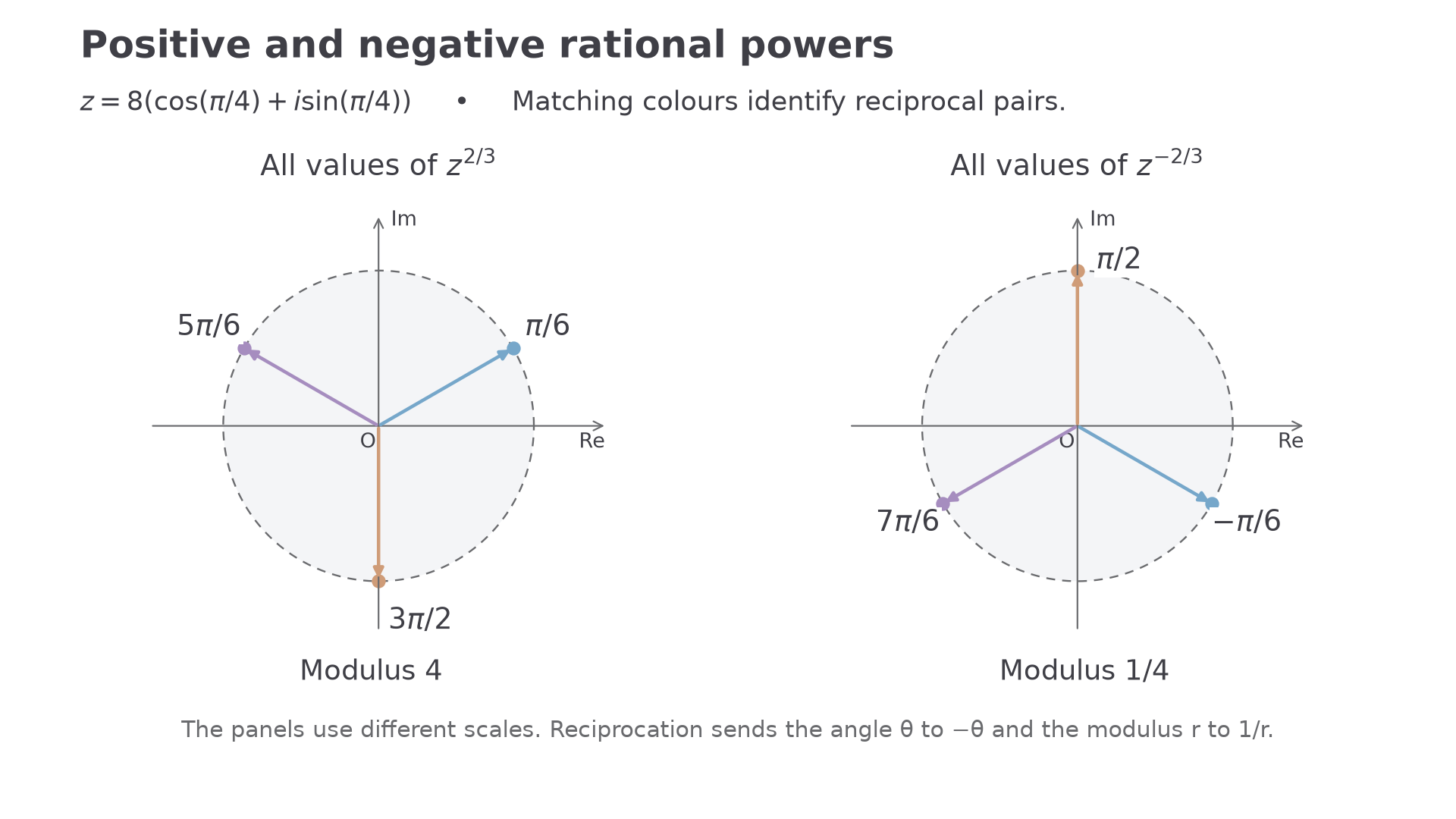
The number of branches is determined by the reduced denominator, not by the numerator's sign.
Watch out
Dividing just one chosen argument by gives only one root. Include before division and list exactly distinct values. Then adjust each angle into any interval the question specifies.
Keep a negative exponent but change the base and its argument.
The nth roots of unity
The nth roots of unity are the solutions of , so their moduli are all and their arguments are equally spaced.
Write , retaining its other arguments . The roots are
For , these are the vertices of a regular n-sided polygon on the unit circle, with one vertex at . Adjacent roots differ in argument by .
A primitive root of unity
A root is primitive if its successive integer powers generate all the nth roots. The number
is primitive: the complete list is .
Not every root is primitive. For example, is a sixth root of unity, but its powers give only and .
This notation is useful because : reduce integer exponents modulo . In particular, , so conjugate roots form reflected pairs on the unit circle. A negative real root occurs only when is even.
Worked example 3: five equally spaced roots
Question. Find all fifth roots of unity in polar form, with arguments in , and describe their positions on an Argand diagram.
Plan. Divide the arguments of unity by , taking five distinct residues.
The arguments are .
Answer. The roots are for . They form a regular pentagon on the unit circle, with a vertex at , and angular spacing .
Check. Raising any listed value to the fifth power multiplies its angle to , giving . No two listed angles differ by a full turn, so the five roots are distinct.
Continue this lesson.
You’re previewing NovaLearn without an account. Create a free account to read the rest.
Create free account