1.2 - Rational functions and asymptotes
A rational curve can have a missing point, an infinite branch or a line that it approaches far from the origin. You will distinguish these features, find intercepts and determine horizontal and oblique asymptotes using algebra.
Domain and intercepts
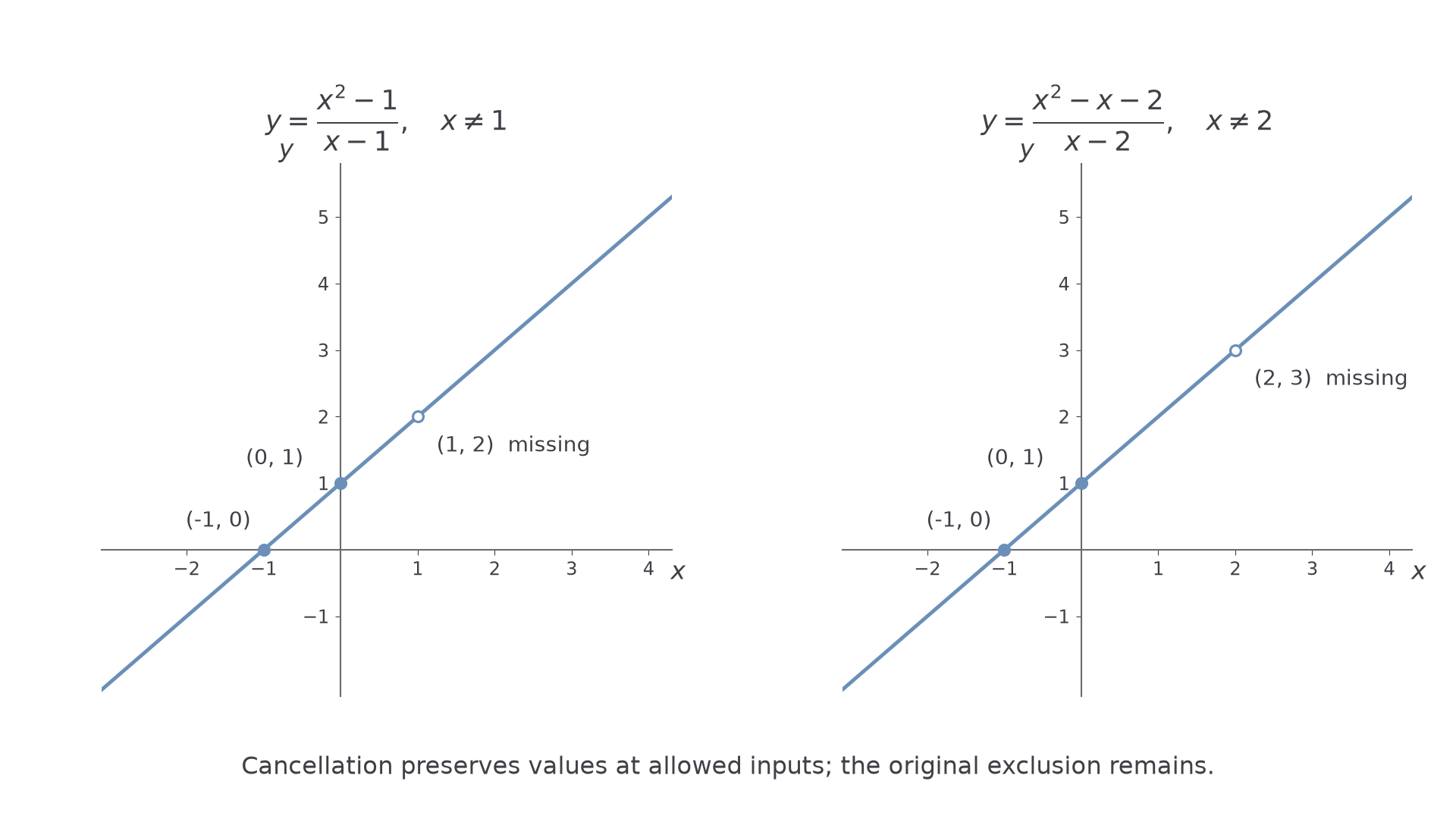
Does cancelling a factor put a missing point back into a graph? Compare with the straight line . Their values agree whenever , but the fraction has no value at .
Rational function and domain
A rational function is a quotient of polynomials. Its domain contains the real inputs for which its original denominator is nonzero, unless a further restriction is stated.
A hole is a missing point at which a finite limiting value exists. Cancelling a common factor can reveal that value; it does not restore the excluded input.
Factor first and record the exclusions before simplifying. To find an intersection with the -axis, make the numerator zero and check that the input belongs to the domain. To find an intersection with the -axis, substitute , if allowed.
Worked example 1: a line with a hole
Question. Find the domain, hole and axis intersections of .
Plan. Keep the denominator restriction while factorising the numerator.
The missing input is , and the simplified expression tends to there. For , , so . Also .
Answer. Domain: . Hole: . Axis intersections: and .
Check. Direct substitution into the original fraction gives and . At , it gives , which is undefined.
Move the cancelled factor from to . The line stays the same, but a different point is missing.
Worked example 2: moving the excluded input
Question. Find the same features of .
Plan. Factorise, then use the simplified expression only on the original domain.
Thus the missing point has height . The allowed zero is , and .
Answer. Domain: . Hole: . Axis intersections: and .
Check. Polynomial multiplication gives . At , the original fraction is , agreeing with the line, while at the original denominator is zero.
An open circle records the missing point without suggesting that a whole vertical line is an asymptote.
[DIAGRAM: asset_name: Cancellation leaves a hole; asset_slug: cam9231-rational-holes; caption: The same straight line can have different missing points; description: Two coordinate panels show y equals x plus 1. The left panel has an open circle at (1,2), the right at (2,3). Both show and label the axis intersections (-1,0) and (0,1), distinguishing a removable hole from an infinite branch.]
Use the original denominator again in this check.
Vertical asymptotes
A denominator zero produces a vertical asymptote when an uncancelled denominator factor makes the function unbounded nearby.
Vertical asymptote
The line is a vertical asymptote when tends to positive or negative infinity as approaches from at least one side.
For a rational function, cancel common factors first, keeping the original domain restrictions. A real root of the remaining denominator gives a vertical asymptote. A root removed completely by cancellation gives a hole instead. If only some copies of a repeated factor cancel, the remaining copies can still give an asymptote.
Worked example 3: two uncancelled factors
Question. Find the vertical asymptotes of .
Plan. Check that neither denominator factor cancels.
The numerator is nonzero at both denominator roots, so neither factor cancels.
Answer. The vertical asymptotes are and .
Check. Near , . Near , . Each function value therefore grows without bound as the corresponding factor tends to zero.
Change only the numerator so that one denominator factor cancels. This changes an infinite branch into a hole.
Worked example 4: one factor cancels
Question. Find the vertical asymptotes and hole of .
Plan. Simplify while retaining both original exclusions.
At , the remaining expression tends to , a finite value. At , its denominator still tends to zero while its numerator stays .
Answer. There is a vertical asymptote and a hole at .
Check. At , the value is approximately , close to . At , the value is , showing the different behaviour near the asymptote.
The opening question now has a precise answer: cancellation preserves the graph at allowed inputs, but preserves the hole as well.
Watch out
“The denominator is zero, so there is an asymptote” skips the cancellation check. For , is excluded but the nearby value is , not infinity.
Distinguish the two types of exclusion here.
Horizontal and oblique asymptotes
Far from the origin, division separates a rational function into a simple part and a remainder that tends to zero.
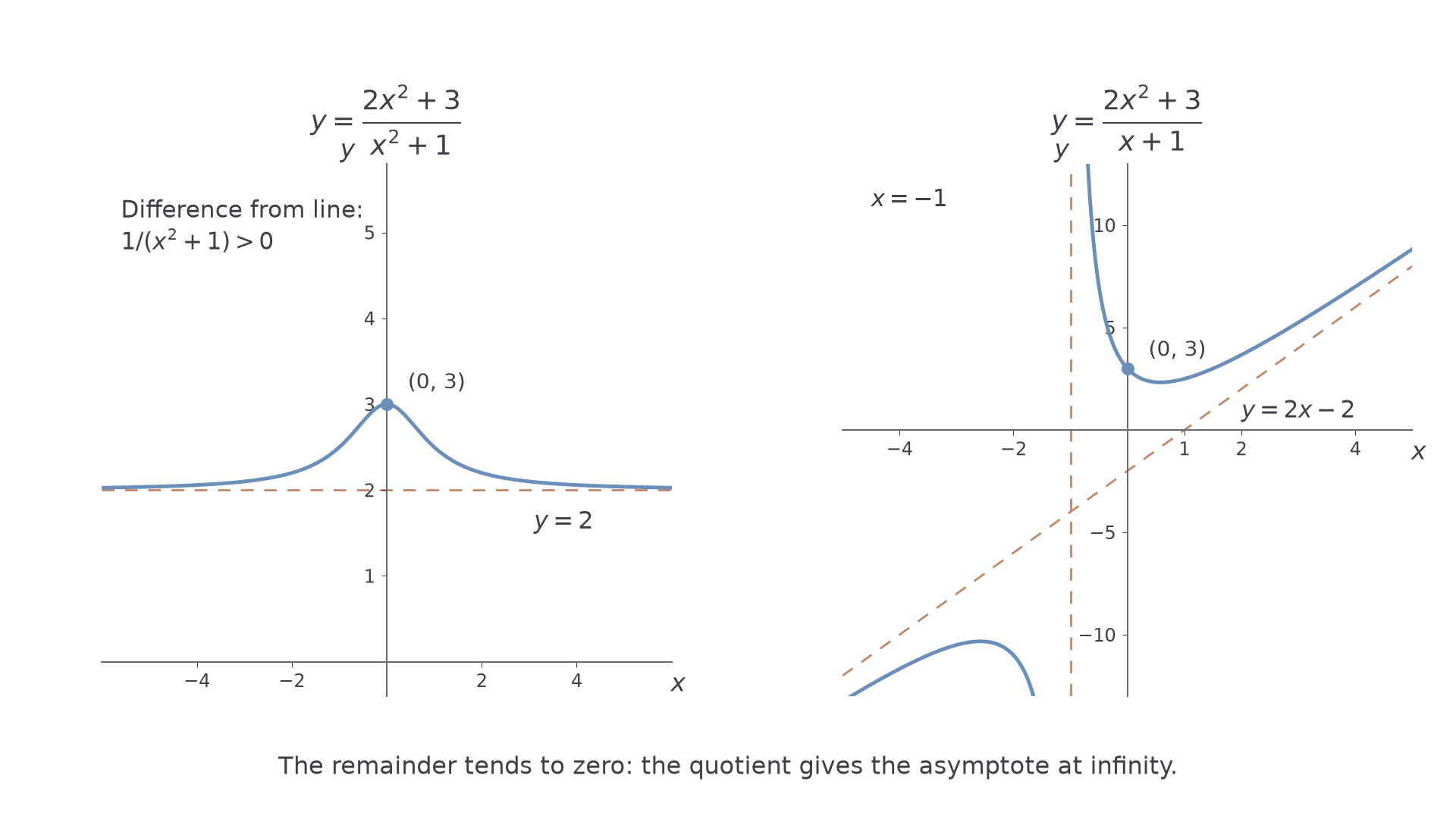
For example, . The second term tends to zero as , so the curve approaches .
Horizontal and oblique asymptotes
A horizontal line is an asymptote if as or . An oblique asymptote is a line , with , for which at an infinite end.
With numerator and denominator degrees at most two, these cases guide the algebra:
| Relative degrees | Result at infinity |
|---|---|
| Numerator degree smaller | Horizontal asymptote |
| Equal degrees | Horizontal asymptote: ratio of leading coefficients |
| Numerator degree one larger | Division gives an oblique asymptote |
Always justify the result by a vanishing remainder or division by the highest power. A quadratic polynomial over a constant denominator has no straight-line asymptote.
Worked example 5: an equal-degree fraction
Question. Determine the asymptotes of .
Plan. Check real denominator zeros, then divide.
Since , there are no vertical asymptotes. Also
Answer. The only asymptote is .
Check. Dividing the original numerator and denominator by gives , independently confirming the height.
Keep the numerator and lower the denominator degree by one. The quotient is now a sloping line.
Worked example 6: a quadratic divided by a linear factor
Question. Determine the asymptotes of .
Plan. Use the denominator root and polynomial division.
so
The remainder tends to zero at both infinite ends. At , the original numerator is .
Answer. The asymptotes are and .
Check. Multiplying back gives . This checks the intercept as well as the gradient.
The dashed line in each panel represents a difference tending to zero, rather than an extra piece of the curve.
[DIAGRAM: asset_name: Horizontal and oblique approaches; asset_slug: cam9231-rational-asymptotes; caption: Division reveals the line approached at each infinite end; description: Two coordinate panels compare (2x squared plus 3)/(x squared plus 1), approaching the horizontal line y equals 2 from above, with (2x squared plus 3)/(x plus 1), approaching y equals 2x minus 2 and having vertical asymptote x equals minus 1. Solid blue curves and dashed clay asymptotes are labelled.]
An asymptote can be crossed. For instance, crosses its horizontal asymptote at the origin. The definition concerns behaviour at infinity.
Quick Recap
- Record original denominator restrictions before cancelling.
- Cancelled factors can leave holes; uncancelled real denominator factors give vertical asymptotes.
- Use division to expose a horizontal or oblique asymptote.
- An asymptote describes limiting behaviour and may cross the curve.
Cancelling a factor never puts an excluded point back into the original graph.