1.2 - Reciprocal and square-root graphs
A known graph can reveal a reciprocal graph or the two branches of a square-root relation. You will track zeros, signs, asymptotes and domains, then use the related sketches to solve equations and inequalities.
The graph of a reciprocal
If a curve approaches height zero, what happens when each output is replaced by its reciprocal? A small positive output becomes a large positive output; a small negative output becomes a large negative output.
For example, outputs become . Taking a reciprocal preserves the sign, fixes the heights and , and exchanges small and large magnitudes.
Reciprocal graph
The graph has a point for each point on with . Its domain contains exactly the inputs where is defined and nonzero.
A zero approached by usually becomes a vertical asymptote of its reciprocal; use the signs on each side to find the directions. If , its reciprocal tends to zero. At an input where the original function is undefined, this can leave a hole rather than an actual zero. If at infinity, the reciprocal tends to .
Worked example 1: a zero becomes a pole
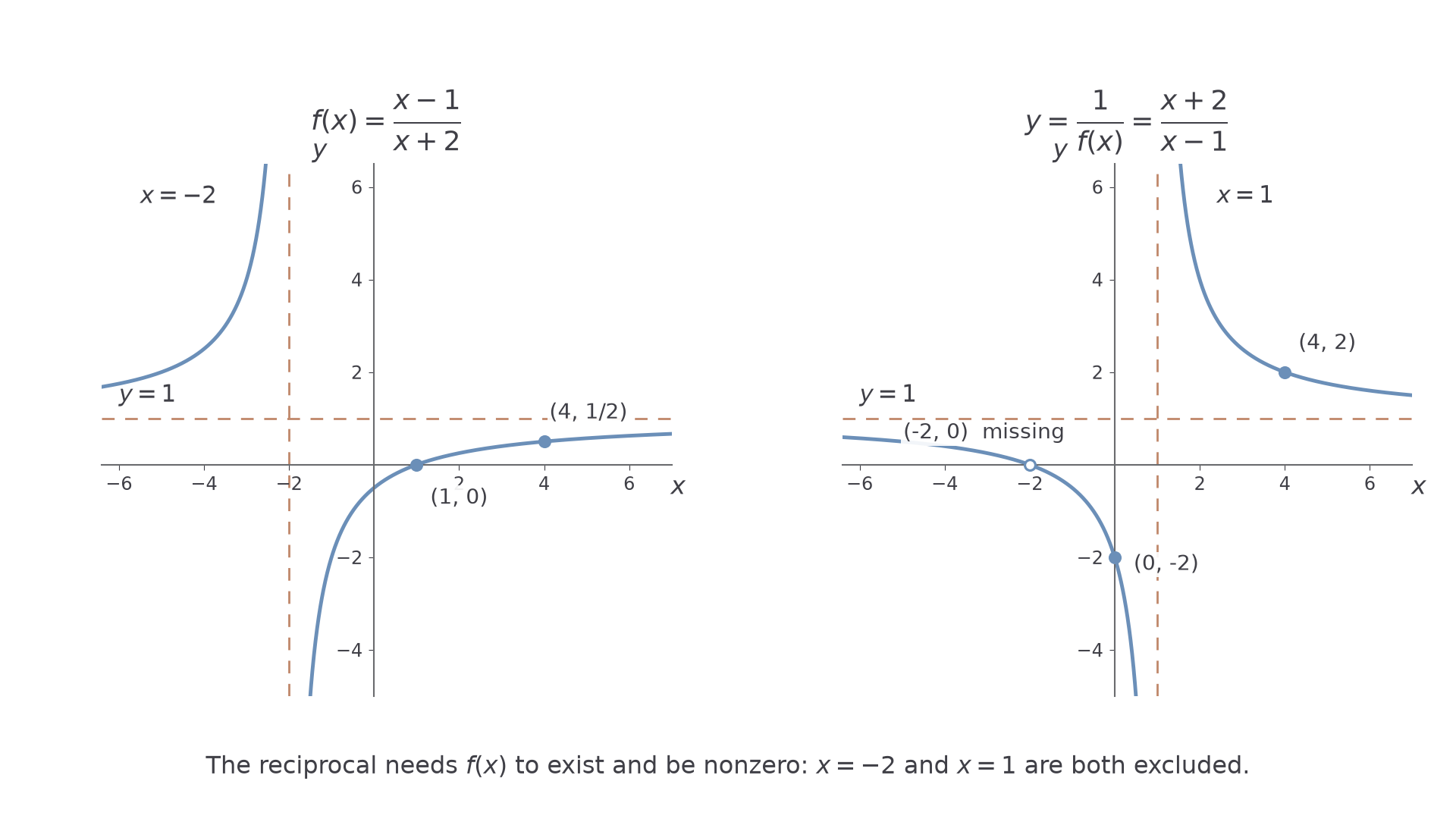
Question. Use to describe the graph of .
Plan. Transfer the zero, signs and fixed heights from the line.
To the left of , both and its reciprocal are negative; to the right, both are positive. Approaching gives on the left and on the right. At infinity, the reciprocal tends to zero. The points with original heights , namely and , remain fixed.
Answer. A reciprocal curve with asymptotes , , passing through and , with no zero.
Check. Directly, , whereas . These confirm the side and relative height of each branch.
Give the original function a vertical asymptote while keeping its zero at . This introduces an inherited exclusion into the reciprocal graph.
Worked example 2: an old pole becomes a hole
Question. Describe for .
Plan. Record where is undefined or zero before reversing the fraction.
The original zero at becomes the vertical asymptote . At the original pole , the reciprocal tends to zero but is still undefined: there is a hole at . At infinity, , so the new horizontal asymptote is also . The -axis intersection is .
Answer. Asymptotes , ; hole ; no -axis intersection; -axis intersection .
Check. At , the original output is , and the new output is . At , the displayed reversed fraction alone would give zero, but does not exist, so neither does .
The open circle is essential. The expression obtained by reversing a fraction can have a larger natural domain than the reciprocal of the original function.
[DIAGRAM: asset_name: Reciprocal outputs and an inherited hole; asset_slug: cam9231-reciprocal-graphs; caption: A zero creates an infinite branch while an original exclusion remains excluded; description: Two panels show f(x) equals (x minus 1)/(x plus 2) and its reciprocal (x plus 2)/(x minus 1) with inherited exclusions. The first has vertical asymptote x equals minus 2 and zero (1,0). The second has vertical asymptote x equals 1 and open circle (-2,0). Both horizontal asymptotes y equals 1 are dashed, and the corresponding points (4,1/2) and (4,2) are labelled.]
Use both domain restrictions in the next check.
The relation y squared equals f(x)
The relation usually has two outputs at an input, because both a positive and a negative number have the same square.
For , the input gives , so and . The input gives , so there is no real point there.
From a squared output to two branches
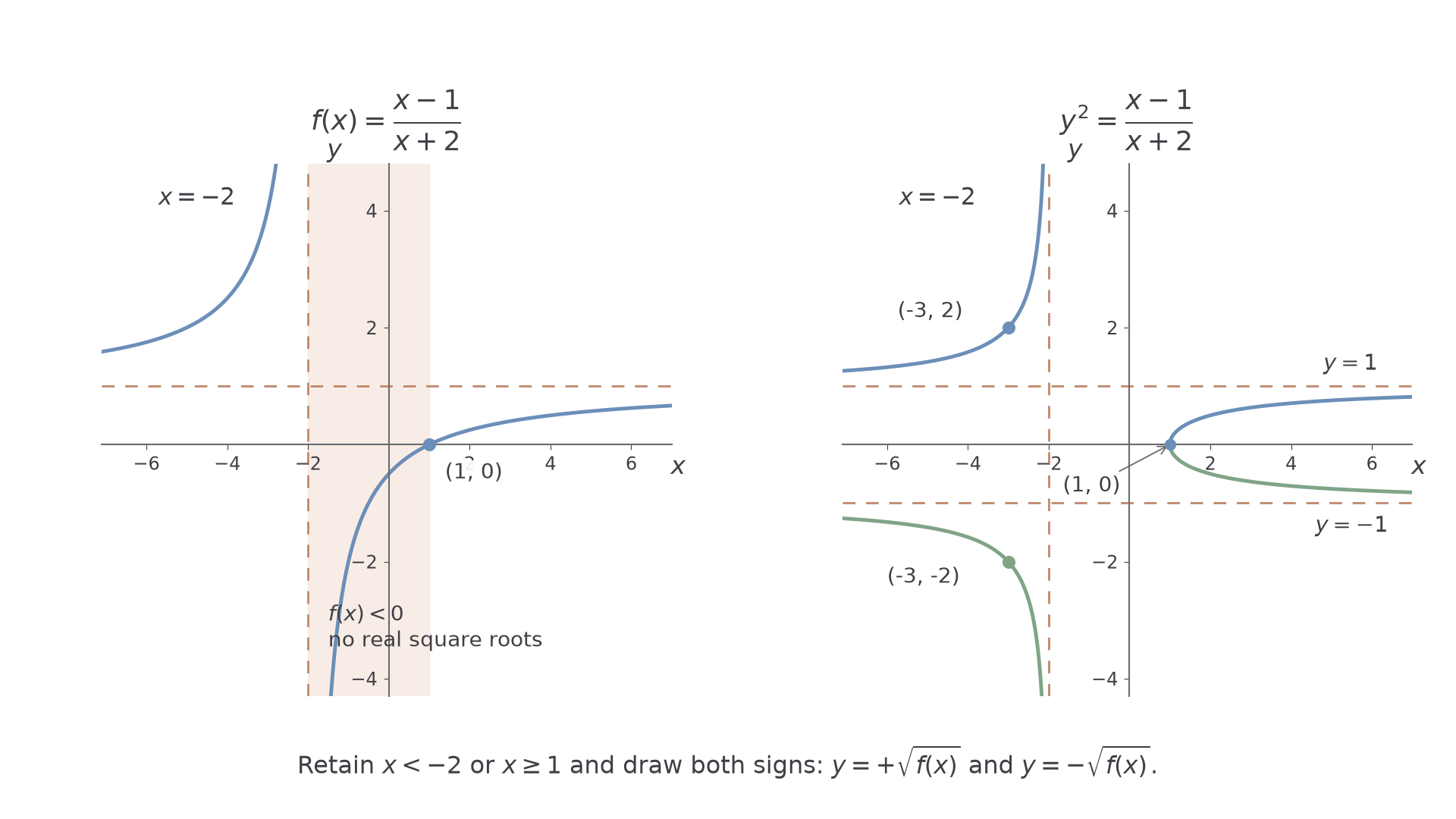
For the real relation , retain only original-domain inputs with , and draw
At , the two branches meet at . These graph rules are not in the formula booklet: learn them.
Heights between and increase under the positive square root, while heights above decrease. Heights and stay fixed on the upper branch. Reflect the upper branch in the -axis to obtain the lower one.
Worked example 3: two halves of a sideways parabola
Question. Describe the relation .
Plan. Restrict the input using nonnegativity, then include both square roots.
We require , so . Hence . Equivalently,
The branches meet at , and pass through , , and .
Answer. A sideways parabola opening to the right, symmetric about the -axis, with leftmost point . Its tangent there is vertical.
Check. In the parametrisation , and . At , the direction is vertical, confirming that the two branches join smoothly rather than forming a corner.
Use the rational function from the reciprocal example instead. Its negative interval must disappear, while its positive intervals produce two branches each.
Worked example 4: selecting intervals before taking roots
Question. Describe , including its asymptotes.
Plan. Make a sign chart at and , then transfer the limiting heights.
For these inputs, . The two right-hand branches meet at . On the left of , the fraction tends to , so the branches tend to and . At both infinite ends, the fraction tends to , giving horizontal asymptotes and . There are no points for .
Answer. Domain in : . Vertical asymptote ; horizontal asymptotes ; sole axis intersection ; symmetry about the -axis.
Check. At , , giving . At , , giving . At , the right side is negative, so no real point exists.
Both signs are part of the relation. Drawing only the upper branch would give , a different object.
[DIAGRAM: asset_name: Both branches of a squared-output relation; asset_slug: cam9231-squared-output; caption: Negative original outputs disappear and positive outputs produce two branches; description: Left panel shows (x minus 1)/(x plus 2), with its negative interval between minus 2 and 1 lightly indicated. Right panel shows both signs of the square root, only for x less than minus 2 or x at least 1. The four branches, meeting point (1,0), point pair (-3, plus or minus 2), vertical asymptote x equals minus 2 and horizontal asymptotes y equals plus or minus 1 are labelled.]
Select allowed inputs before attempting the sketch.
Solving from related graphs
A horizontal line on a related graph corresponds to a particular height on the original graph, so translate the condition before solving.
For a nonzero constant , an intersection of with means . An intersection of with means , and the reflected height gives the same inputs. For two nonzero values of the same sign, taking reciprocals reverses their order: for example, but . Separate intervals across a zero or undefined input before using this rule. For inequalities, use a sign chart or the sketch rather than multiplying by a denominator of unknown sign.
Worked example 5: an inequality on a reciprocal graph
Question. For , find the inputs where .
Plan. Find the crossing with height , then compare the branch with that line on its domain.
The reciprocal is , with . Now
The critical inputs are , where the expression is undefined, and , where it is zero. The ratio is negative for , positive for , and negative for . The inherited exclusion lies outside the solution interval.
Answer. .
Check. At , ; at , ; at , . A point to the left, , gives .
Change the related graph from a reciprocal to a squared-output relation. Height now corresponds to original height , rather than .
Worked example 6: intersections on both square-root branches
Question. Find all points of on the lines and .
Plan. Square either stated height and solve the same original-height equation.
For both heights, , so
This input is allowed and lies in the positive interval .
Answer. The points are and .
Check. The original right side at is . Both stated outputs square to , verifying both points rather than just the upper one.
The opening question has two useful answers: an original zero can create an infinite reciprocal branch, while an original positive height creates a pair of squared-output points.
Watch out
From , multiplying by without a sign check can reverse or lose part of the inequality. Subtract the line height and use its critical inputs instead.
An inherited hole can lie inside an inequality's solution set, so remove it explicitly.
Quick Recap
- A reciprocal preserves signs, fixes heights , and excludes original zeros as well as original undefined inputs.
- For , require and retain both square-root signs.
- Translate line intersections into original heights before solving.
- For inequalities, use sign intervals and remove holes even when the algebra simplifies.